

Everything You Need to Know About Liquid Nitrogen (LN2)
Liquid nitrogen (LN2) is a cryogenic liquid produced by cooling nitrogen gas to its liquid state. It plays a crucial role in a wide range of industries, from food processing to medical applications. This article explores the properties, production process, applications, and safety precautions of liquid nitrogen.
What is Liquid Nitrogen?
Liquid nitrogen is nitrogen gas that has been cooled to a liquid state at extremely low temperatures. It is colorless, odorless, and non-toxic. At room temperature, nitrogen exists as a gas and makes up about 78% of the Earth’s atmosphere. To convert it into a liquid, nitrogen must be cooled to below its boiling point of -196°C (-321°F).
2. Physical & Chemical Properties of Liquid Nitrogen
- Boiling Point: -196°C (-321°F)
- State: Colorless, odorless, and non-toxic
- Inertness: Chemically inert at ambient temperatures, making it suitable for many industrial applications
- Density: Liquid nitrogen is approximately 0.808 g/cm³ at its boiling point
- Vapor Density: Heavier than air, which makes it accumulate at low points if not ventilated properly
Evaporation & Boil-Off Characteristics of Liquid Nitrogen
Liquid nitrogen (LN₂) is stored at its boiling point of –196 °C. Because of this extremely low temperature, it is constantly absorbing heat from its surroundings and gradually turning into nitrogen gas. This process is known as boil-off. Even in well-insulated containers, small heat leaks cause continuous evaporation.
Key Physical Data Related to Boil-Off
| Property | Value | Importance |
|---|---|---|
| Boiling Point | –196 °C (–321 °F) | LN₂ continuously boils at normal pressure |
| Latent Heat of Vaporisation | ~199 kJ/kg | Energy required for liquid to turn into gas |
| Liquid Density | 0.808 kg/L | Used to calculate storage weight and volume |
| Expansion Ratio (Liquid → Gas) | ~1 : 694 at 20 °C | Small liquid volumes create large gas volumes |
Typical Boil-Off Rates by Storage Type
Boil-off rate depends mainly on container insulation quality, size, and ambient temperature. Higher surrounding temperatures increase heat transfer into the vessel, leading to faster evaporation.
| Container Type | Typical Boil-Off Rate |
|---|---|
| Open or poorly insulated Dewar | 2–10% per day |
| Standard laboratory Dewar (insulated) | 0.5–2% per day |
| Vacuum-insulated cryogenic tank | 0.1–0.5% per day |
Gas Expansion from Evaporation
When liquid nitrogen evaporates, it expands dramatically. This is important for both storage planning and safety ventilation design.
Gas Volume (m³) ≈ Liquid Volume (L) × 0.694
Example: If 50 litres of liquid nitrogen evaporate, it produces approximately 34.7 m³ of nitrogen gas. In enclosed or poorly ventilated areas, this can displace oxygen and create an oxygen-deficient atmosphere.
Specification Comparison: Liquid Nitrogen vs Nitrogen Gas
| Parameter | Liquid Nitrogen (LN₂) | Nitrogen Gas (N₂) |
|---|---|---|
| Chemical Composition | N₂ (liquid phase) | N₂ (gaseous phase) |
| Physical State @ 1 atm, 20°C | Cryogenic liquid | Gas |
| Boiling Point | −196°C (−321°F) | Not applicable (already gaseous) |
| Density | ~808 kg/m³ (at boiling point) | ~1.184 kg/m³ (at 20°C, 1 atm) |
| Volume Expansion Ratio | 1:694 (1 L LN₂ → ~694 L N₂ gas) | Not applicable |
| Cooling Capacity | High (latent heat of vaporization ~199 kJ/kg) | Low (sensible heat only) |
| Typical Storage Method | Vacuum-insulated cryogenic tanks or Dewars | High-pressure cylinders, tube trailers, bulk tanks |
| Typical Storage Pressure | Low pressure (0.5–3 bar for bulk tanks) | High pressure (150–300 bar in cylinders) |
| Infrastructure Requirements | Cryogenic-rated piping, insulated transfer lines, phase separators | Pressure-rated piping, regulators, standard gas manifolds |
| Primary Industrial Applications | Cryopreservation, rapid freezing, cryogenic grinding, shrink fitting | Inerting, purging, blanketing, pressure transfer, chemical synthesis |
| Operational Hazards | Cryogenic burns, oxygen deficiency due to rapid vaporization | Asphyxiation, high-pressure release hazards |
| Personal Protective Equipment (PPE) | Cryogenic gloves, face shield, insulated apron | Standard industrial PPE; pressure safety compliance |
| Evaporation / Loss Consideration | Continuous boil-off (depends on tank insulation performance) | No phase loss under sealed pressure storage |
| Energy Requirement (Production) | High (air separation + liquefaction process) | Moderate (air separation or PSA generation) |
| Cost Profile | Higher capital and handling cost; cost-effective at high volume | Lower capital cost; economical for standard inerting applications |
| Selection Criteria | Required when process temperature < −100°C or rapid heat removal is critical | Selected when inert atmosphere is required without cryogenic cooling |
Engineering Selection Guidance
Specify Liquid Nitrogen when the process requires ultra-low temperature control, rapid thermal shock, or cryogenic phase change cooling.
Specify Nitrogen Gas when the application requires inert atmosphere control, oxidation prevention, blanketing, or pressurization without extreme cooling demand.
Advantages and Limitations
Liquid Nitrogen (LN₂)
Advantages
- Provides ultra-low temperature capability.
- High cooling efficiency due to phase-change heat absorption.
- High nitrogen density per unit volume.
Limitations
- Requires specialized cryogenic storage and transfer systems.
- Higher capital and operational safety requirements.
- Continuous boil-off losses must be managed.
Nitrogen Gas (N₂)
Advantages
- Cost-effective and widely available.
- Simpler storage and transportation.
- Ideal for inert atmosphere control and oxidation prevention.
Limitations
- Cannot achieve ultra-low temperatures.
- Lower volumetric density compared to liquid form.
- Requires proper high-pressure handling protocols.
How is Liquid Nitrogen Made?
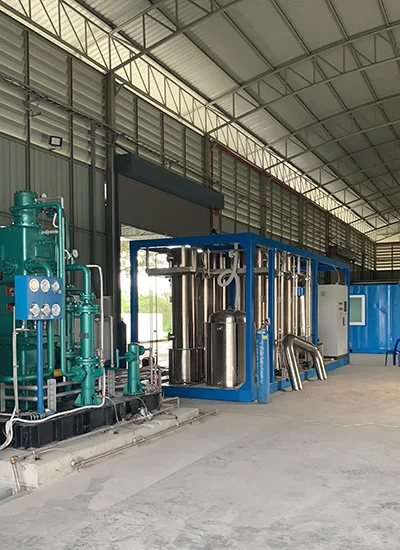
Liquid nitrogen is primarily produced by air separation and liquefaction. The process starts with the compression of air, followed by cooling to extremely low temperatures, causing the nitrogen to condense into liquid form. Here’s a step-by-step breakdown:
- Air Separation: Air, composed of 78% nitrogen and 21% oxygen, is first separated into its component gases.
- Liquefaction: Nitrogen gas is cooled to -196°C, turning it into liquid nitrogen.
- Storage: Liquid nitrogen is stored in specially designed insulated containers, such as Dewar flasks, which provide excellent thermal insulation to keep it at cryogenic temperatures.
Looking for a Reliable Liquid Nitrogen Solution?
Whether you need bulk storage, transport, or on-site supply,
Storage & Supply Models
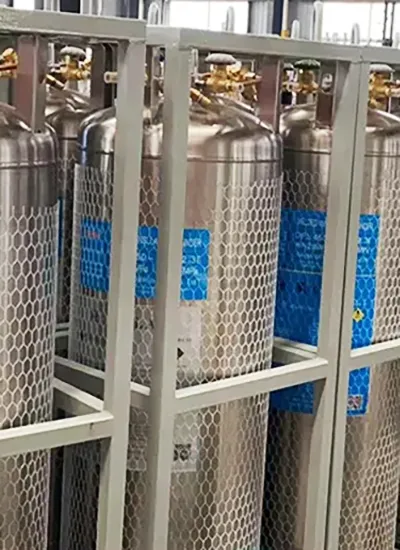
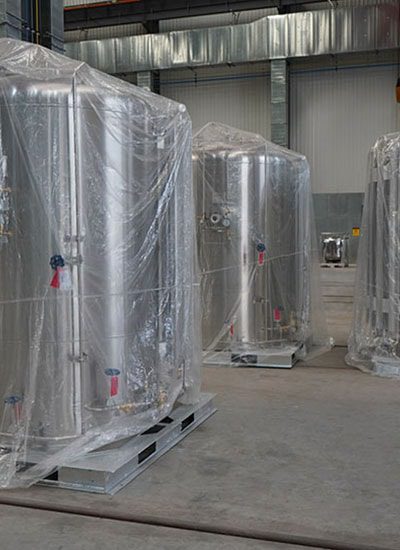
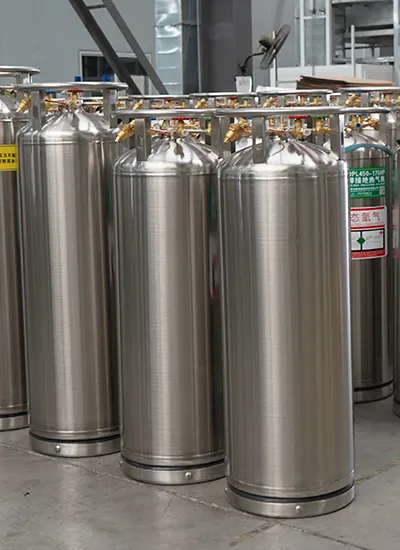
- LN2 Dewars: Small-scale storage vessels for laboratory and medical applications.
- Liquid Cylinders: Pre-filled liquid nitrogen cylinders for small volume and backup supply needs.
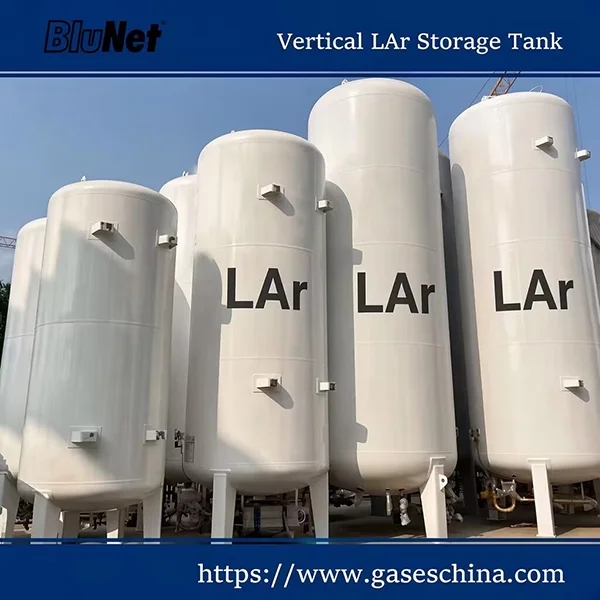
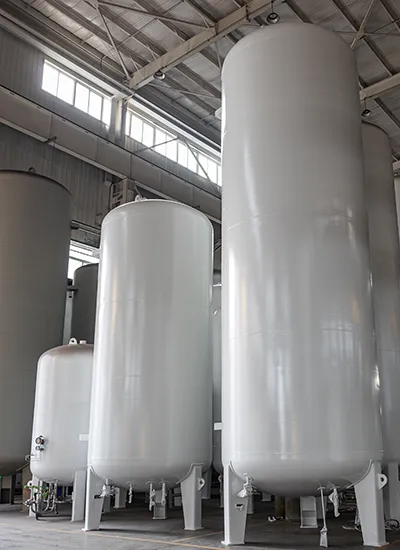
- MicroBulk & Bulk Tanks: Refillable LIN cryogenic tanks designed for high-volume industrial consumption.
- ISO Tank Containers: Cryogenic ISO tanks for global transport and large-scale liquid nitrogen distribution.
TECHNICAL FAQs
About Liquid Nitrogen and LN₂ Supply
Liquid nitrogen is stored in vacuum-insulated systems, including Dewars for small-scale use, microbulk tanks for medium demand, and bulk cryogenic storage tanks for continuous industrial supply.
For industrial applications, vacuum-insulated bulk tanks or microbulk systems are preferred due to lower boil-off rates, higher capacity, and stable pressure control.
Boil-off losses are minimized using high-vacuum insulation, multilayer insulation (MLI), proper tank sizing, and pressure control systems integrated into cryogenic storage tanks.
Typical systems include vacuum-insulated piping, cryogenic transfer hoses, phase separators, vaporizers, and pressure regulators to ensure safe and efficient LN2 handling.
Safety systems include pressure relief valves, burst discs, oxygen deficiency monitoring, proper ventilation, and cryogenic-rated materials to prevent hazards during operation.
LN2 is supplied via delivered Dewars, refillable microbulk systems, or bulk tank installations supported by tanker deliveries and on-site storage infrastructure.
Selection depends on consumption rate, required pressure, installation space, refill frequency, and total cost of ownership including boil-off and logistics.
)
No comment