


Microbulk cryogenic tanks are essential for on-site storage and supply of LOX, LIN, LAR, and CO₂. Engineers, EPC contractors, and procurement managers often ask:
“What material is used in microbulk tanks, and how does it differ under ASME, EN, or GB standards?”
This guide explains microbulk tank material selection with real-world industry insight, while showing BluNet’s certified microbulk tank solutions.
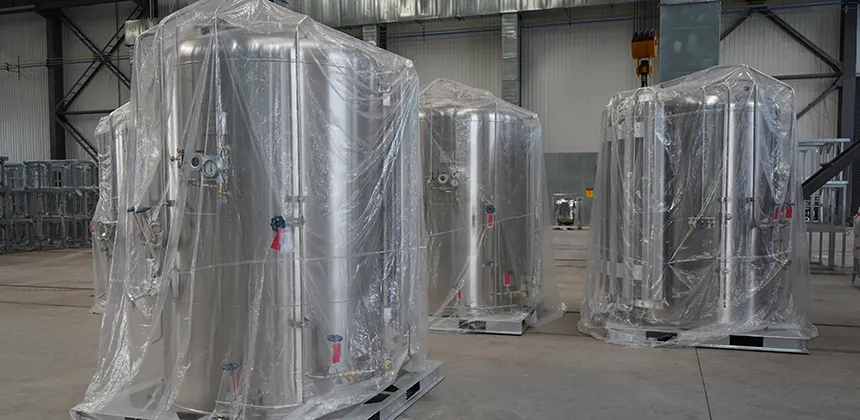
WHAT IS A MICROBULK TANK?
Microbulk tanks are small-to-medium cryogenic storage systems, typically:
- 1–10 m³ capacity
- Vacuum insulated
- Designed for on-site industrial gas delivery
- Operating under low-temperature, pressurised liquid conditions
Structure:
- Inner pressure vessel – stores the cryogenic liquid
- Outer jacket – ambient structural shell
- Insulation – vacuum + multilayer or perlite
Material selection is critical for the inner vessel, which is exposed to extreme cold.
2. Why Microbulk Tank Material Matters
The right material ensures:
- Toughness at low temperature
- Fracture resistance
- Weldability
- Corrosion resistance
- Compliance with international standards
- Long-term reliability
Cryogenic liquids (down to –196°C for LIN) can make ordinary carbon steel brittle. Therefore, inner vessel materials are carefully chosen based on Minimum Design Metal Temperature (MDMT), impact tests, and pressure vessel codes.
3. Inner Vessel Materials by Standard
3.1 ASME Section VIII (U.S. System)
Common inner vessel materials:
- SA-240 Type 304
- SA-240 Type 304L
- SA-240 Type 316L
- Occasionally SA-516 Gr.70
Industry choice: 304L stainless steel
304L is preferred because it has:
- Excellent toughness at cryogenic temperatures
- Low carbon content for better weldability
- Strong corrosion resistance
- Cost-effective solution
All BluNet microbulk tanks use 304L inner vessels to meet ASME compliance. See our LOX microbulk tanks for details.
3.2 EN 13458 (European PED System)
Common inner vessel materials:
- 1.4301 (304)
- 1.4307 (304L)
- 1.4404 (316L)
- 1.4571 (316Ti)
EN 13458 emphasises:
- Charpy impact testing
- Material traceability
- PED documentation
BluNet microbulk tanks for EU markets comply with EN 13458 and PED CE standards. Browse our EN-certified tanks.
3.3 GB 150 / TSG 21 (China)
Typical inner vessel materials:
- 06Cr19Ni10 (304 equivalent)
- 022Cr19Ni10 (304L equivalent)
- Q345R (moderate temperature CO₂ tanks)
Export-oriented tanks almost always use 304L equivalent stainless steel.
4. Outer Jacket Materials
Across all standards, the outer jacket is usually carbon steel:
| Standard | Common Grades |
|---|---|
| ASME | SA-36, SA-516 Gr.70 |
| EN | S235JR, P265GH, S355 |
| GB | Q235B, Q345R |
BluNet tanks combine 304L inner + carbon steel outer jackets, ensuring safety and durability for international shipping.
5. Microbulk Tank Material by Gas Type
| Gas | Storage Temp | Inner Vessel Material |
|---|---|---|
| LOX | –183°C | 304L / 316L |
| LIN | –196°C | 304L |
| LAR | –186°C | 304L |
| LCO₂ | –20°C to –30°C | 304L |
304L is standard across almost all gases, simplifying manufacturing and certification for global markets.
6. 304 vs 304L vs 316L
304L vs 304: Lower carbon content improves weldability and reduces corrosion risk.
304L vs 316L: 316L contains molybdenum for higher corrosion resistance but is more expensive and generally reserved for harsh chemical or medical applications.
7. What Determines Material Choice?
- Minimum Design Metal Temperature (MDMT)
- Pressure rating
- Corrosion allowance
- Food-grade or medical-grade requirement
- Customer certification (ASME / PED / GB)
- Inspection level (third-party, e.g., Bureau Veritas or TUV)
At BluNet, we consult with customers to select the optimal material based on these criteria.
8. ASME vs EN vs GB — Real Differences
| Factor | ASME | EN 13458 | GB 150 |
|---|---|---|---|
| Certification | U Stamp | CE (PED) | Manufacturing license |
| Low Temp Control | MDMT calculation | Impact tests | Temperature-based |
| Material Traceability | Required | Very strict | Manufacturer dependent |
| Third-Party Inspection | Authorized Inspector | Notified Body | Local authority |
Note: Steel grades are often equivalent; differences lie in compliance documentation.
9. Can Carbon Steel Be Used for Inner Vessel?
Only for moderate temperature CO₂ tanks. For LOX, LIN, or LAR, carbon steel is not suitable due to brittleness risk.
BluNet provides fully certified microbulk tanks for LOX, LIN, LAR, and CO₂ that comply with ASME, EN 13458, and GB 150. Our engineering team can help you choose the correct material, configuration, and certification for your application.
TECHNICAL FAQs
About Microbulk Tank Materials
Microbulk tanks are commonly used to store liquid oxygen (LOX), liquid nitrogen (LIN), liquid argon (LAR), and liquid carbon dioxide (LCO2). While the overall tank structure is similar, some design parameters differ depending on the gas. For example, LOX systems require oxygen-compatible materials and strict cleaning standards, LIN tanks operate at extremely low temperatures around −196°C, and LCO2 tanks typically operate at higher temperatures and pressures. These factors influence material selection, pressure ratings, and safety components.
The inner vessel of a microbulk cryogenic tank is commonly made from 304L stainless steel because it maintains excellent toughness and strength at very low temperatures. It is widely used for storing liquid nitrogen (LIN), liquid oxygen (LOX), and liquid argon (LAR). For liquid carbon dioxide (LCO2), which is stored at higher temperatures around −20°C to −30°C, either 304L stainless steel or suitable low-temperature carbon steel may be used depending on the design code and operating conditions.
Carbon steel becomes brittle at extremely low temperatures and may crack when exposed to cryogenic liquids. For this reason, stainless steels such as 304L or 316L are commonly used for cryogenic tank inner vessels because they maintain strength and ductility at temperatures as low as −196°C.
The outer shell of a microbulk tank is usually made from carbon steel such as SA-36 or SA-516. Since the outer jacket operates at ambient temperature, carbon steel provides structural strength and reduces manufacturing costs.
Microbulk tanks are manufactured according to international pressure vessel standards such as ASME Section VIII, EN 13458 with PED certification, and GB 150 with TSG 21 regulations. These standards ensure safety, material quality, and structural reliability.
Microbulk tanks use vacuum insulation between the inner vessel and outer shell. The vacuum space is often filled with perlite or multilayer insulation, which reduces heat transfer and minimizes evaporation of the cryogenic liquid.
)
No comment