


Understanding oxygen cylinder volume calculation is essential for hospitals, industrial gas users, laboratories, welding operations, and emergency oxygen systems. Whether you need to calculate how much oxygen is stored inside a cylinder or estimate how long an oxygen cylinder will last during use, accurate calculation improves safety, operational planning, and cost control.
This guide explains professional methods for calculating oxygen cylinder volume, remaining oxygen capacity, and oxygen usage duration using practical formulas and real engineering examples.
The information in this article is based on standard compressed gas engineering principles and common medical oxygen cylinder calculation practices. Actual cylinder capacity may vary depending on manufacturer specifications, filling pressure, regional standards, and application requirements.
What Determines Oxygen Cylinder Capacity?
The amount of oxygen stored inside a cylinder depends on three key factors: cylinder water capacity, filling pressure, and oxygen consumption rate during use.
1. Water Capacity of the Cylinder
Water capacity refers to the internal volume of the steel cylinder itself and is usually measured in liters (L). Common cylinder sizes include:
- 10L oxygen cylinder
- 40L oxygen cylinder
- 50L oxygen cylinder
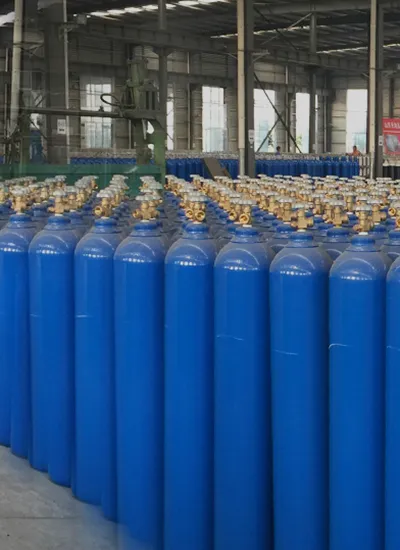
A standard industrial oxygen cylinder is commonly 40L and is widely used for oxygen supply, welding, cutting, and manufacturing operations.
2. Filling Pressure
Oxygen is stored as compressed gas under high pressure. Common filling pressures include:
- 13 MPa
- 14.7 MPa
- 15 MPa
Higher pressure allows more gaseous oxygen to be stored inside the same cylinder size.
3. Oxygen Flow Rate During Use
For medical oxygen systems, oxygen is consumed based on the prescribed flow rate, such as:
- 2 L/min
- 3 L/min
- 5 L/min
- 10 L/min
Higher flow rates result in faster oxygen depletion and shorter cylinder duration.
How Long Will an Oxygen Cylinder Last?
The simplest method for oxygen cylinder duration calculation is dividing the total oxygen volume by the oxygen flow rate.
Basic Formula for Oxygen Cylinder Duration
Duration (hours) = Total Oxygen Volume (L) ÷ [Flow Rate (L/min) × 60]
This method works best when the cylinder is fully filled and the total oxygen volume is already known.
Example: E-Type Oxygen Cylinder Duration
An E-type medical oxygen cylinder typically contains approximately 1000 liters of oxygen when fully filled.
If the oxygen flow rate is prescribed at:
- 3 liters per minute
Calculation Example
Duration = 1000 ÷ (3 × 60)
Result
The oxygen cylinder will last approximately:
5.5 hours
This method is widely used for quick bedside medical estimation and emergency oxygen planning.
More Accurate Method: Oxygen Cylinder Duration Formula Using Cylinder Constants
If the cylinder may not be completely full, pressure-based calculation provides more accurate results. Medical oxygen systems commonly use cylinder constants for this purpose.
Pressure-Based Formula
Duration (minutes) = [(Pressure (psi) − 200) × Cylinder Constant] ÷ Flow Rate (L/min)
Why Is 200 psi Subtracted?
A reserve pressure of approximately 200 psi is maintained for safety. Oxygen cylinders should not be used below this level because low-pressure operation may create delivery instability and safety risks.
Standard Medical Oxygen Cylinder Constants
These constants are commonly used for standard medical oxygen cylinder duration calculations.
| Cylinder Type | Cylinder Constant |
|---|---|
| D | 0.16 |
| E | 0.28 |
| M | 1.56 |
| G | 2.41 |
| H / K | 3.14 |
Example Using Pressure Gauge Reading
Suppose:
- Cylinder type: E
- Pressure gauge reading: 1800 psi
- Flow rate: 4 L/min
Calculation
Duration = [(1800 − 200) × 0.28] ÷ 4
Result
The oxygen supply will last approximately:
112 minutes
or approximately
1.9 hours
This method is more accurate than fixed-volume estimation when refill status is uncertain.
How to Calculate Oxygen Cylinder Gas Volume
When oxygen is stored inside a high-pressure cylinder, it exists as compressed gas. We often need to calculate the equivalent oxygen volume at standard atmospheric pressure.
Engineering Formula for Oxygen Cylinder Volume
V ≈ (V1 × P) ÷ 0.098
Where:
- V = total gaseous oxygen volume (L)
- V1 = water capacity of the cylinder (L)
- P = oxygen pressure inside the cylinder (MPa)
This formula is commonly used for industrial gas estimation under standard conditions.
Example: Full 40L Oxygen Cylinder Volume
Suppose:
- Water capacity = 40L
- Oxygen pressure = 14.7 MPa
- Ambient temperature = 20°C
Calculation
V ≈ (40 × 14.7) ÷ 0.098
Result
The total oxygen volume is approximately:
6000 liters
or
6 cubic meters (6 m³)
This is a typical capacity for a standard industrial oxygen cylinder.
How to Estimate Remaining Oxygen in a Used Cylinder
After partial use, the remaining oxygen volume can be estimated using the pressure gauge reading.
Remaining Oxygen Formula
V′ ≈ [(P′ + 0.1) × V1] ÷ 0.098
Where:
- V′ = remaining oxygen volume (L)
- P′ = current pressure gauge reading (MPa)
- V1 = cylinder water capacity (L)
The additional 0.1 MPa compensates for atmospheric pressure correction.
Example: Remaining Oxygen in a Used Cylinder
Suppose
- Water capacity = 40L
- Remaining pressure = 0.8 MPa
Calculation
V′ ≈ [(0.8 + 0.1) × 40] ÷ 0.098
Result
Remaining oxygen volume is approximately:
367 liters
or
0.367 m³
This helps operators schedule refilling and avoid oxygen supply interruption.
Common Oxygen Cylinder Sizes and Typical Capacities
| Cylinder Size | Water Capacity | Typical Oxygen Volume |
|---|---|---|
| Portable D Cylinder | Small | 340–425 L |
| E Cylinder | Small / Medium | 680–1000 L |
| M Cylinder | Large | 3000+ L |
| H / K Cylinder | Large Industrial | 7000+ L |
| Standard Industrial Cylinder | 40L | 6000 L |
Safety Notes for Oxygen Cylinder Handling
Oxygen cylinders must always be handled according to medical gas standards, industrial gas regulations, and manufacturer safety instructions.
- Never use oxygen cylinders below reserve pressure
- Keep cylinders away from heat, sparks, oil, and ignition sources
- Use only approved pressure regulators and valves
- Store cylinders upright and properly secured
- Inspect valves, gauges, and connections regularly
- Follow local gas safety compliance requirements
Because oxygen strongly supports combustion, improper handling may create severe fire and explosion hazards.

No comment