

Liquefied Natural Gas (LNG) has become a fast-growing alternative energy source for industrial facilities seeking cleaner, more efficient, and reliable fuel solutions. Compared with coal, diesel, and heavy fuel oil, LNG provides lower carbon emissions, reduced particulate matter, and high combustion efficiency, making it suitable for power generation, manufacturing, chemical processing, metallurgy, food production, mining, marine transportation, and off-grid energy systems.
Unlike conventional fuels, LNG must be stored at approximately -162°C (-260°F). At this cryogenic temperature, natural gas condenses into a liquid occupying only about 1/600 of its gaseous volume, enabling efficient transportation and storage. Maintaining LNG in liquid form requires specially engineered cryogenic storage tanks designed to minimize heat transfer and ensure safe, reliable long-term operation.
Industrial users rely on advanced cryogenic storage solutions to integrate LNG tanks, insulation systems, pressure control, and safety equipment. This guide explains LNG storage tank design, types, insulation technologies, safety standards, and selection considerations. For a broader overview of cryogenic technologies, see our cryogenic tanks guide or explore our LNG storage systems.
What Is an LNG Storage Tank?
An LNG storage tank is a vacuum-insulated cryogenic pressure vessel specifically designed to store liquefied natural gas at extremely low temperatures while minimizing evaporation losses and maintaining stable operating pressure.
Unlike conventional steel fuel tanks, LNG storage tanks incorporate multiple layers of thermal protection and sophisticated pressure control systems to safely contain cryogenic liquids. Their design must withstand both mechanical stresses and continuous thermal cycling throughout the equipment’s operational life.
A typical industrial LNG storage system consists of the following major components:
- Inner stainless steel pressure vessel
- Outer carbon steel protective shell
- High-vacuum insulation space
- Perlite or multi-layer insulation (MLI)
- Pressure building vaporizer
- Economizer system
- Liquid level instrumentation
- Pressure transmitters
- Temperature sensors
- Safety relief valves
- Emergency shut-off valves
- Liquid and gas transfer pipelines
Each component contributes to maintaining product quality, minimizing boil-off gas generation, and ensuring safe long-term operation under demanding industrial conditions.
How LNG Storage Tanks Work
The operating principle of an LNG storage tank is based on minimizing heat transfer into the cryogenic liquid while carefully controlling internal pressure.
The inner vessel stores LNG at approximately -162°C. Surrounding the inner vessel is a high-vacuum insulation space that significantly reduces conductive and convective heat transfer. Additional insulation materials such as expanded perlite or multi-layer insulation reduce radiant heat entering the tank.
Despite advanced insulation technologies, a small amount of heat inevitably enters every cryogenic storage vessel. This causes a portion of the LNG to vaporize into natural gas, commonly referred to as Boil-Off Gas (BOG).
Rather than allowing pressure to increase uncontrollably, modern LNG storage systems utilize pressure-building coils, economizers, vaporizers, and gas recovery systems to regulate pressure while making productive use of the evaporated gas whenever possible.
This carefully balanced system allows LNG to remain in liquid form for extended storage periods with minimal product losses.
Main Components of an LNG Storage Tank
| Component | Function |
|---|---|
| Inner Vessel | Stores liquefied natural gas under cryogenic conditions. |
| Outer Shell | Provides structural protection and supports the insulation system. |
| Vacuum Space | Reduces conductive and convective heat transfer. |
| Perlite or MLI Insulation | Minimizes radiant heat transfer and lowers boil-off rates. |
| Pressure Building Coil | Maintains stable operating pressure. |
| Economizer | Uses vapor before pressure rises excessively. |
| Safety Relief Valves | Protect the tank from overpressure. |
| Level Gauge | Monitors LNG inventory. |
| Pressure Gauge | Continuously measures internal pressure. |
| Temperature Sensors | Monitor cryogenic operating conditions. |
Types of LNG Storage Tanks
Industrial LNG storage tanks are available in several configurations to accommodate different storage capacities, operating pressures, transportation methods, and installation environments.
| Tank Type | Typical Capacity | Main Advantages | Typical Applications |
|---|---|---|---|
| Vertical Cryogenic Tank | 5–300 m³ | Excellent insulation and space efficiency | Industrial plants, factories, power stations |
| Horizontal LNG Tank | 3–100 m³ | Compact installation with lower height requirements | Manufacturing facilities and industrial parks |
| ISO LNG Tank Container | 20 ft / 40 ft | Portable and suitable for multimodal transport | Road, rail, and marine transportation |
| Full Containment Tank | Thousands of cubic meters | Highest level of safety for bulk LNG storage | LNG terminals and receiving stations |
| Satellite LNG Station | Customized | Complete LNG receiving and regasification solution | Remote industrial users |
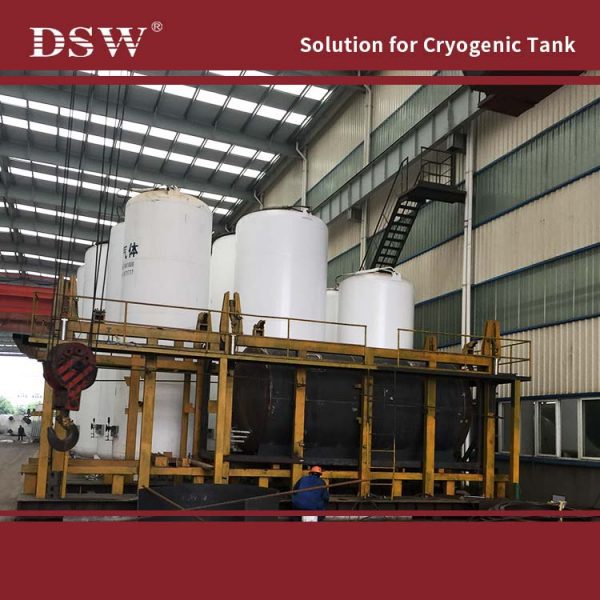
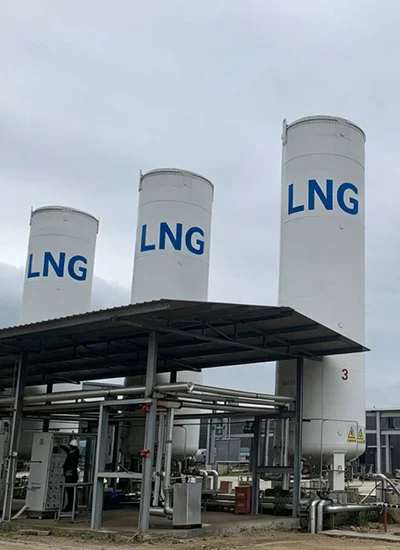
Vertical LNG Storage Tanks
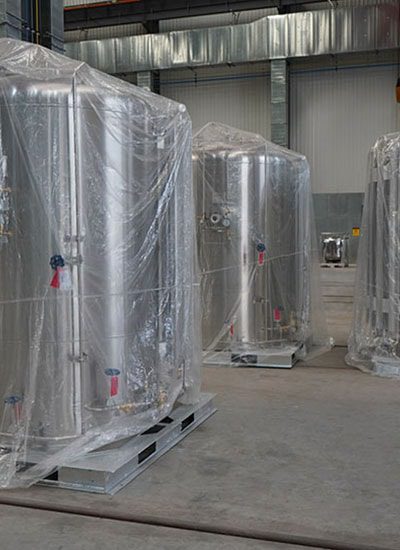
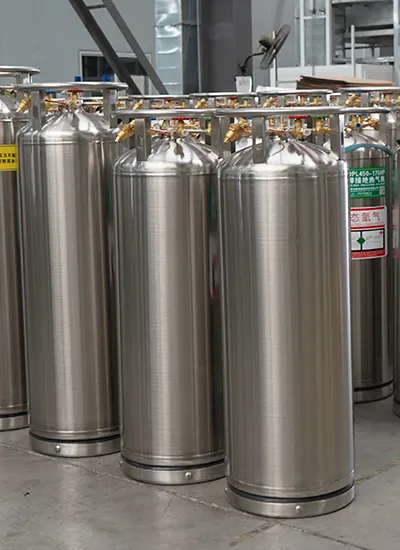
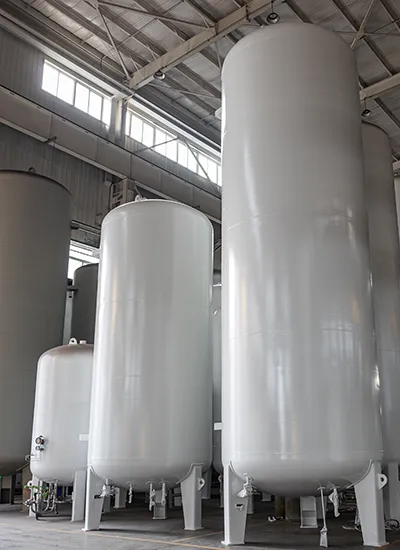
Vertical vacuum-insulated tanks are the preferred solution for most industrial users because they provide large storage capacity while occupying relatively little ground space. Their geometry also contributes to lower heat ingress and improved thermal efficiency.
Horizontal LNG Storage Tanks
Horizontal tanks are commonly selected where installation height is limited or transportation constraints exist. They are frequently used for medium-capacity industrial applications and packaged LNG systems.
ISO LNG Tank Containers
ISO containers enable LNG transportation by truck, railway, or vessel while complying with international container standards. They are widely used for supplying LNG to remote facilities without permanent storage infrastructure.
Full Containment Tanks
Large LNG import terminals and liquefaction plants utilize full containment tanks consisting of an inner cryogenic steel tank and an outer reinforced concrete containment structure. These systems provide maximum operational safety and environmental protection.
Selecting the Right LNG Storage Capacity
Proper tank sizing directly affects operational reliability, fuel logistics, capital investment, and long-term operating costs. An undersized tank may require frequent LNG deliveries and increase the risk of production interruptions, while an oversized tank can result in unnecessary capital expenditure.
Engineers typically evaluate the following factors when determining storage capacity:
- Average daily LNG consumption
- Maximum production demand
- LNG delivery schedule
- Emergency reserve requirements
- Expected boil-off gas generation
- Future production expansion plans
- Local climate conditions
- Supply chain reliability
A simplified engineering calculation is:
Tank Capacity = Daily LNG Consumption × Days Between Deliveries × Safety Margin
Depending on operational requirements, a safety margin between 10% and 30% is commonly incorporated into the design to provide adequate reserve capacity.
Example Capacity Calculation
| Parameter | Example Value |
|---|---|
| Daily LNG Consumption | 15 m³/day |
| Delivery Interval | 7 days |
| Safety Margin | 20% |
| Recommended Tank Capacity | 126 m³ |
In practice, detailed engineering calculations also consider seasonal demand fluctuations, boil-off gas recovery, production schedules, emergency fuel reserves, and future plant expansion. Proper sizing not only improves operational efficiency but also reduces transportation costs and minimizes LNG losses throughout the storage lifecycle.
Explore LNG Storage & BOG Control Systems
Whether you need bulk storage, transport, or on-site supply,
Cryogenic Insulation Technologies
Thermal insulation is one of the most critical factors affecting the performance of an LNG storage tank. Since LNG is stored at approximately -162°C (-260°F), even a small amount of heat entering the vessel can increase boil-off gas generation, raise internal pressure, and reduce storage efficiency.
Modern industrial LNG storage tanks are designed with advanced insulation systems that significantly reduce conductive, convective, and radiant heat transfer. Selecting the appropriate insulation technology depends on tank size, operating pressure, storage duration, environmental conditions, and project budget.
Vacuum Insulation
Vacuum insulation removes most of the air between the inner vessel and the outer shell, greatly reducing conductive and convective heat transfer. A high-quality vacuum is essential for maintaining excellent thermal performance throughout the tank’s service life.
Expanded Perlite Insulation
Expanded perlite is one of the most widely used insulation materials in industrial cryogenic tanks. It is lightweight, non-combustible, chemically stable, and provides excellent thermal resistance when combined with a high-vacuum environment.
Advantages of perlite insulation include:
- Excellent thermal insulation performance
- Long service life
- Low maintenance requirements
- Stable performance under cryogenic temperatures
- Cost-effective for medium and large storage tanks
Multi-Layer Insulation (MLI)
Multi-layer insulation consists of multiple layers of highly reflective aluminum foil separated by low-conductivity spacer materials. These reflective layers dramatically reduce radiant heat transfer and are commonly used in high-performance cryogenic applications.
MLI is particularly suitable for applications requiring extremely low boil-off rates and superior thermal efficiency.
Hybrid Insulation Systems
Many modern LNG storage tanks combine vacuum insulation, expanded perlite, and multi-layer insulation to maximize thermal performance. Hybrid systems are frequently used for large industrial storage tanks operating under demanding environmental conditions.
| Insulation Type | Main Advantages | Typical Applications |
|---|---|---|
| Vacuum Insulation | Excellent thermal barrier | All cryogenic tanks |
| Expanded Perlite | Reliable and economical | Industrial storage tanks |
| Multi-Layer Insulation (MLI) | Lowest radiant heat transfer | High-performance cryogenic systems |
| Hybrid Insulation | Maximum thermal efficiency | Large LNG storage facilities |
High-performance insulation not only minimizes LNG losses but also reduces operating costs by lowering boil-off gas generation throughout the equipment’s service life.
Boil-Off Gas (BOG) Management
Even with advanced insulation systems, a small amount of LNG continuously absorbs heat from its surroundings. This causes a portion of the liquid to evaporate into natural gas, commonly referred to as Boil-Off Gas (BOG).
Effective BOG management is essential for maintaining stable tank pressure, improving energy efficiency, and minimizing product losses.
Modern LNG storage facilities commonly employ several pressure control strategies.
Pressure Building System
A pressure building coil vaporizes a controlled quantity of LNG to maintain the desired operating pressure during liquid withdrawal.
Economizer System
The economizer automatically supplies vapor to downstream equipment before additional liquid is vaporized, helping stabilize pressure while reducing unnecessary LNG consumption.
Gas Recovery System
Large industrial LNG facilities often recover boil-off gas and redirect it to process equipment, boilers, turbines, or pipeline systems instead of venting it into the atmosphere.
Emergency Venting
In abnormal operating conditions, safety relief valves safely release excess pressure to protect the storage vessel. Emergency venting should occur only under carefully controlled conditions and in accordance with applicable safety regulations.
| BOG Management Method | Primary Purpose |
|---|---|
| Pressure Building Coil | Maintain operating pressure |
| Economizer | Reduce unnecessary vapor generation |
| Gas Recovery System | Reuse natural gas within the facility |
| Emergency Relief Valve | Protect against excessive pressure |
Properly designed BOG management systems improve operational efficiency while maximizing the utilization of valuable natural gas resources.
Safety Features and International Standards
Industrial LNG storage tanks are designed with multiple layers of safety protection to ensure reliable operation throughout their service life. Engineering design, material selection, manufacturing quality, and operational procedures must comply with internationally recognized standards.
Common international standards include:
- ASME Section VIII for pressure vessel design and construction
- EN 13458 for cryogenic vessels
- EN 1473 for LNG installations
- ISO 21009 for static cryogenic vessels
- NFPA 59A for LNG production, storage, and handling facilities
- PED requirements for European markets
Compliance with these standards helps ensure structural integrity, operational safety, and regulatory acceptance across global markets.
Typical Safety Features
- Dual safety relief valves
- Emergency shut-down valves
- Pressure monitoring system
- Temperature monitoring system
- Liquid level gauges
- Vacuum monitoring devices
- Gas leak detection system
- Emergency vent stack
- Vacuum-insulated transfer piping
- Fire protection interfaces
Modern LNG facilities also integrate programmable control systems and remote monitoring technologies, allowing operators to monitor equipment status continuously and respond rapidly to abnormal operating conditions.
LNG Storage Tank Manufacturing Process
The long-term performance of an LNG storage tank depends on precision engineering, qualified materials, certified welding procedures, and rigorous quality control throughout manufacturing.
Although manufacturing methods vary according to tank size and applicable design codes, the typical production process follows these stages:
1. Raw Material Inspection
All pressure-retaining materials are verified against material certificates to ensure compliance with design specifications and applicable standards.
2. Plate Rolling and Shell Fabrication
Steel plates are rolled into cylindrical sections and assembled to form the inner vessel and outer shell with precise dimensional control.
3. Precision Welding
Qualified welders perform automatic and manual welding procedures following approved Welding Procedure Specifications (WPS). Careful control of heat input helps maintain mechanical properties and dimensional accuracy.
4. Non-Destructive Testing (NDT)
Critical welds are inspected using appropriate non-destructive examination methods such as:
- Radiographic Testing (RT)
- Ultrasonic Testing (UT)
- Magnetic Particle Testing (MT)
- Liquid Penetrant Testing (PT)
5. Vessel Assembly
The inner vessel is positioned inside the outer shell before insulation materials are installed and the vacuum space is sealed.
6. Vacuum Evacuation and Insulation Filling
The insulation space is filled with expanded perlite or other specified insulation materials before achieving the required vacuum level.
7. Pressure and Leak Testing
Completed tanks undergo comprehensive testing that may include:
- Hydrostatic testing
- Pneumatic testing
- Helium leak testing
- Vacuum retention testing
- Functional testing of valves and instrumentation
8. Final Inspection
Before shipment, each LNG storage tank is subjected to dimensional inspection, documentation review, quality verification, and final acceptance testing to ensure compliance with customer specifications and applicable codes.
Installation Considerations
Proper installation is essential for achieving safe, efficient, and reliable long-term operation. Installation planning should begin during the engineering phase to ensure compatibility between the storage system, site infrastructure, and downstream process equipment.
Foundation Design
Foundations should be designed to support the fully loaded weight of the LNG storage tank while minimizing settlement and preventing frost-related ground movement. Reinforced concrete foundations are commonly used for industrial installations.
Piping Layout
Vacuum-insulated transfer pipelines reduce heat gain during LNG transfer and improve overall system efficiency. Piping should also allow adequate flexibility to accommodate thermal contraction during cryogenic operation.
Equipment Accessibility
Sufficient clearance should be maintained around the storage tank for routine inspection, maintenance activities, emergency access, and future equipment upgrades.
Safety Distances
Installation layouts should comply with applicable regulations regarding separation distances from buildings, ignition sources, roadways, and occupied areas. Proper ventilation and emergency access routes should also be incorporated into the site design.
Environmental Considerations
Wind loads, seismic conditions, ambient temperatures, corrosion exposure, and local climate should all be considered during structural and mechanical design.
Following mechanical installation, commissioning activities typically include pressure testing, instrumentation calibration, functional testing, leak detection, vacuum verification, and operator training before the LNG storage system is placed into commercial service.
Maintenance and Inspection
Regular maintenance is essential to ensure the safe operation, reliability, and long service life of industrial LNG storage tanks. Although cryogenic tanks are designed for decades of operation, routine inspection helps identify potential issues related to insulation performance, instrumentation accuracy, pressure control, and mechanical integrity.
A well-planned preventive maintenance program reduces unexpected downtime, improves operational efficiency, and helps maintain compliance with applicable safety regulations.
Daily Inspection
Operators should perform routine checks of key operating parameters, including:
- LNG liquid level
- Tank pressure
- Operating temperature
- Valve status
- Alarm conditions
- Visible leakage or abnormal conditions
Monthly Inspection
Monthly maintenance activities typically include:
- Inspection of valves and pipeline connections
- Verification of pressure gauges and level indicators
- Checking insulation system performance
- Reviewing operating records
- Inspection of external surfaces for corrosion or damage
Quarterly Inspection
Quarterly checks may include:
- Testing safety relief systems
- Checking emergency shut-down functions
- Reviewing control system performance
- Testing alarm and monitoring systems
Annual Inspection
Annual maintenance programs may include:
- Non-destructive testing (NDT) where required
- Vacuum performance evaluation
- Instrumentation calibration
- Safety system inspection
- Structural condition assessment
Many modern LNG facilities also use digital monitoring systems and Industrial Internet of Things (IIoT) technologies to collect operating data in real time. Predictive maintenance based on pressure trends, temperature changes, and insulation performance can help prevent failures before they occur.
Industrial Applications
LNG storage tanks are used across many industries where reliable and efficient energy supply is required. They are especially valuable in locations where natural gas pipelines are unavailable or where companies need a flexible alternative fuel source.
| Industry | LNG Application |
|---|---|
| Power Generation | Fuel supply for gas turbines, generators, and peak-shaving systems |
| Steel Manufacturing | Fuel for furnaces, reheating systems, and industrial heating processes |
| Chemical Industry | Process heating and energy supply |
| Food Processing | Boiler fuel and thermal energy production |
| Glass Manufacturing | High-temperature industrial heating applications |
| Mining Operations | Remote power generation and energy supply |
| Marine Industry | LNG bunkering and ship fuel systems |
| Remote Industrial Facilities | Off-grid energy solution where pipeline gas is unavailable |
For industrial users, LNG provides several advantages:
- Lower emissions compared with coal and heavy fuel oil
- Stable and efficient energy supply
- Reduced dependence on pipeline infrastructure
- Flexible transportation and storage options
- Improved combustion efficiency
As industries continue transitioning toward cleaner energy solutions, LNG storage systems remain an important bridge technology between traditional fuels and future low-carbon energy sources.
LNG Storage Tanks Compared with Diesel and LPG Storage
When selecting an industrial fuel system, companies often compare LNG with diesel and LPG based on cost, environmental impact, storage requirements, and operational flexibility.
| Comparison Factor | LNG | Diesel | LPG |
|---|---|---|---|
| Storage Condition | -162°C cryogenic storage | Ambient temperature | Pressurized liquid storage |
| Energy Efficiency | High | High | Medium to high |
| Carbon Emissions | Lower | Higher | Lower than diesel |
| Infrastructure Requirement | Requires cryogenic equipment | Simple storage system | Requires pressure vessels |
| Large Industrial Applications | Excellent | Common | Moderate |
| Remote Energy Supply | Excellent | Good | Good |
Although LNG storage systems require specialized cryogenic equipment, many high-consumption industrial users benefit from lower fuel costs, cleaner combustion, and improved long-term energy security.
Factors Affecting LNG Storage Tank Cost
The cost of an LNG storage system depends on much more than the tank capacity alone. Each project requires engineering consideration of operating conditions, safety requirements, installation environment, and future expansion plans.
The main factors affecting LNG storage tank cost include:
- Storage capacity and tank dimensions
- Operating pressure requirements
- Tank design configuration
- Insulation technology
- Material selection
- Instrumentation and automation level
- Safety systems
- LNG vaporizer selection
- Piping system design
- Foundation and installation requirements
- Applicable international certifications
Initial Investment vs Long-Term Benefits
Compared with conventional fuel storage systems, LNG infrastructure generally requires a higher initial investment because of cryogenic technology and safety requirements.
However, long-term economic benefits may include:
- Lower fuel operating costs
- Reduced maintenance expenses
- Improved combustion efficiency
- Lower emissions compliance costs
- Reliable energy supply in remote locations
For industries with continuous high-volume energy demand, LNG storage systems can provide attractive lifecycle economics and long-term operational advantages.
How to Select the Right LNG Storage Tank Supplier
Selecting an experienced LNG storage tank manufacturer is critical to ensuring safety, performance, and long-term reliability. Industrial buyers should evaluate suppliers based on engineering capability, manufacturing experience, certification, and after-sales support.
Important supplier evaluation criteria include:
- Experience with cryogenic pressure vessel manufacturing
- Compliance with international design standards
- Certified welding and inspection procedures
- Factory testing capability
- Quality management systems
- Successful industrial project references
- Technical support and commissioning service
- Ability to customize tank capacity and configuration
A qualified supplier should provide complete technical documentation, including design drawings, pressure test reports, material certificates, inspection records, and operating manuals.
TECHNICAL FAQs
About LNG Storage Tanks
An LNG storage tank is a cryogenic pressure vessel designed to store liquefied natural gas at approximately -162°C (-260°F). It uses vacuum insulation and specialized materials to maintain LNG in liquid form while minimizing heat transfer and boil-off gas losses.
An LNG storage tank works by combining a cryogenic inner vessel, vacuum insulation system, and pressure control equipment. The insulation reduces heat ingress, while pressure-building systems and boil-off gas management systems maintain stable operating conditions.
LNG is normally stored at approximately -162°C (-260°F), where natural gas changes from a gas into a liquid and its volume is reduced by about 600 times, making transportation and storage more efficient.
Common LNG storage tank types include vertical cryogenic tanks, horizontal LNG tanks, ISO LNG tank containers, full containment tanks, and LNG satellite storage systems. The suitable type depends on storage capacity, installation space, and application requirements.
LNG boil-off gas is primarily caused by heat ingress into cryogenic systems. This includes thermal conduction through tank walls, imperfect vacuum or multilayer insulation (MLI), ambient temperature exposure, and increased surface-area-to-volume ratio in smaller tanks. Additional factors such as LNG sloshing, pressure fluctuations, and transport vibration in ISO containers or LNG carriers can also increase boil-off generation.
LNG storage tank capacity is selected based on daily LNG consumption, delivery frequency, peak demand, reserve requirements, boil-off rate, and future expansion plans. Engineers typically calculate capacity based on fuel demand and required storage days with an appropriate safety margin.
Boil-off gas (BOG) is natural gas generated when a small amount of LNG evaporates due to unavoidable heat transfer into the storage tank. LNG systems manage BOG through pressure control, recovery systems, or process utilization.
Yes. Industrial LNG storage tanks are designed with multiple safety features, including vacuum insulation, pressure relief valves, emergency shut-off systems, gas detection, monitoring equipment, and compliance with international standards such as ASME, EN, ISO, and NFPA requirements.
Industrial LNG storage tanks are commonly designed according to international standards including ASME Section VIII, EN 13458, EN 1473, ISO 21009, NFPA 59A, and other regional pressure vessel regulations.
LNG storage tanks are widely used in power generation, steel manufacturing, chemical processing, food processing, glass manufacturing, mining, marine transportation, and remote industrial facilities requiring reliable energy supply.
With proper design, manufacturing, installation, and maintenance, industrial LNG storage tanks can provide reliable service for several decades. Regular inspection and preventive maintenance help extend equipment lifespan.
LNG is transferred from storage tanks through cryogenic pumps, vacuum-insulated piping, and specialized filling systems designed to minimize heat gain and maintain LNG temperature during transfer.
Conclusion: LNG Storage Tanks as a Reliable Industrial Energy Solution
LNG storage tanks are critical components of modern industrial energy systems, providing safe, efficient, and flexible storage of liquefied natural gas for a wide range of applications.
Successful LNG storage projects depend on selecting the correct tank type, optimizing capacity, applying effective insulation technology, managing boil-off gas, complying with international safety standards, and implementing proper installation and maintenance procedures.
With increasing demand for cleaner and more efficient energy solutions, industrial LNG storage systems will continue to play an important role in supporting reliable energy supply, reducing operating costs, and helping industries achieve their environmental goals.

No comment