

CNG cylinder manufacturing is a highly specialized engineering process that combines advanced metallurgy, precision forming, automated production, and rigorous quality control to produce pressure vessels capable of safely storing compressed natural gas at working pressures of up to 250 bar. These cylinders are widely used in passenger vehicles, buses, heavy-duty trucks, industrial equipment, and gas transportation systems where safety, durability, and long service life are essential.
Modern manufacturers employ automated production lines, CNC machining, heat treatment, non-destructive testing (NDT), hydrostatic pressure testing, and comprehensive quality assurance systems. Backed by advanced manufacturing capabilities, every production stage—from raw material inspection to final testing—is carefully controlled to ensure compliance with international standards such as ISO 11439, ISO 9809, ECE R110, NGV2, DOT, and PED. This integrated manufacturing approach enables cylinders to withstand thousands of pressure cycles while maintaining structural integrity and long-term reliability.
This comprehensive guide explains the complete CNG cylinder manufacturing process, the different cylinder types, materials used, engineering design principles, production equipment, quality control procedures, testing methods, and international certifications. Whether you are an OEM, gas distributor, fleet operator, or engineering professional, understanding how CNG cylinders are manufactured can help you select safer, more reliable products for your applications.
CNG Cylinder Manufacturing Process Overview
Modern CNG cylinders are produced through a carefully controlled manufacturing sequence that ensures consistent quality, dimensional accuracy, and long-term reliability.
- Raw Material Inspection
- Steel Tube Manufacturing
- Hot Forming & Neck Spinning
- Heat Treatment
- CNC Neck Machining
- Surface Preparation
- Powder Coating
- Hydrostatic Pressure Testing
- Non-Destructive Testing
- Final Inspection & Packaging
What is CNG Cylinder Manufacturing?
CNG cylinder manufacturing refers to the complete industrial process of producing seamless or composite pressure vessels designed to safely store compressed natural gas. Unlike conventional steel containers, CNG cylinders must withstand extremely high internal pressures while maintaining excellent fatigue resistance over thousands of filling and discharge cycles.
The manufacturing process integrates metallurgy, pressure vessel engineering, precision machining, heat treatment, advanced testing, and strict quality management. Every cylinder is designed to achieve high mechanical strength, excellent corrosion resistance, dimensional consistency, and long operational life under demanding service conditions.
Depending on vehicle requirements and weight considerations, manufacturers produce four internationally recognized cylinder types: Type 1 seamless steel cylinders, Type 2 hoop-wrapped cylinders, Type 3 fully wrapped aluminum-lined cylinders, and Type 4 composite cylinders with polymer liners. Each type offers distinct advantages in strength, weight, durability, and cost.
Professional manufacturers utilize automated production systems and internationally certified quality management procedures to ensure every cylinder satisfies applicable safety regulations before shipment.
Types of CNG Cylinders
CNG cylinders are classified into four internationally recognized categories based on construction materials and reinforcement methods. Selecting the appropriate cylinder type depends on vehicle design, payload requirements, operating conditions, and lifecycle cost.
Type 1 Seamless Steel Cylinders
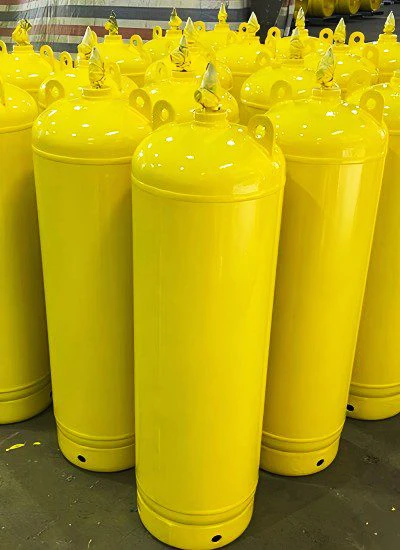
Type 1 cylinders are manufactured entirely from seamless alloy steel using hot spinning and heat treatment technologies. They are the most widely used cylinders for commercial vehicles because of their outstanding durability, impact resistance, and relatively low manufacturing cost.
- 100% seamless steel construction
- Excellent fatigue performance
- Long service life
- High impact resistance
- Ideal for buses and trucks
Typical Applications
- City buses
- Heavy-duty trucks
- Municipal vehicles
- Industrial gas storage
- Stationary CNG systems
Type 2 Hoop-Wrapped Cylinders
Type 2 cylinders combine a seamless steel liner with fiberglass or carbon fiber reinforcement wrapped around the cylindrical section. This hybrid construction reduces weight while maintaining excellent structural strength and pressure resistance.
- Reduced cylinder weight
- Higher strength-to-weight ratio
- Improved fatigue resistance
- Lower operating cost
Advantages
- Lighter than Type 1
- Higher payload capacity
- Improved vehicle efficiency
- Long fatigue life
Type 3 Fully Wrapped Cylinders
Type 3 cylinders feature a lightweight aluminum liner fully wrapped with carbon fiber composite. This construction significantly reduces weight while providing exceptional mechanical performance, corrosion resistance, and durability.
- Aluminum liner
- Carbon fiber reinforcement
- Outstanding corrosion resistance
- Excellent fatigue performance
Applications
- Passenger vehicles
- High-performance fleets
- Specialty vehicles
- Light commercial vehicles
Type 4 Composite Cylinders
Type 4 cylinders utilize a polymer liner completely wrapped with carbon fiber composites, making them the lightest CNG storage solution available. Their exceptional weight savings improve vehicle fuel efficiency and payload capacity while offering excellent corrosion resistance.
- Polymer liner
- Carbon fiber construction
- Maximum weight reduction
- Excellent corrosion resistance
- Very long fatigue life
Typical Industries
- Natural gas vehicles
- Hydrogen applications
- Public transportation
- Advanced mobility solutions
Materials Used in CNG Cylinder Manufacturing
The performance, safety, and service life of a CNG cylinder depend largely on the quality of the materials used during manufacturing. Modern CNG cylinders are produced using carefully selected metals and composite materials that provide high tensile strength, excellent fatigue resistance, corrosion protection, and reliable performance under repeated high-pressure filling cycles. Material selection varies depending on the cylinder type, operating pressure, weight requirements, and intended application.
Professional manufacturers source certified raw materials from qualified suppliers and perform comprehensive incoming material inspections, including chemical composition analysis, mechanical property testing, ultrasonic inspection, and traceability verification. This ensures every cylinder meets international safety standards and delivers consistent long-term performance.
High-Strength Alloy Steel
High-strength alloy steel is the primary material used for manufacturing seamless Type 1 CNG cylinders. These steels are specially developed for pressure vessel applications and provide an excellent combination of strength, toughness, ductility, and fatigue resistance.
Depending on the applicable standard and customer requirements, manufacturers commonly use chromium-molybdenum alloy steels or other high-strength seamless cylinder steels that maintain structural integrity under repeated pressure cycling.
- Excellent tensile strength
- High yield strength
- Superior fatigue resistance
- Excellent impact toughness
- Long service life
- Outstanding pressure resistance
Typical Applications
- Type 1 seamless CNG cylinders
- Heavy-duty trucks
- City buses
- Industrial gas storage
- Cascade storage systems
- Tube trailers
Aluminum Alloy Liners
Type 3 composite cylinders use lightweight aluminum alloy liners that provide an effective gas barrier while significantly reducing overall cylinder weight. Aluminum alloys offer excellent corrosion resistance, good formability, and outstanding compatibility with composite overwrapping processes.
The aluminum liner carries part of the internal pressure while the surrounding carbon fiber composite provides the majority of the structural strength, resulting in a lightweight yet extremely durable pressure vessel.
- Low density
- Excellent corrosion resistance
- High dimensional accuracy
- Good ductility
- Excellent compatibility with composite winding
Carbon Fiber Composite
Carbon fiber is the preferred reinforcement material for Type 3 and Type 4 CNG cylinders due to its exceptional strength-to-weight ratio. During manufacturing, continuous carbon fiber filaments are impregnated with epoxy resin and precisely wound around the cylinder liner using automated filament winding machines.
Carbon fiber reinforcement significantly reduces cylinder weight while maintaining excellent pressure resistance and fatigue performance.
Key Benefits
- Extremely high tensile strength
- Very lightweight construction
- Outstanding fatigue life
- Excellent pressure resistance
- Reduced vehicle weight
- Improved fuel efficiency
Glass Fiber Reinforcement
Glass fiber is commonly used in Type 2 hoop-wrapped cylinders and selected composite cylinder designs. Although it has a lower strength-to-weight ratio than carbon fiber, glass fiber provides excellent durability, electrical insulation, corrosion resistance, and cost-effective reinforcement for medium-pressure applications.
- Good mechanical strength
- Excellent corrosion resistance
- High dimensional stability
- Economical reinforcement material
- Suitable for hoop-wrapped cylinder construction
High-Performance Polymer Liners
Type 4 CNG cylinders utilize high-performance polymer liners instead of metallic liners. These liners provide an effective gas-tight barrier while minimizing cylinder weight. Engineering polymers are selected for their excellent chemical resistance, dimensional stability, and compatibility with carbon fiber composite structures.
Because the structural strength is provided almost entirely by the carbon fiber overwrap, polymer liners allow manufacturers to achieve the lightest cylinder designs available for natural gas vehicle applications.
Epoxy Resin Systems
Advanced epoxy resin systems are used to bond carbon fiber and glass fiber reinforcements during filament winding. The cured resin matrix transfers loads evenly between fibers, protects the composite from environmental damage, and contributes to the cylinder’s overall mechanical performance.
- Excellent bonding strength
- High fatigue resistance
- Good chemical resistance
- Stable mechanical properties
- Long-term environmental durability
Complete CNG Cylinder Manufacturing Process
The manufacturing of CNG cylinders involves a series of carefully controlled engineering processes designed to produce pressure vessels capable of safely storing compressed natural gas at high pressures. From raw material inspection to final testing, every production stage is performed according to strict quality management procedures and international standards. Modern manufacturing facilities combine automated production equipment, precision machining, advanced heat treatment, and comprehensive inspection technologies to ensure every cylinder delivers consistent performance, structural integrity, and long service life.
Although production methods may vary depending on whether the cylinder is Type 1, Type 2, Type 3, or Type 4, the overall manufacturing workflow follows a similar sequence of material preparation, forming, machining, heat treatment, surface finishing, testing, and final inspection.
1. Raw Material Inspection
Manufacturing begins with the inspection of incoming raw materials. Only certified alloy steels, aluminum alloys, carbon fiber, glass fiber, polymer liners, and resin systems that comply with engineering specifications are approved for production.
Each material batch is verified for chemical composition, mechanical properties, dimensional accuracy, and traceability before entering the production line. Material certificates and inspection reports are reviewed to ensure compliance with applicable international standards.
This first stage is essential because the mechanical performance of the finished cylinder depends directly on the consistency and quality of the raw materials.
Quality Checks
- Chemical composition analysis
- Mechanical property testing
- Ultrasonic inspection
- Surface defect inspection
- Mill certificate verification
- Material traceability
2. Seamless Steel Tube Manufacturing
For Type 1 seamless cylinders, high-strength steel billets are heated and pierced to produce seamless tubes. The tubes are then hot rolled, elongated, and sized to achieve the required outside diameter, wall thickness, and dimensional accuracy.
Unlike welded tubes, seamless tubes eliminate longitudinal welds, providing superior pressure resistance, improved fatigue performance, and greater structural reliability under repeated filling cycles.
Dimensional inspections are carried out throughout the forming process to verify concentricity, straightness, wall thickness uniformity, and surface quality.
3. Hot Forming and Neck Spinning
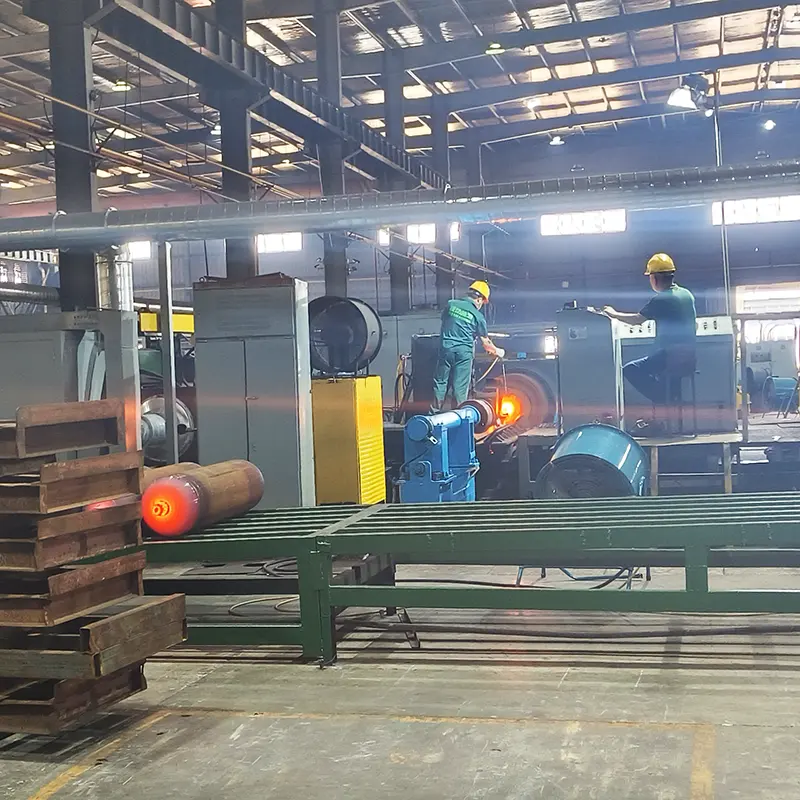
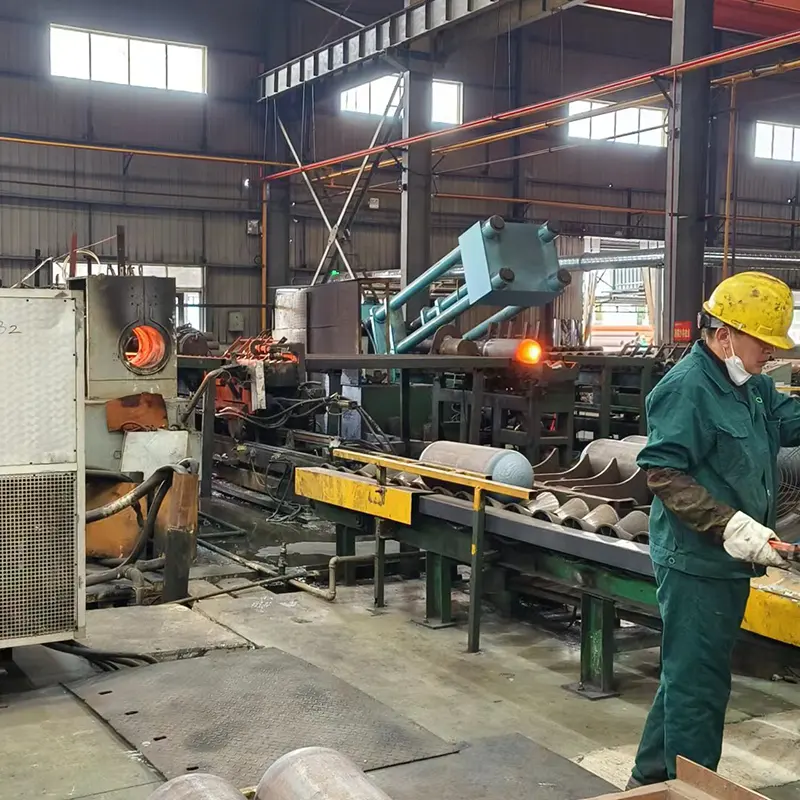
After seamless tubes are prepared, both cylinder ends are formed using precision hot spinning equipment. The steel is heated to the required forming temperature before rotating at controlled speeds while specialized spinning rollers gradually shape the cylinder neck and bottom.
Hot spinning creates a seamless transition between the cylindrical body and dome ends while maintaining uniform wall thickness. This process significantly improves pressure resistance and reduces stress concentrations that could affect long-term fatigue performance.
Modern CNC spinning machines provide excellent dimensional consistency and repeatability for high-volume production.
4. Heat Treatment
Heat treatment is one of the most critical manufacturing stages because it determines the final mechanical properties of the cylinder. After hot forming, cylinders undergo controlled quenching and tempering to optimize strength, toughness, ductility, and fatigue resistance.
Temperature, heating time, cooling rate, and furnace atmosphere are precisely controlled throughout the process to ensure uniform mechanical properties across the entire cylinder body.
Proper heat treatment significantly improves resistance to cyclic pressure loading and extends the service life of the cylinder.
5. CNC Neck Machining
Following heat treatment, CNC machining centers precisely machine the cylinder neck, valve threads, sealing surfaces, and critical dimensions. Computer-controlled machining ensures excellent dimensional accuracy and compatibility with standardized cylinder valves.
Every machined thread is inspected using calibrated gauges to verify compliance with the applicable thread specification.
6. Surface Preparation
Before coating, cylinder surfaces are thoroughly cleaned using shot blasting or abrasive blasting equipment. Surface preparation removes scale, oxidation, oil, and contaminants while creating a uniform surface profile that improves coating adhesion.
Proper surface preparation enhances corrosion resistance and contributes to the long-term durability of the protective coating system.
7. Protective Coating
Finished cylinders receive durable protective coatings such as epoxy primer, powder coating, or polyurethane paint. These coatings protect the cylinder from corrosion, environmental exposure, UV degradation, and mechanical damage during transportation and service.
Automated coating systems provide consistent film thickness and excellent surface finish while improving production efficiency.
8. Hydrostatic Pressure Testing
Every CNG cylinder undergoes hydrostatic pressure testing before leaving the factory. During this test, the cylinder is completely filled with water and pressurized above its normal working pressure to verify structural integrity and permanent expansion characteristics.
Hydrostatic testing confirms that the cylinder can safely withstand high internal pressure without leakage, excessive deformation, or structural defects.
9. Non-Destructive Testing (NDT)
Modern manufacturers employ multiple non-destructive inspection methods to detect internal or surface defects without damaging the finished cylinder. Depending on the production process and applicable standards, inspections may include ultrasonic testing, magnetic particle inspection, eddy current testing, and visual examination.
NDT ensures hidden discontinuities are identified before cylinders proceed to final approval.
- Ultrasonic Testing (UT)
- Magnetic Particle Inspection (MPI)
- Eddy Current Testing (ECT)
- Visual Inspection (VT)
10. Final Inspection, Marking and Packaging
Before shipment, every cylinder undergoes a comprehensive final inspection covering dimensions, weight, thread accuracy, pressure test records, coating quality, identification markings, and documentation. Cylinders that satisfy all inspection criteria are permanently marked with the required manufacturing information, serial numbers, working pressure, test pressure, production date, and certification details.
Finished cylinders are carefully packaged to prevent damage during storage and international transportation. Complete production records are maintained to provide full product traceability throughout the cylinder’s service life.
Advanced Manufacturing Equipment for CNG Cylinders
Manufacturing high-pressure CNG cylinders requires advanced production equipment capable of delivering exceptional dimensional accuracy, consistent mechanical properties, and repeatable product quality. Modern CNG cylinder factories integrate automated forming, CNC machining, controlled heat treatment, robotic handling, and comprehensive testing systems to ensure every cylinder meets stringent international safety standards.
At every stage of production, precision equipment is used to control critical manufacturing parameters such as wall thickness, concentricity, material properties, surface finish, and thread accuracy. Automated inspection systems and digital quality records further improve traceability and manufacturing consistency while reducing the possibility of human error.
Steel Billet Heating Furnace
Production begins by heating alloy steel billets to the required forging temperature using energy-efficient gas-fired or induction heating furnaces. Uniform heating is essential to maintain consistent material properties during piercing, rolling, and hot spinning operations.
Modern furnaces feature automatic temperature monitoring and programmable heating cycles to ensure every billet reaches the correct forming temperature before entering the production line.
Main Functions
- Uniform billet heating
- Temperature control
- Energy-efficient operation
- Automated process monitoring
Seamless Tube Piercing and Rolling Mill
For Type 1 seamless steel cylinders, heated billets are processed through piercing and rolling mills to produce seamless tubes with uniform wall thickness and excellent concentricity. This manufacturing method eliminates longitudinal welds and provides superior structural integrity for high-pressure applications.
Automated rolling equipment continuously monitors tube dimensions to maintain strict production tolerances throughout the forming process.
CNC Hot Spinning Machine
Computer-controlled hot spinning machines precisely form the cylinder neck and bottom while maintaining smooth transitions and uniform wall thickness. CNC control ensures excellent repeatability and dimensional consistency across large production batches.
- Automatic forming
- Uniform wall thickness
- High dimensional accuracy
- Reduced material stress
- Excellent repeatability
Manufacturing Advantage
CNC spinning minimizes dimensional variation, improves fatigue performance, and produces seamless dome geometries capable of safely withstanding repeated pressure cycles.
Controlled Heat Treatment Furnace
Heat treatment furnaces perform quenching and tempering operations that optimize the mechanical properties of finished cylinders. Computer-controlled temperature recording ensures consistent hardness, tensile strength, ductility, and impact toughness throughout every production batch.
Precise control of heating, soaking, cooling, and tempering cycles is essential for achieving reliable pressure vessel performance.
CNC Thread Machining Centers
High-precision CNC machining centers manufacture valve threads, neck finishes, sealing surfaces, and identification markings. Automated machining improves dimensional accuracy and ensures compatibility with standardized cylinder valves and accessories.
- Automatic thread cutting
- Precision neck machining
- Laser marking capability
- High repeatability
Automatic Powder Coating Line
Automated powder coating systems apply durable protective coatings with consistent thickness and excellent adhesion. Controlled curing ovens ensure optimum coating hardness, chemical resistance, and long-term weather protection.
Hydrostatic Pressure Testing System
Every finished cylinder undergoes hydrostatic testing using computerized pressure testing equipment. The system records test pressure, permanent expansion, pressure holding time, and test results to verify compliance with international standards.
Recorded Parameters
- Test pressure
- Holding time
- Permanent expansion
- Leak detection
- Digital records
Fatigue Cycle Testing Machine
Fatigue testing equipment repeatedly pressurizes cylinders through thousands of filling and discharge cycles to verify long-term durability under real operating conditions. These tests simulate years of service and confirm compliance with international fatigue performance requirements.
Burst Pressure Testing Equipment
Burst testing machines increase internal pressure until cylinder failure occurs. The measured burst pressure confirms that the cylinder exceeds the minimum burst ratio specified by the applicable manufacturing standard, providing an additional safety margin beyond normal operating pressure.
Non-Destructive Testing Laboratory
Dedicated NDT laboratories utilize advanced inspection equipment to identify surface and internal defects without damaging the cylinder. Inspection methods typically include ultrasonic testing (UT), magnetic particle inspection (MPI), eddy current testing (ECT), and visual inspection (VT).
- Ultrasonic Testing (UT)
- Magnetic Particle Inspection (MPI)
- Eddy Current Testing (ECT)
- Visual Inspection (VT)
- Digital inspection reports
Digital Manufacturing & Quality Traceability
Leading CNG cylinder manufacturers implement digital quality management systems that record every stage of production, from raw material receipt to final inspection. Each cylinder is assigned a unique serial number linked to material certificates, heat treatment records, machining data, pressure test results, coating inspections, and final quality approval. This complete traceability ensures efficient quality control, simplifies product verification, and supports long-term lifecycle management.
International Standards & Certifications
Reliable CNG cylinder manufacturers design and produce pressure vessels in accordance with internationally recognized standards and certification requirements. Compliance with these regulations verifies that cylinders have undergone rigorous design validation, material qualification, pressure testing, fatigue testing, and safety evaluations before entering service.
| Standard | Description | Application |
|---|---|---|
| ISO 11439 | High-pressure cylinders for on-board storage of natural gas | CNG vehicle cylinders |
| ISO 9809 | Seamless steel gas cylinders | Type 1 cylinders |
| ECE R110 | European regulation for CNG vehicle components | European vehicles |
| NGV2 | North American CNG cylinder standard | Natural gas vehicles |
| ISO 11120 | Large seamless steel gas cylinders | Tube trailers & cascade systems |
| PED | European Pressure Equipment Directive | Pressure equipment |
| TPED | Transportable Pressure Equipment Directive | Transport cylinders |
| DOT | U.S. Department of Transportation regulations | North American market |
| ADR | European regulations for dangerous goods transport | Road transportation |
Compliance with these international standards demonstrates that CNG cylinders have successfully passed comprehensive mechanical testing, pressure testing, fatigue evaluation, environmental assessment, and quality inspections, ensuring reliable performance throughout their service life.
Safety Testing of CNG Cylinders
Every CNG cylinder must undergo extensive testing before it is approved for use. These evaluations verify the cylinder’s structural integrity, pressure resistance, fatigue life, and safety under demanding operating conditions. Testing is performed in accordance with applicable international standards to ensure reliable performance throughout the cylinder’s service life.
| Test | Purpose |
|---|---|
| Hydrostatic Pressure Test | Verifies structural integrity under high internal pressure. |
| Burst Pressure Test | Confirms the cylinder exceeds minimum burst pressure requirements. |
| Fatigue Cycle Test | Simulates thousands of filling and discharge cycles. |
| Drop Test | Evaluates resistance to accidental impacts. |
| Bonfire Test | Assesses cylinder behavior during fire exposure. |
| Impact Resistance Test | Measures resistance to external mechanical damage. |
| Penetration Test | Evaluates resistance to localized damage. |
| Environmental Exposure Test | Verifies long-term durability under harsh environmental conditions. |
Together, these tests confirm that CNG cylinders can safely withstand high-pressure operation, repeated filling cycles, transportation, impact loads, and challenging environmental conditions, providing reliable long-term performance in automotive and industrial applications.
Applications of CNG Cylinders
CNG cylinders are widely used in the transportation, industrial, and energy sectors for the safe storage of compressed natural gas. Their high-pressure capability, long service life, and reliable performance make them an efficient solution for clean-energy applications, helping reduce fuel costs and emissions.
Passenger Vehicles
Lightweight Type 3 and Type 4 composite cylinders improve vehicle efficiency while safely storing natural gas for daily transportation.
- Private automobiles
- Taxi fleets
- Ride-sharing vehicles
- Government vehicles
Key Benefits
- Lower fuel costs
- Reduced CO₂ emissions
- Long driving range
- Lower operating costs
- Clean-burning fuel
Public Transportation
High-capacity seamless steel cylinders are widely used in CNG-powered buses and coaches, helping reduce emissions and operating costs while ensuring reliable daily service.
- City buses
- Airport shuttles
- School buses
- Municipal fleets
Commercial Trucks
Heavy-duty trucks use high-capacity CNG cylinders to support long-distance transportation with lower fuel costs and reduced emissions.
- Logistics trucks
- Distribution vehicles
- Garbage trucks
- Construction vehicles
- Heavy-duty transport fleets
Industrial Equipment
Industrial facilities use CNG cylinders for stationary gas storage, mobile energy systems, backup fuel supplies, and power generation where reliable natural gas storage is required.
- Industrial gas storage systems
- Manufacturing facilities
- Power generation equipment
- Construction sites
- Mining operations
Mobile Refueling Systems
Transportable CNG cylinder systems provide flexible natural gas distribution for remote locations, temporary fueling operations, emergency energy supply, and areas without pipeline infrastructure.
- Mobile CNG refueling stations
- Remote industrial projects
- Emergency fuel supply
- Temporary fueling operations
- Pipeline maintenance support
Why Choose CNG Cylinders?
Designed for high-pressure performance, long service life, and excellent fatigue resistance, CNG cylinders provide safe and dependable natural gas storage for transportation and industrial applications. Available in seamless steel and advanced composite designs, they improve operational efficiency while supporting cleaner, lower-emission energy solutions.
Looking for a Reliable CNG Cylinder Manufacturer?
Whether you need Type I steel CNG cylinders, custom specifications, or OEM manufacturing, BluNet provides certified high-pressure gas cylinders for vehicle, industrial, and energy applications worldwide.
How to Select the Right CNG Cylinder
Selecting the appropriate CNG cylinder depends on the intended application, required driving range or gas storage capacity, installation space, and applicable regulatory standards. Choosing the correct cylinder improves safety, operational efficiency, and long-term performance.
Key Selection Factors
- Application (vehicle, industrial, or mobile refueling)
- Working pressure (typically 200 or 250 bar)
- Required water capacity
- Available installation space
- Cylinder weight and material (Type 1–Type 4)
- Applicable international standards and certifications
- Service life and inspection requirements
- Environmental and operating conditions
Our engineering team can recommend the most suitable CNG cylinder configuration based on your technical requirements, operating conditions, and project specifications.
TECHNICAL FAQs
About CNG Cylinder Manufacturing
BluNet manufactures high-pressure CNG cylinders for transportation and industrial applications. We provide standard and customized solutions based on customer specifications and applicable international standards.
Our manufacturing processes are designed to comply with internationally recognized standards, including ISO 11439, ISO 9809, ECE R110, NGV2, ISO 11120, PED, TPED, and DOT requirements, depending on the project and destination market.
Every cylinder undergoes comprehensive inspections, including dimensional checks, hydrostatic pressure testing, non-destructive testing (NDT), leak testing, coating inspection, and final quality verification before shipment.
Yes. We offer OEM and customized manufacturing services, including cylinder dimensions, water capacity, valve configuration, surface coating, branding, and packaging to meet specific project requirements.
Each cylinder is assigned a unique serial number linked to its raw material certificates, manufacturing records, heat treatment data, inspection reports, and pressure test results, ensuring complete traceability throughout the production process.
CNG cylinders are widely used in passenger vehicles, buses, commercial trucks, industrial gas storage systems, mobile refueling units, power generation, and other compressed natural gas applications.
Yes. Our engineering team provides technical consultation, product selection, customized design support, and manufacturing solutions for OEMs, distributors, fleet operators, and EPC contractors.
Simply contact our sales team with your required cylinder type, working pressure, water capacity, quantity, and destination market. We will recommend the most suitable solution and provide a detailed quotation.
Related CNG Cylinder and Tank Resources
More Technical Information about CNG cylinder manufacturing
DSW CNG Cylinder Manufacturing Excellence
DSW is committed to manufacturing high-quality CNG cylinders that meet the demanding requirements of the global transportation and industrial gas industries. Supported by advanced production facilities, experienced engineers, and rigorous quality management, we provide reliable compressed natural gas storage solutions for OEMs, distributors, fleet operators, and EPC contractors worldwide.
From raw material inspection to final pressure testing, every CNG cylinder is manufactured under strict quality control to ensure safety, durability, and long-term performance. Whether you require standard products or customized OEM solutions, DSW is your trusted manufacturing partner for high-performance CNG cylinder solutions.