


Designing Cryogenic Storage Vessels
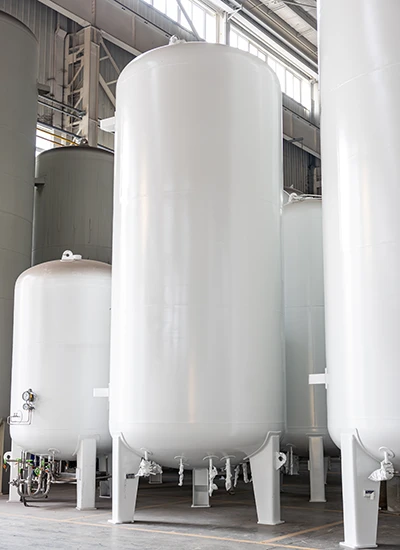
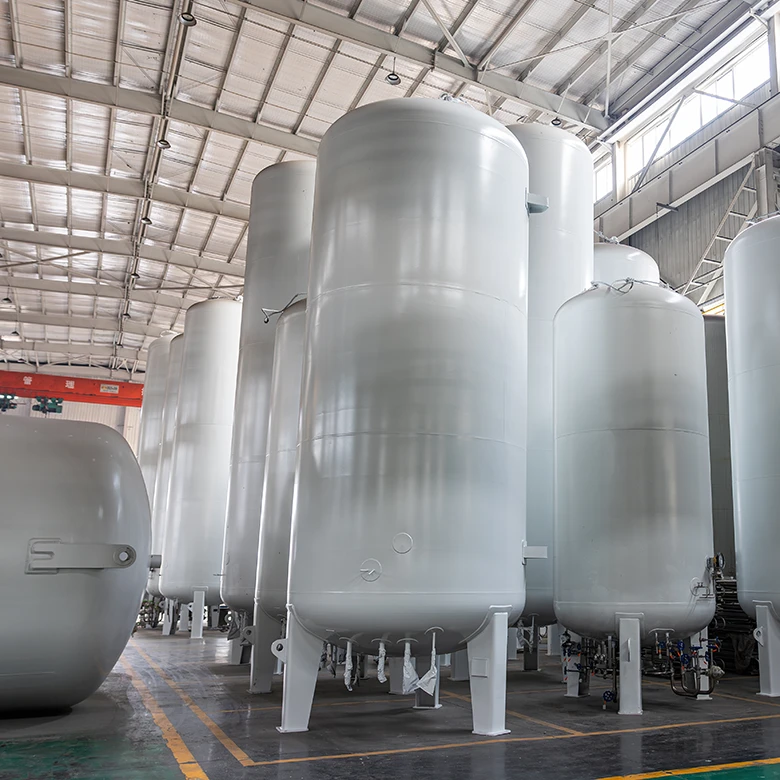
The design of cryogenic storage vessels involves careful calculation of several key variables, including the thickness and diameter of the product vessel, the thickness and diameter of the outer shell, and the thickness of structural stiffeners. These calculations depend on the specific design codes being followed.
Before liquefaction, the incoming air is passed through a post-filter to remove impurities. The filtered air then enters the cold box, which consists of:
- Heat exchangers
- Expansion turbines
- Inlet and outlet manifolds
- A column with aluminum trays
The compressed air is first cooled in the heat exchanger to approximately -140°C. During this process, cold air bypasses non-condensable gases such as gaseous nitrogen. The air then expands in the turbine, further reducing the temperature to around -180°C, causing liquefaction.
The liquid air flows through the aluminum tray column from top to bottom. Here, nitrogen and other gases evaporate while oxygen collects in the bottom reservoirs. Liquid nitrogen forms at the top of the column, where it is pumped to the cold converter. Condensable nitrogen gases are also used to pre-cool incoming compressed air, enhancing energy efficiency. Argon, present as a minor impurity, is separated in an additional column to ensure the purity of the final liquid nitrogen.
Key Considerations in Cryogenic Vessel Design
Effective cryogenic vessel design balances safety, thermal efficiency, and material performance. Critical aspects include:
- Vessel Dimensions and Thickness: Proper calculation of the vessel and outer shell dimensions ensures resistance to internal pressures and thermal stresses.
- Stiffener Design: Provides structural integrity under extreme temperature variations and prevents deformation.
- Material Selection: Materials must maintain strength at cryogenic temperatures and be compatible with stored gases like nitrogen and oxygen.
- Thermal Insulation: Reduces heat ingress, minimising boil-off and improving storage efficiency. (See dedicated section below.)
- Filtration and Purity Control: Ensures that air or gas is free from impurities prior to liquefaction, maintaining high-purity liquid gases.
- Heat Exchangers and Expansion Turbines: Efficiently cool and liquefy gases while recovering energy.
- Collection and Storage: Tray and column arrangements separate nitrogen, oxygen, and other gases for safe and efficient storage in cold converters.
- Compliance with Design Codes: Fabrication must follow international standards such as ASME, EN, or CODE 2000.
Well-designed cryogenic vessels ensure safe, reliable, and efficient production and storage of liquid gases.
Design Parameters of Cryogenic Vessels
Key variables considered during design include vessel thickness, diameter, outer shell dimensions, and stiffener thickness. These are calculated according to the selected design codes to ensure safety and performance.
Design Codes for Cryogenic Storage Vessels
Design codes establish the rules and standards for the safe design and manufacture of cryogenic storage vessels. They ensure operational safety, quality control, and compliance with international regulations. Common codes include:
- ASME Section VIII Division I & II (USA)
- PD 5500 (UK)
- AD Merkblatter (Germany)
- IS 2825 (India)
While the objectives of these codes are similar, their approaches to material selection, design methodology, and fabrication requirements differ based on regional standards.
Cryogenic Materials
Materials used in cryogenic vessel construction must retain strength and ductility at extremely low temperatures. Common materials include:
Stainless Steels
Austenitic stainless steels remain tough and ductile down to -269°C, making them ideal for cryogenic applications.
9% Nickel Steel
9% nickel steels combine austenitic and ferritic structures, offering excellent strength and resistance to brittle fracture. These materials are widely used for storing and transporting liquid gases like nitrogen, methane, and ethylene.
Aluminium Alloys
Alloys such as 5083 (Mg 0.445%, Mn 0.6%, Cr 0.15%) and 6003 (Mn 1.26%, Cu 0.12%) are commonly used for cryogenic vessels, air separation columns, and heat exchangers. They exhibit superior toughness and maintain structural integrity down to liquid helium temperatures (-269°C).
Copper Alloys
Copper alloys, including alpha brass and phosphorous-deoxidized copper, are still employed in small air separation plants. While their yield strength is lower than steel, their performance is reliable at cryogenic temperatures.
Thermal Insulation in Cryogenic Vessels
Thermal insulation is a critical component in cryogenic vessel design. Its primary function is to reduce heat ingress from the environment, minimising liquid gas evaporation (boil-off) and maintaining storage efficiency.
Key Insulation Methods
- Vacuum Insulation: A vacuum jacket between the inner vessel and outer shell dramatically reduces heat transfer by conduction and convection.
- Multilayer Insulation (MLI): Multiple layers of reflective foils separated by low-conductivity spacers reduce radiative heat transfer. Commonly used in large storage tanks and transport dewars.
- Foam or Perlite Insulation: High-performance foams or perlite fill provide thermal resistance in smaller tanks or where vacuum insulation is impractical.
Benefits of High-Quality Insulation
- Minimises boil-off, reducing loss of expensive cryogenic liquids.
- Maintains stable low temperatures for safe storage and transport.
- Improves energy efficiency and lowers operational costs.
- Enhances safety by preventing excessive pressure build-up due to evaporated gases.
Optimal insulation design considers vessel size, liquid type, ambient conditions, and storage duration. Combining vacuum insulation with multilayer reflective shields is the most effective solution for industrial applications.

No comment