

Modern industries rely on the safe and efficient transportation of liquefied gases such as LNG, liquid nitrogen, oxygen, and argon. These gases must be stored and transported at extremely low temperatures, requiring specialised equipment.
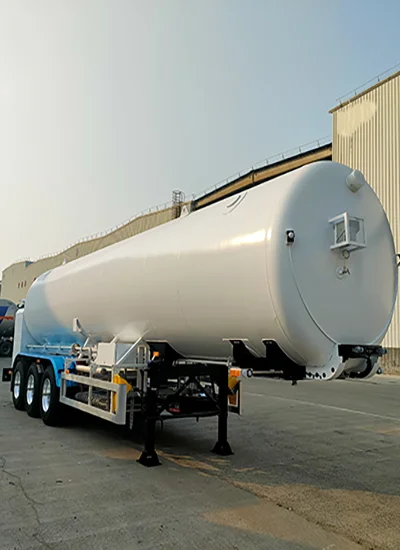
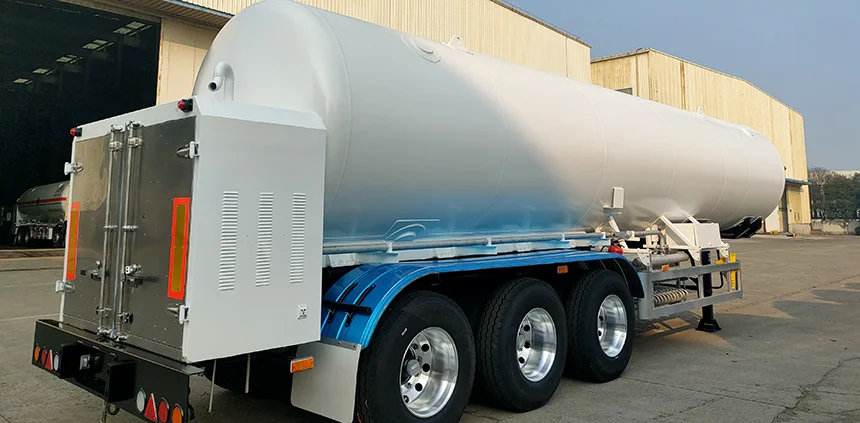
A cryogenic semi-trailer, also known as a cryogenic tanker trailer or cryo truck, is a heavy-duty transport system designed to safely deliver cryogenic liquids over long distances. These specialized vehicles are widely used in the energy, healthcare, manufacturing, and food industries to maintain reliable cryogenic transportation of liquefied gases.
In this guide, we explain how cryogenic trailers work, their structure, applications, and how to choose reliable cryogenic trailer manufacturers.
What Is a Cryogenic Semi-Trailer?
A cryogenic semi-trailer is a vacuum-insulated tanker mounted on a semi-trailer chassis used to transport liquefied gases at extremely low temperatures, typically below −150 °C.
These trailers are engineered to maintain the cryogenic state of gases such as:
- Liquefied natural gas (LNG)
- Liquid nitrogen (LIN)
- Liquid oxygen (LOX)
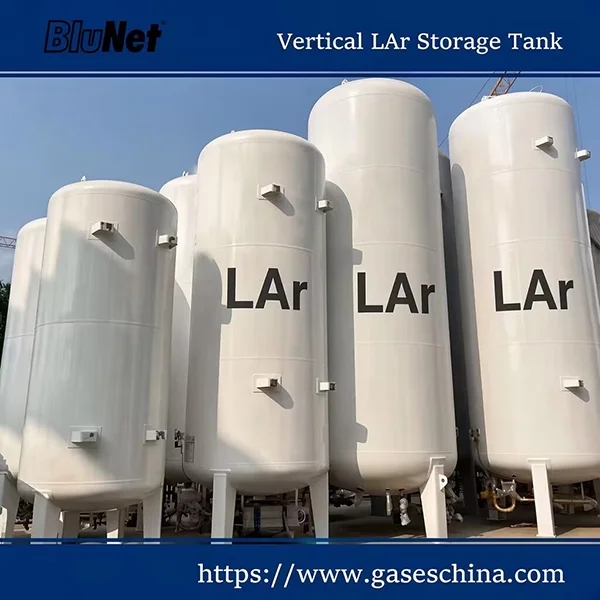
- Liquid argon (LAR)
- Liquid carbon dioxide (LCO₂)
Because cryogenic liquids quickly evaporate when exposed to heat, these trailers use double-layer vacuum insulation systems to minimise heat transfer and prevent product loss during transport.
In practical operation, the cryogenic tanker trailer is pulled by a gas transport truck or tractor unit, forming a mobile system capable of delivering bulk industrial gases to factories, hospitals, laboratories, and LNG stations.
Key Components of a Cryogenic Semi-Trailer
A modern cryogenic semi-trailer consists of several integrated components designed for safety and thermal performance.
Vacuum-Insulated Cryogenic Tank
The tank is the core component of the trailer. It usually includes:
- Stainless steel inner vessel designed for ultra-low temperatures
- Carbon steel or aluminium outer shell for structural support
- High-vacuum multilayer insulation to reduce heat transfer
This construction helps maintain cryogenic temperatures while reducing evaporation losses during long-distance transportation.
Semi-Trailer Chassis
The cryogenic tank is mounted on a reinforced semi-trailer chassis designed for heavy loads and road stability.
Common configurations include:
- Single-axle trailer
- Double-axle trailer
- Triple-axle heavy-duty trailer
A low centre of gravity improves stability and safety during transport.
Pump and Transfer System
Many cryogenic trailers include transfer systems such as:
- Cryogenic pumps
- Insulated transfer hoses
- Flow control valves
- Pressure building systems
These systems allow operators to transfer cryogenic liquids safely from the trailer to storage tanks or gas supply systems.
Safety and Control Systems
To ensure safe operation, cryogenic tanker trailers are equipped with:
- Pressure relief valves
- Emergency shut-off valves
- Temperature and pressure monitoring instruments
- Insulated pipelines and connectors
These features help prevent over-pressure conditions and maintain safe transportation of cryogenic liquids.
Types of Cryogenic Transport Trailers
Cryogenic tanker trailers are designed for different gases and industrial applications.
LNG Trailer
An LNG trailer is specifically designed for transporting liquefied natural gas. LNG trailers are widely used in energy distribution and clean fuel supply systems.
Typical features include:
- Tank capacity from 23,000 to 46,500 litres
- Vacuum insulated tank construction
- Pressure control and safety systems
These systems are commonly supplied by specialised LNG trailer manufacturers serving global energy logistics.
Liquid Nitrogen Trailer
A liquid nitrogen trailer or liquid nitrogen truck transports nitrogen at approximately −196 °C.
Applications include:
- Food freezing and preservation
- Electronics manufacturing
- Scientific laboratories
- Metal heat treatment
Because nitrogen evaporates quickly at ambient temperatures, these trailers are designed to minimise boil-off losses.
Industrial Gas Cryogenic Trailers
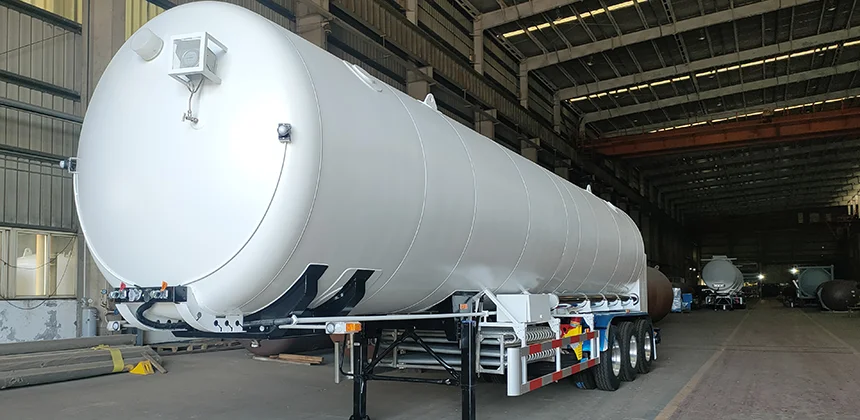
Cryogenic transport trailers are also used for transporting:
- Liquid oxygen for medical facilities
- Argon for welding and metallurgy
- Carbon dioxide for food processing
- Nitrous oxide for medical applications
Bulk distribution using cryogenic trailers ensures stable supply across industrial networks.
Typical Capacity and Specifications
| Parameter | Typical Range |
|---|---|
| Tank Capacity | 20,000 – 60,000 litres |
| Working Pressure | 0.2 – 2.2 MPa |
| Design Temperature | Down to −196 °C |
| Insulation Type | High vacuum multilayer insulation |
| Tank Material | Stainless steel inner tank with carbon steel outer shell |
Advantages
- Efficient bulk transportation for LNG and industrial gases
- Excellent thermal insulation to reduce product evaporation
- Flexible logistics for supplying factories, hospitals, and LNG stations
- Advanced safety systems ensuring safe operation
Applications
Cryogenic trailers play an essential role in many industries.
- Energy industry – LNG transport and distribution
- Healthcare – medical oxygen supply
- Manufacturing – industrial gas supply
- Food processing – liquid nitrogen freezing
- Scientific research – laboratory cryogenic applications
Choosing Reliable Cryogenic Trailer Manufacturers
When selecting a supplier for cryogenic trailers, several factors should be considered:
- Engineering experience in cryogenic equipment design
- Compliance with international standards such as ASME, ADR, and ISO
- Customisable tank capacity and trailer configuration
- Reliable after-sales service and technical support
For complete solutions beyond individual trailers, DSW provides integrated cryogenic transport solutions, including cryogenic tanker trailers, ISO tank containers, and customized liquefied gas transportation systems.
Conclusion
A cryogenic semi-trailer plays a crucial role in the global supply chain for liquefied gases. From LNG distribution to liquid nitrogen transportation, these specialised cryogenic tanker trailers ensure safe and efficient delivery of cryogenic liquids across industries.
With advanced vacuum insulation, robust safety systems, and high-capacity tanks, modern cryogenic trailers provide reliable solutions for large-scale cryogenic transportation worldwide.
TECHNICAL FAQs
About Cryogenic Semi-trailer
A cryogenic semi-trailer is a vacuum-insulated tanker mounted on a semi-trailer chassis, designed for the safe transportation of liquefied gases at cryogenic temperatures, typically below -150 °C. It maintains the liquefied state of LNG, liquid nitrogen (LIN), liquid oxygen (LOX), liquid argon (LAR), and liquid carbon dioxide (LCO₂) during long-distance transport.
Cryogenic tanker trailers use double-wall construction with a stainless steel inner vessel and carbon steel or aluminum outer shell. High-vacuum multilayer insulation combined with reflective shields minimizes conductive, convective, and radiative heat transfer, reducing boil-off rates and maintaining ultra-low temperatures over long hauls.
Typical specifications include tank capacities of 20,000–60,000 litres, working pressures from 0.2–2.2 MPa, design temperatures down to -196 °C for liquid nitrogen, and high-vacuum multilayer insulation. Tanks are engineered for structural integrity under thermal contraction and expansion, with reinforced semi-trailer chassis for axle load distribution.
Cryogenic trailers employ integrated pump and transfer systems, including submersible or external cryogenic pumps, insulated transfer hoses, flow control valves, and pressure-building circuits. These systems control the flow rate, maintain temperature, and prevent flash evaporation during offloading operations.
Types include LNG trailers for liquefied natural gas, liquid nitrogen trailers or trucks for nitrogen at -196 °C, and industrial gas trailers for LOX, LAR, CO₂, and N₂O. Each type is engineered for specific thermal loads, vapor pressure control, tank material selection, and safety system integration according to ASME and ISO standards.

No comment