


A cryogenic vessel works by keeping liquefied gases at extremely low temperatures while controlling heat transfer, internal pressure and gas flow. Its performance depends on the design of the inner vessel, outer jacket, insulation system, pressure-control equipment and liquid or gas delivery connections.
Unlike conventional storage containers, cryogenic vessels are engineered to limit heat entering the stored liquid. Even with effective insulation, a small amount of heat will enter over time, causing some liquid to evaporate. The vessel must therefore manage both thermal conditions and pressure during storage and operation.
This guide explains how cryogenic vessels work, including vacuum insulation, heat transfer, pressure regulation, boil-off gas management and liquid delivery systems.
1. Basic Operating Principle of a Cryogenic Vessel
A typical vacuum-insulated cryogenic vessel consists of an inner container surrounded by an outer jacket. The inner vessel holds the liquefied gas, while the insulation space between the two structures reduces heat transfer from the external environment.
The vessel operates through several coordinated functions:
- Liquid containment: The inner vessel stores the cryogenic liquid under specified operating conditions.
- Thermal insulation: The insulation system reduces heat entering the stored liquid.
- Pressure management: Valves, pressure-building equipment and safety devices help maintain the required operating pressure.
- Gas handling: Vaporized gas is managed through designated piping, venting or gas recovery arrangements.
- Liquid and gas delivery: Dedicated connections allow the stored medium to be withdrawn in liquid or gaseous form, depending on the system design.
These functions work together to maintain suitable storage conditions and support reliable gas supply. The exact arrangement varies according to the stored medium, vessel capacity, operating pressure and intended application.
2. How Vacuum Insulation Works
Vacuum insulation is widely used in industrial cryogenic storage vessels because it significantly reduces heat transfer between the surrounding environment and the stored liquid. It is particularly important for applications involving liquid nitrogen, liquid oxygen, liquid argon and liquefied natural gas.
2.1 Inner Vessel and Outer Jacket
The inner vessel is the primary container that holds the cryogenic liquid. It is designed according to the required pressure, temperature, material compatibility and applicable design standards.
The outer jacket surrounds the inner vessel and protects the insulation space. In a vacuum-insulated design, the space between the inner vessel and outer jacket is evacuated to a low pressure to reduce heat transfer through the remaining gas.
2.2 How the Vacuum Space Reduces Heat Transfer
Heat can enter a cryogenic vessel through three main mechanisms: conduction, convection and radiation.
- Conduction: Heat travels through solid materials and structural connections between the inner vessel and outer jacket.
- Convection: Heat is transferred by the movement of gas or liquid. Reducing the gas pressure in the insulation space greatly limits gas convection.
- Radiation: Thermal energy travels between surfaces through electromagnetic radiation, even without direct physical contact.
Vacuum insulation primarily reduces heat transfer through gas conduction and convection. Radiation is commonly reduced through reflective insulation materials, such as multilayer insulation (MLI), where used. Supports, piping connections and other structural components must also be designed to limit unwanted heat leakage.
2.3 The Role of Multilayer Insulation
Some vacuum-insulated cryogenic vessels use multilayer insulation (MLI) within the evacuated space. This system consists of multiple reflective layers separated by low-conductivity spacer materials.
The reflective layers reduce radiative heat transfer between the inner vessel and outer jacket. Combined with the vacuum environment, MLI can improve insulation performance when properly designed, installed and maintained.
Not every cryogenic vessel uses the same insulation arrangement. The choice depends on the vessel design, thermal requirements, manufacturing method and intended service conditions.
3. How Heat Affects the Cryogenic Liquid
Even with effective insulation, a cryogenic vessel cannot completely eliminate heat input. Heat enters through structural supports, piping connections, insulation systems and other thermal paths.
When heat reaches the stored cryogenic liquid, part of the liquid may absorb this energy and evaporate. This process is known as vaporization. The resulting gas is commonly referred to as boil-off gas (BOG).
The amount of boil-off depends on several factors:
- Quality and condition of the insulation system.
- Vessel size, geometry and surface area.
- Stored liquid and its thermodynamic properties.
- Operating pressure and temperature.
- Liquid fill level and storage conditions.
- Frequency of liquid withdrawal and changes in operating conditions.
Understanding heat input is essential when evaluating cryogenic vessel performance, particularly for applications requiring long-term storage or continuous gas supply.
4. How Cryogenic Vessels Control Internal Pressure
As some of the stored liquid evaporates, gas accumulates in the vapor space above the liquid. Depending on the vessel design and operating conditions, this can cause internal pressure to increase.
Cryogenic vessels therefore incorporate pressure-control arrangements to maintain pressure within the specified operating range. The configuration differs between stationary storage tanks, transportable vessels and liquid cylinders.
4.1 Pressure-Building System
Some cryogenic vessels use a pressure-building circuit to increase internal pressure when required. A pressure-building circuit typically directs a controlled amount of liquid through a vaporizing coil or heat exchanger. The liquid absorbs heat and vaporizes, and the resulting gas is returned to the vessel’s vapor space.
This process increases vessel pressure and can help provide the pressure needed to deliver liquid from the container. The system is particularly relevant to certain liquid cylinders and cryogenic supply vessels.
Not all cryogenic vessels use a pressure-building circuit. Its inclusion depends on the intended operating function and system design.
4.2 Pressure-Relief Devices
Pressure-relief devices protect the vessel against excessive pressure. Depending on the design, these may include pressure-relief valves and other approved safety devices.
If internal pressure reaches the specified relief setting, the device opens to discharge gas through the designated relief arrangement. This helps prevent pressure from exceeding the vessel’s allowable limits.
Pressure-relief devices are safety components, not normal pressure-control substitutes. Their selection, installation, discharge routing and inspection must follow the applicable design requirements and operating procedures.
4.3 Pressure Regulation During Operation
Internal pressure changes with heat input, liquid withdrawal, gas consumption and operating conditions. A properly designed system uses suitable valves, regulators, instruments and piping to manage these changes.
Operators should monitor pressure and temperature according to the manufacturer’s instructions and the applicable operating procedures.
5. What Is Boil-Off Gas and How Is It Managed?
Boil-off gas (BOG) is the vapor produced when heat entering a cryogenic vessel causes part of the stored liquid to evaporate. It is a normal physical phenomenon in cryogenic storage systems, although the amount produced depends heavily on the insulation performance and operating conditions.
How the gas is handled depends on the vessel type and the gas supply system.
5.1 Boil-Off Rate (BOR)
The boil-off rate (BOR) describes the rate at which stored cryogenic liquid evaporates under specified test or operating conditions. It is commonly expressed as a percentage of the vessel’s liquid capacity per day.
For example, a stated BOR of 0.2% per day indicates that the equivalent of 0.2% of the reference liquid capacity evaporates over 24 hours under the specified conditions. The actual interpretation depends on the test method, reference capacity and measurement basis.
BOR is an important performance consideration when comparing cryogenic vessels. However, figures should only be compared when the test conditions and calculation methods are consistent.
5.2 Common BOG Management Methods
Depending on the application, boil-off gas may be managed through several arrangements:
- Gas utilization: Vaporized gas may be supplied to a connected process when its pressure and quality meet the required conditions.
- Gas recovery: Suitable systems may collect and recover boil-off gas for further use.
- Pressure management: Control equipment helps maintain pressure within the specified operating range.
- Safe venting: Where required by the system design, gas may be discharged through an appropriately designed vent arrangement.
For larger storage installations, BOG management can affect gas utilization efficiency, operating costs and overall system design.
6. How Liquid and Gas Are Delivered from a Cryogenic Vessel
Cryogenic vessels can be configured to supply either liquid or gaseous products. The delivery arrangement depends on the stored medium, pressure requirements, downstream equipment and application.
6.1 Liquid Withdrawal
Liquid withdrawal systems draw cryogenic liquid from the lower section of the inner vessel through a dedicated liquid outlet. The liquid is transferred through appropriately insulated piping to the receiving equipment or downstream process.
In pressure-operated systems, the pressure difference between the vessel and the receiving system provides the force needed to move the liquid. The actual delivery pressure and flow rate depend on the vessel configuration and system design.
6.2 Gas Withdrawal
Gas can be withdrawn from the vapor space or produced by vaporizing liquid through a suitable vaporizer. The resulting gas is then supplied through a gas outlet and associated pressure-control equipment.
For example, a liquid nitrogen storage system may supply liquid nitrogen directly to a process or convert it into gaseous nitrogen through a vaporizer, depending on the user’s requirements.
6.3 External Vaporizers
External vaporizers convert cryogenic liquid into gas before it enters the downstream distribution system. Ambient air vaporizers use heat from the surrounding air, while other designs use water, steam or dedicated heat-transfer systems.
Vaporizer capacity must be matched to the required gas flow, inlet conditions, outlet temperature and operating environment. The vessel, vaporizer, piping and pressure-control equipment should be considered as an integrated supply system.
7. What Happens When a Cryogenic Vessel Loses Vacuum?
In a vacuum-insulated cryogenic vessel, the insulation space is designed to maintain a sufficiently low pressure to reduce heat transfer. If the vacuum deteriorates, more residual gas may remain in the insulation space, increasing heat transfer to the inner vessel.
Possible consequences include:
- Higher heat input into the stored cryogenic liquid.
- Increased liquid evaporation and boil-off gas generation.
- Faster pressure changes during storage.
- Reduced holding time and thermal performance.
- Greater demand on pressure-control and gas-handling systems.
Vacuum deterioration may be associated with leakage, material outgassing, insulation degradation or other conditions affecting the insulation space. The actual cause requires appropriate inspection and diagnosis.
Vacuum performance should be evaluated using the manufacturer’s specified inspection and testing procedures. A suspected vacuum problem should not be addressed by unauthorized modification of the vessel or its insulation system.
8. Factors That Affect Cryogenic Vessel Performance
The operating performance of a cryogenic vessel depends on more than its insulation system. Its design, manufacturing quality and operating conditions all influence thermal efficiency, pressure stability and service reliability.
| Factor | Effect on Performance |
|---|---|
| Vacuum quality | Affects heat transfer through the insulation space. |
| Insulation materials | Influence radiative heat transfer and overall insulation performance. |
| Structural supports | Can create thermal bridges between the inner vessel and outer jacket. |
| Piping connections | May introduce additional heat paths and affect delivery performance. |
| Operating pressure | Influences liquid and vapor conditions and system operation. |
| Operating conditions | Liquid fill level, ambient temperature and withdrawal patterns affect performance. |
| Manufacturing quality | Affects structural integrity, vacuum integrity and long-term reliability. |
When selecting a cryogenic vessel, buyers should evaluate the complete operating requirements rather than relying on capacity alone. Design pressure, insulation performance, stored medium, delivery method and applicable standards all need to be considered.
9. How Cryogenic Vessel Design Supports Different Applications
Although the basic principles of thermal insulation and pressure management are shared, cryogenic vessels are designed differently for different applications.
Stationary Cryogenic Storage Tanks
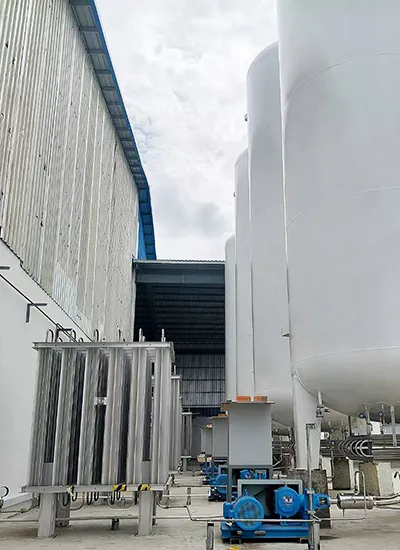
Stationary tanks are designed for fixed installations that require storage of larger quantities of liquefied gases. They are commonly integrated with vaporizers, pumps, pressure-control equipment and gas distribution systems.
Learn more about industrial cryogenic storage tanks and their applications.
Cryogenic Liquid Cylinders
Liquid cylinders are vacuum-insulated pressure vessels designed for the storage and delivery of cryogenic liquids. They commonly include pressure-building and liquid or gas withdrawal arrangements, depending on the model and intended service.
Explore our industrial gas cylinder solutions for different gas supply requirements.
Cryogenic Dewars
Cryogenic Dewars are used for storing and handling small quantities of cryogenic liquids. Some are open-neck, non-pressurized containers, while other specialized designs are engineered for pressurized service. Their construction and operating principles should not be assumed to be identical to those of industrial storage tanks or liquid cylinders.
See our liquid nitrogen Dewars for examples of cryogenic liquid storage containers.
TECHNICAL FAQs
About How Does a Cryogenic Vessel Work
A cryogenic vessel uses thermal insulation to reduce heat entering the stored liquid. Vacuum-insulated designs use an evacuated space between the inner vessel and outer jacket, often combined with reflective insulation materials to reduce heat transfer.
Vacuum insulation reduces gas conduction and convection in the space surrounding the inner vessel. When combined with suitable insulation materials and low-heat-leak structural supports, it helps maintain the low temperatures required for cryogenic liquid storage.
Yes. A small amount of heat enters even a well-insulated vessel, causing some liquid to evaporate. The resulting vapor is known as boil-off gas. The amount depends on insulation performance, vessel design and operating conditions.
Pressure is managed through the vessel’s designed piping, valves, instruments and control arrangements. Some systems use a pressure-building circuit to vaporize a controlled amount of liquid and increase vessel pressure. Pressure-relief devices provide protection against excessive pressure.
The boil-off rate (BOR) indicates how quickly stored cryogenic liquid evaporates under specified conditions. It is commonly expressed as a percentage of the reference liquid capacity per day. The test conditions and calculation basis should be checked when comparing BOR values.
Yes. Depending on its design, a cryogenic vessel may provide liquid through a liquid withdrawal connection or gas through a vapor space outlet or an external vaporizer. The required delivery arrangement depends on the application and downstream system.
Loss of vacuum can increase heat transfer into the stored liquid. This may increase boil-off, affect pressure behavior and reduce storage performance. The vessel should be inspected and assessed according to the manufacturer’s procedures.
Conclusion
A cryogenic vessel works by combining liquid containment, thermal insulation, pressure management and controlled fluid delivery. In vacuum-insulated designs, the inner vessel and outer jacket create an insulation space that limits heat transfer, while valves, piping and other equipment manage pressure and product flow.
Understanding these engineering principles helps buyers and engineers evaluate cryogenic storage equipment according to the stored medium, operating conditions, insulation performance and gas supply requirements.
For an overview of vessel configurations, applications and manufacturing solutions, visit our Cryogenic Vessels Manufacturer page or contact BluNet to discuss your project requirements.

No comment