


A cryogenic vessel is a specialized container engineered to store or transport liquefied gases at extremely low temperatures, typically below -150°C (-238°F). These vessels use suitable insulation systems, low-temperature materials, and pressure-control equipment to maintain the required operating conditions while minimizing heat transfer from the surrounding environment.
Cryogenic vessels are used throughout industrial gas production, healthcare, chemical processing, energy, food processing, and scientific research. Depending on their design and application, they include stationary storage tanks, transportable vessels, liquid cylinders, and dewars. Understanding their construction, operating principles, and technical requirements is essential when selecting equipment for cryogenic liquid storage and supply.
1. What Is a Cryogenic Vessel?
A cryogenic vessel is an engineered container designed to hold liquefied gases at extremely low temperatures while maintaining specified pressure and thermal conditions. The term covers a broad range of equipment used for storing, handling, and transporting cryogenic liquids, including liquid nitrogen, liquid oxygen, liquid argon, and liquefied natural gas (LNG).
Unlike conventional liquid storage containers, cryogenic vessels must withstand the effects of extremely low temperatures, including material contraction, thermal stress, and heat transfer from the external environment. Their design therefore requires suitable low-temperature materials, effective insulation, pressure-management systems, and appropriate safety devices.
Many industrial cryogenic vessels use a double-wall construction consisting of an inner vessel and an outer jacket. The space between these walls is commonly evacuated to create a vacuum insulation system. Multilayer insulation may also be installed within the evacuated space to reduce heat transfer through thermal radiation.
The term cryogenic vessel is broader than cryogenic storage tank. It includes different equipment configurations, from small laboratory dewars and portable liquid cylinders to large stationary storage tanks and specialized transport vessels. Each type is designed around its intended medium, storage capacity, operating pressure, and application.
Basic Working Principle of a Cryogenic Vessel
A cryogenic vessel maintains liquefied gases at extremely low temperatures through a combination of thermal insulation, pressure management and controlled gas handling. In a typical vacuum-insulated design, the inner vessel holds the cryogenic liquid while the outer jacket and evacuated insulation space reduce heat transfer from the surrounding environment.
As small amounts of heat enter the vessel, some stored liquid may evaporate, producing boil-off gas. Pressure-control devices and appropriately designed piping help manage this gas and maintain safe operating conditions. The specific operating principle depends on the vessel design, stored medium and intended application.
For a more detailed explanation of vacuum insulation, heat transfer, pressure regulation and boil-off gas management, see our guide: How Does a Cryogenic Vessel Work?
3. Main Components of a Cryogenic Vessel
The construction of a cryogenic vessel varies according to its storage medium, pressure rating, capacity, and application. Many industrial vacuum-insulated vessels incorporate the following main components:
Inner Vessel
The inner vessel directly contains the cryogenic liquid. It is manufactured from materials selected for their mechanical strength, toughness, and suitability at extremely low temperatures. Austenitic stainless steels, including 304 and 316 grades, are commonly used in many industrial cryogenic applications.
Outer Jacket
The outer jacket surrounds and protects the inner vessel. In vacuum-insulated designs, it forms the external enclosure of the insulation system and helps maintain the vacuum space. Its material and structural configuration depend on the vessel design, external loading conditions, and applicable engineering requirements.
Vacuum Space and Insulation System
The insulation space between the inner vessel and outer jacket is designed to minimize heat transfer. In vacuum-insulated vessels, most of the gas is removed from this space to reduce heat transfer through gas conduction and convection. Multilayer insulation or other suitable insulating materials may be added to improve thermal performance.
Support System
The inner vessel must be supported within the outer jacket while accommodating thermal contraction and mechanical loads. Support arrangements are designed to maintain structural stability while limiting unwanted heat transfer through the support connections.
Piping, Valves and Safety Devices
Cryogenic vessels use specialized piping and valves for filling, liquid withdrawal, gas discharge, venting, and pressure control. Depending on the design, monitoring and safety equipment may include pressure gauges, liquid-level indicators, pressure-building circuits, pressure regulators, and pressure-relief valves.
4. Main Types of Cryogenic Vessels
Cryogenic vessels can be classified according to their construction, mobility, storage capacity, and intended application. The main types used in industrial gas systems include stationary storage vessels, transportable vessels, liquid cylinders, and dewars.
Stationary Cryogenic Storage Vessels
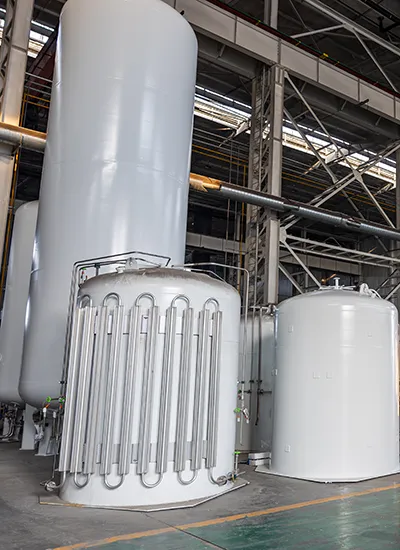
Stationary cryogenic vessels are installed at industrial facilities, gas distribution centers, hospitals, and production plants. They are designed for long-term storage of liquefied gases and are available in vertical and horizontal configurations.
These vessels are commonly used for bulk storage of liquid nitrogen, liquid oxygen, and liquid argon. They can be connected to vaporizers and gas distribution systems to provide a continuous supply for industrial processes.
Explore our cryogenic storage tanks for different industrial gas storage applications.
Transportable Cryogenic Vessels
Transportable cryogenic vessels are designed to move liquefied gases between production facilities, distribution centers, and end users. Depending on the transportation method, they may include portable containers, road transport tanks, cryogenic semi-trailers, and cryogenic ISO tank containers.
Their engineering requirements include structural strength, insulation performance, pressure management, transportation loads, and compliance with applicable transport regulations.
Cryogenic Liquid Cylinders
Cryogenic liquid cylinders are portable, vacuum-insulated pressure vessels used for storing and supplying relatively small quantities of liquefied gases. They commonly incorporate liquid and gas withdrawal connections, pressure-building circuits, and pressure-relief devices.
Liquid cylinders are widely used to supply liquid nitrogen, liquid oxygen, and liquid argon to laboratories, healthcare facilities, manufacturing plants, and other industrial users.
See our industrial gas cylinders and related gas supply equipment.
Cryogenic Dewars
Cryogenic dewars are insulated containers used for storing and handling cryogenic liquids, often in relatively small quantities. They are available in different sizes and configurations, including open-neck laboratory dewars and specialized pressurized designs.
Open-neck dewars are generally non-pressurized containers, whereas pressurized cryogenic dewars are specifically engineered to operate under pressure. Liquid cylinders are another type of portable vacuum-insulated pressure vessel, typically equipped with dedicated filling, withdrawal, and pressure-control systems.
For more information, see our liquid nitrogen dewars.
Comparison of Cryogenic Vessel Types
| Vessel Type | Main Purpose | Typical Application |
|---|---|---|
| Stationary Vessel | Bulk liquid storage | Industrial gas plants and factories |
| Transportable Vessel | Liquid gas transportation | Gas distribution and logistics |
| Liquid Cylinder | Portable pressurized supply | Hospitals and industrial facilities |
| Dewar | Small-volume liquid storage | Laboratories and research |
5. Which Gases Are Stored in Cryogenic Vessels?
Cryogenic vessels are used to store various liquefied gases. Each medium has specific physical properties, boiling temperatures, pressure requirements, and safety considerations that must be addressed during vessel design and operation.
Liquid Nitrogen (LN2)
Liquid nitrogen has a normal boiling point of approximately -196°C at atmospheric pressure. It is widely used in industrial cooling, food processing, electronics manufacturing, pharmaceutical production, and laboratory applications. Storage systems must maintain suitable insulation and pressure-control conditions to minimize liquid losses.
Liquid Oxygen (LOX)
Liquid oxygen has a normal boiling point of approximately -183°C at atmospheric pressure. It is used in healthcare, steelmaking, chemical processing, wastewater treatment, and other industrial applications. Oxygen service requires strict material compatibility, cleanliness, and contamination control because oxygen strongly supports combustion.
Liquid Argon (LAr)
Liquid argon has a normal boiling point of approximately -186°C at atmospheric pressure. It is commonly used in metal fabrication, welding, electronics manufacturing, and industrial processes requiring an inert atmosphere.
Liquefied Natural Gas (LNG)
LNG consists primarily of methane and is stored at temperatures around -162°C at atmospheric pressure. Specialized cryogenic vessels are used for LNG storage, distribution, and transportation in the energy sector. LNG equipment must account for the specific properties of natural gas and the applicable design and transportation requirements.
Technical Note:
Liquid carbon dioxide (CO₂) is stored under pressure, with storage temperatures and operating conditions different from those typically used for cryogenic liquids such as liquid nitrogen, oxygen and argon. Although specialized low-temperature CO₂ storage systems exist, liquid CO₂ is not generally considered a typical deep-cryogenic storage medium.
6. Industrial Applications of Cryogenic Vessels
Cryogenic vessels support industrial operations where reliable storage, handling, and supply of liquefied gases are required. Their applications extend across a wide range of industries.
- Healthcare and Medical: Storage and supply of liquid oxygen for medical gas systems and healthcare facilities, subject to applicable medical oxygen requirements.
- Metal Manufacturing: Supply of liquid argon and nitrogen for welding, metal processing, and controlled-atmosphere applications.
- Chemical Processing: Storage and delivery of industrial gases used in chemical production, cooling, inerting, and process control.
- Electronics Manufacturing: Supply of high-purity nitrogen and other gases for semiconductor and electronics production.
- Food Processing: Liquid nitrogen applications in freezing, chilling, and temperature-controlled food processing.
- Energy and LNG: Storage and transportation of liquefied natural gas for energy distribution and industrial use.
- Research and Laboratories: Storage of cryogenic liquids for scientific research, testing, and sample preservation.
7. How to Select the Right Cryogenic Vessel
Selecting a suitable cryogenic vessel requires evaluating the stored medium, operating conditions, storage demand, installation environment, and applicable engineering standards. The following technical parameters should be considered during equipment selection.
Stored Medium and Material Compatibility
Identify the gas to be stored, including its physical properties, operating temperature, chemical compatibility, and safety requirements. Different gases may require different vessel materials, insulation arrangements, and pressure-control configurations.
Storage Capacity and Consumption
Determine the required storage volume based on daily consumption, delivery frequency, operating schedules, and expected future demand. The selected vessel should provide sufficient usable capacity while accounting for filling limits and operational reserves.
Operating Pressure and MAWP
The normal operating pressure and maximum allowable working pressure (MAWP) are important design considerations. The vessel pressure rating, piping, valves, and pressure-relief devices must be appropriate for the intended service and comply with the applicable design code.
Operating Temperature and Thermal Performance
The design temperature must be suitable for the stored medium and expected operating conditions. Insulation performance, heat ingress, vacuum integrity, and boil-off characteristics should be evaluated when comparing different vessel designs.
Design Standards and Certification
Cryogenic vessels must be designed, manufactured, inspected, and tested in accordance with the regulations and standards applicable to their intended service and destination market. Depending on the vessel type and application, relevant requirements may include ASME, EN, GB standards, and applicable transportation regulations. The required design code and certification should be confirmed before equipment procurement.
Installation and Transportation Requirements
Consider available installation space, foundation requirements, filling access, maintenance clearance, transportation conditions, and connections to the downstream gas supply system. Stationary and transportable vessels have different structural and operational requirements.
8. Engineering Considerations in Cryogenic Vessel Manufacturing
Reliable cryogenic vessel manufacturing requires coordinated engineering, material selection, pressure-vessel fabrication, insulation processing, and quality inspection. Each manufacturing stage must be matched to the intended storage medium, design pressure, operating temperature, and applicable standards.
Low-Temperature Material Selection
Materials used in the inner vessel must maintain suitable mechanical properties and toughness at cryogenic temperatures. Material selection also considers pressure, corrosion resistance, weldability, and compatibility with the stored medium.
Fabrication and Welding
The inner vessel and outer jacket require fabrication processes appropriate to their respective design conditions. Welding procedures, qualified personnel, dimensional control, and inspection requirements are important factors in achieving structural integrity and manufacturing consistency.
Vacuum Insulation Processing
For vacuum-insulated vessels, the insulation space must be properly prepared, evacuated, and maintained according to the design requirements. Vacuum integrity is an important factor affecting long-term thermal performance and liquid retention.
Inspection and Testing
Quality control may include material verification, dimensional inspection, weld examination, pressure testing, leak testing, and vacuum-related performance checks, as required by the applicable design code and inspection plan. Testing requirements should be established according to the vessel type and intended service.
Manufacturing documentation, inspection records, and applicable certification provide important evidence that the completed equipment meets its specified design and quality requirements.
TECHNICAL FAQs
About Cryogenic Vessels
Cryogenic temperatures are generally considered to be below -150°C (-238°F). At these temperatures, many gases can be liquefied and stored in specialized vessels under suitable temperature and pressure conditions.
A cryogenic vessel is a broad term covering containers designed for cryogenic service, including storage tanks, liquid cylinders, dewars, and transport vessels. A cryogenic tank generally refers to a storage or transport container designed for holding liquefied gases. A cryogenic tank is therefore one type of cryogenic vessel, but not every cryogenic vessel is a tank.
No. Many industrial cryogenic vessels use vacuum insulation, often combined with multilayer insulation, but other insulation arrangements are also used. The appropriate configuration depends on the stored medium, vessel design, operating conditions, and required thermal performance.
Austenitic stainless steels, including 304 and 316 grades, are commonly used for inner vessels because of their low-temperature toughness and corrosion resistance. Other materials may be used for outer jackets and structural components, depending on the design, pressure, temperature, and applicable codes.
Boil-off gas is the vapor generated when heat enters a cryogenic vessel and causes a portion of the stored liquid to evaporate. The amount of boil-off depends on insulation performance, vessel design, operating conditions, filling level, and liquid handling practices.
Storage duration varies according to vessel size, insulation performance, stored medium, operating pressure, filling conditions, and frequency of liquid withdrawal. There is no single storage duration applicable to all cryogenic vessels.
A cryogenic liquid cylinder is generally a vacuum-insulated pressure vessel equipped with pressure control and liquid or gas withdrawal systems. A dewar is a broader term for an insulated cryogenic container and may be either non-pressurized or specifically designed for pressurized service.
Conclusion
Cryogenic vessels are essential equipment for storing, handling, and transporting liquefied gases at extremely low temperatures. From laboratory dewars and portable liquid cylinders to large industrial storage tanks and transport vessels, each configuration serves specific operating and application requirements.
Understanding vessel construction, insulation systems, pressure control, material selection, and applicable design standards helps industrial users identify suitable equipment for their gas storage and supply requirements. Proper vessel selection and engineering are essential for reliable operation, thermal performance, and safe handling of cryogenic liquids.

No comment