


What is a cryogenic tank?
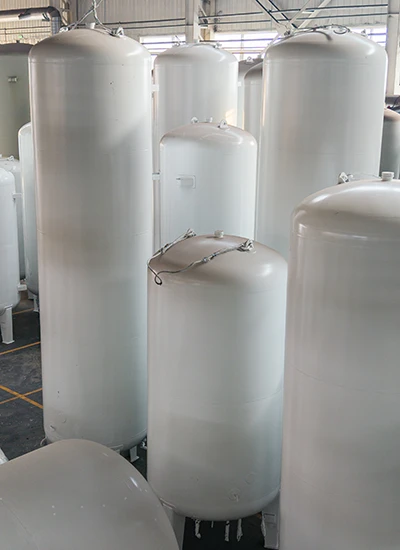
Cryogenic tanks are liquid tanks, tank containers, or cryogenic vessels with double-wall construction made of a stainless steel inner vessel and carbon steel outer vacuum jacket with MLI standard. Other options are single-wall vessels, insulated on non-insulated or triple-wall containers that store high-temperature gases like LNG, co2, and nitrous oxide. These are gas supply system parts used in various sectors, such as steel processing, medical technology, electronics, water treatment, energy production, and food handling.
What Are Cryogenic Tanks Made Of?
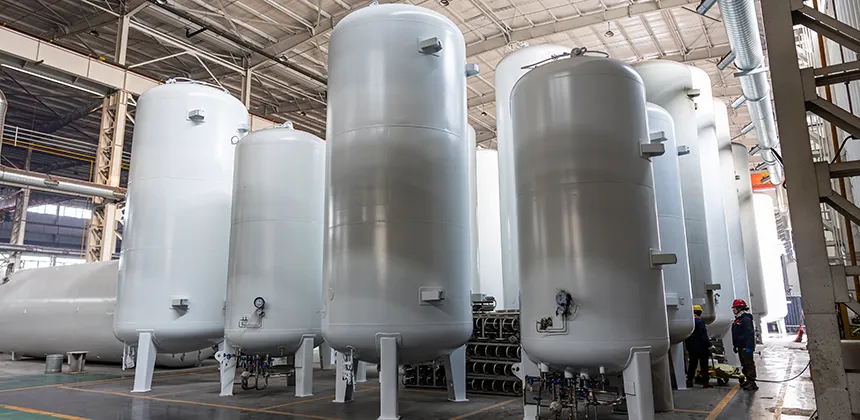
Cryogenic bulk tanks are engineered with a robust multi-layer structure to ensure safe operation under extreme temperatures and pressures. The design consists of three main components:
Inner Pressure Vessel
The inner vessel is typically made of stainless steel or nickel alloys, chosen for their excellent mechanical strength and resistance to brittle fracture at cryogenic temperatures. This vessel directly contains the liquefied gas.
Outer Vessel
The outer shell is usually constructed from carbon steel or stainless steel. It provides structural support and maintains the vacuum insulation layer. Unlike the inner vessel, it operates at ambient temperature.
Vacuum Insulation System
Between the two walls is a high-vacuum space combined with multilayer insulation (MLI). This system minimizes heat transfer via conduction, convection, and radiation, significantly reducing boil-off gas (BOG).
What Is the Pressure of a Cryogenic Tank?
The working pressure of cryogenic storage tanks typically ranges from 2 to 37 bar, depending on the application and stored medium. Tanks are equipped with pressure control systems, including:
- Pressure relief valves (PRVs)
- Pressure-building vaporizers
- Gas regulators
These systems ensure safe operation by maintaining stable internal pressure during storage and gas withdrawal.
What Is the Capacity of a Cryogenic Tank?
Cryogenic tanks are available in a wide range of capacities, typically from 3,000 liters to over 100,000 liters. Standard working pressures often include 18 bar, 22 bar, and 36 bar, depending on system design.
They can be configured as:
- Vertical cryogenic tanks (space-saving installations)
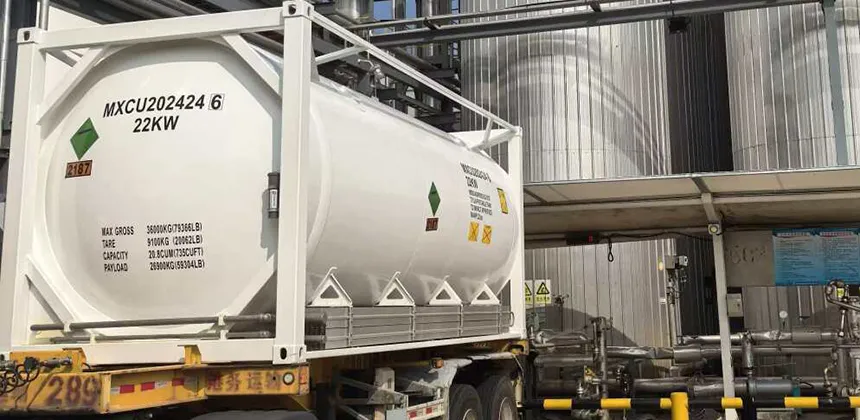
- Horizontal cryogenic tanks (transport and mobile use)
- ISO tank containers (international bulk transport)
Which Liquids Are Stored in Cryogenic Tanks?
Cryogenic tanks are designed to store liquefied gases with extremely low boiling points. The most commonly stored cryogenic fluids include:
- Liquid nitrogen (LN₂)
- Liquid oxygen (LOX)
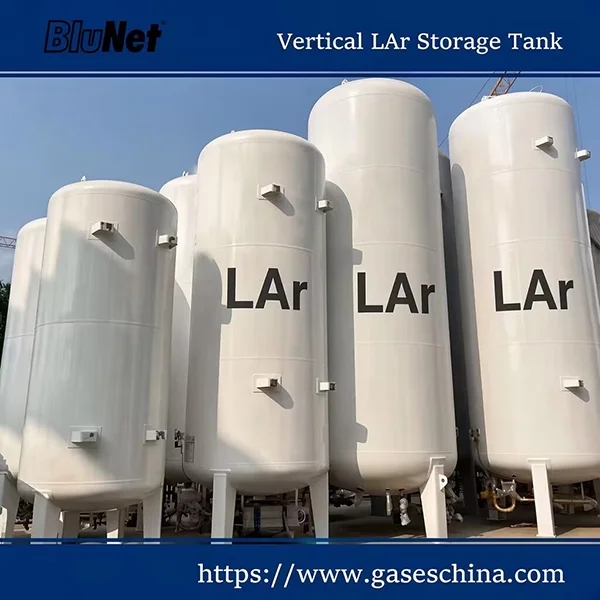
- Liquid argon (LAr)
- Liquefied natural gas (LNG)
- Liquid carbon dioxide (CO₂)
- Liquid hydrogen (LH₂)
- Liquid helium (LHe)
These gases are widely used across industries due to their efficiency in liquid form, enabling high-density storage and cost-effective transportation.
Cryogenic Fluids and Their Boiling Points
Cryogenic fluids with their boiling point in kelvins and degrees Celsius.
| Fluid | Boiling point (K) | Boiling point (°C) |
|---|---|---|
| Helium-3 | 3.19 | -269.96 |
| Helium-4 | 4.214 | -268.936 |
| Hydrogen | 20.27 | -252.88 |
| Neon | 27.09 | -246.06 |
| Nitrogen | 77.09 | -196.06 |
| Air | 78.8 | -194.35 |
| Fluorine | 85.24 | -187.91 |
| Argon | 87.24 | -185.91 |
| Oxygen | 90.18 | -182.97 |
| Methane | 111.7 | -161.45 |
Why Are Cryogenic Tanks Important?
Cryogenic tanks play a vital role in modern industry by enabling the safe storage, transport, and controlled use of liquefied gases. Their advanced insulation systems reduce energy loss, improve efficiency, and ensure compliance with safety standards.
From healthcare and food preservation to energy and semiconductor manufacturing, cryogenic tanks are essential infrastructure supporting global industrial operations.
Why Choose BluNet Cryogenic Tanks?
At BluNet, we deliver high-performance cryogenic storage solutions designed for safety, efficiency, and long-term reliability. Our tanks are engineered to meet international standards and demanding industrial applications.
- Advanced vacuum insulation for minimal boil-off loss
- Custom tank sizes from 3,000L to 100,000L+
- Compliance with global standards (ASME, CE)
- Reliable performance for LNG, LOX, LIN, and LAr
- Competitive pricing with direct manufacturer supply
Whether you need bulk storage, transport solutions, or customized cryogenic systems, our team provides expert support from design to delivery.
TECHNICAL FAQs
About Cryogenic Tank Structure, Types, and Applications
A cryogenic tank is used to store and transport liquefied gases such as liquid nitrogen, oxygen, argon, LNG, and carbon dioxide at extremely low temperatures below -150°C for industrial, medical, and energy applications.
Cryogenic tanks use a double-wall structure with vacuum insulation and multilayer insulation (MLI) to minimize heat transfer and reduce evaporation of liquefied gases.
Cryogenic tanks typically operate at pressures between 2 and 37 bar, depending on the gas type and application, and are equipped with safety systems such as pressure relief valves and vaporizers.
Cryogenic tanks are constructed with a stainless steel inner vessel for low-temperature performance and a carbon steel outer shell to provide structural support and maintain vacuum insulation.
Common gases stored in cryogenic tanks include liquid nitrogen, oxygen, argon, hydrogen, helium, LNG, and carbon dioxide, all maintained in liquid form at cryogenic temperatures.

No comment