

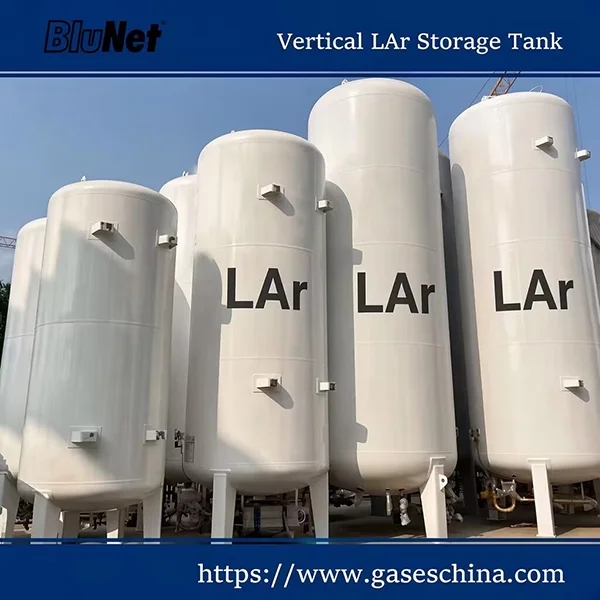
Cryogenic vaporizers are used to convert liquefied gases such as LNG, liquid nitrogen (LIN), liquid oxygen (LOX), and liquid argon (LAR) into gaseous form before distribution or use.
Two common vaporization technologies are ambient air vaporization and heated water-bath vaporization.
Ambient air vaporizers are attractive because they use naturally available atmospheric heat and require little operating energy. However, their continuous vaporization capacity is affected by ambient temperature, humidity, frost formation, and required outlet gas temperature.
Water-bath and other heated vaporizers can provide higher and more controllable heat-transfer capacity, making them suitable for continuous high-flow applications.
The key engineering question is therefore not simply whether one technology is “more efficient” but how much heat can be transferred continuously and reliably under the required operating conditions.
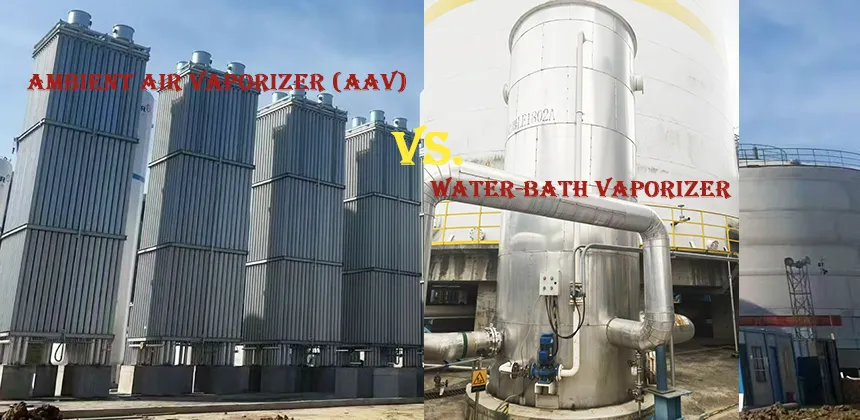
What Is a Cryogenic Vaporizer?
A cryogenic vaporizer is a heat exchanger designed to transfer heat into a cryogenic liquid so that the liquid changes into gas.
Typical cryogenic liquids include:
- Liquid nitrogen (LIN)
- Liquid oxygen (LOX)
- Liquid argon (LAR)
- Liquefied natural gas (LNG)
- Liquid carbon dioxide (LCO2)
The basic process is:
Cryogenic liquid → Heat exchanger → Heat input → Vaporized gas → Gas distribution system
Because cryogenic liquids are stored at extremely low temperatures,a substantial amount of heat must be supplied to achieve complete vaporization and, in many applications, to warm the gas to an acceptable outlet temperature.
The vaporizer therefore becomes an important component of the overall cryogenic storage tank and gas supply system.
How Does an Ambient Air Vaporizer Work?
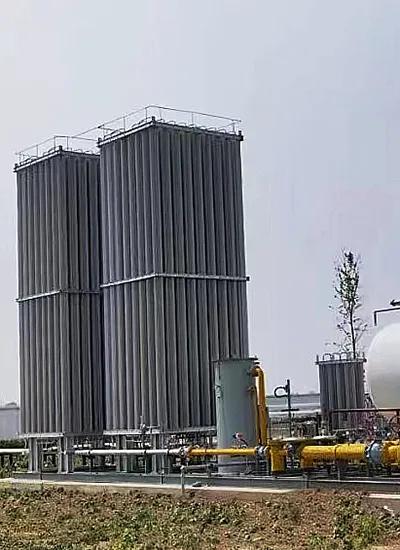
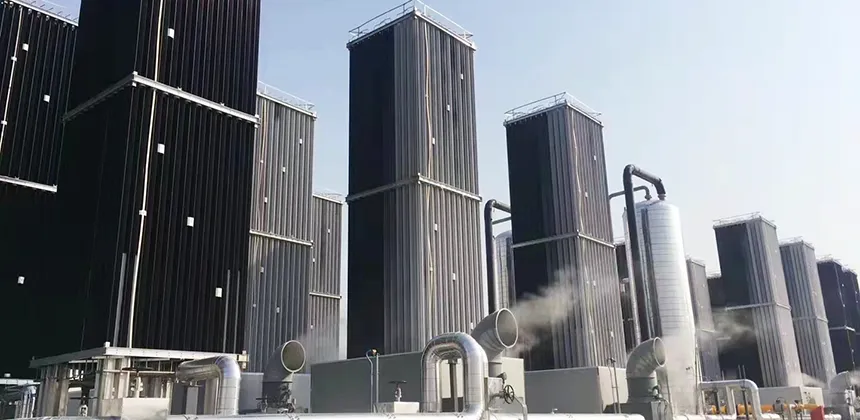
An Ambient Air Vaporizer (AAV) uses heat naturally available in the surrounding atmosphere.
The typical heat-transfer path is:
Ambient air → Aluminum fins → Heat-transfer tube → Cryogenic liquid
Cryogenic liquid flows through specially designed tubes while the surrounding air transfers heat through the external fins and tube walls.
Aluminum is commonly used because it provides high thermal conductivity, low weight, good low-temperature performance, and a large effective heat-transfer area when combined with finned structures.
Major advantages of ambient air vaporization include:
- Very low external energy consumption
- Simple system configuration
- Low operating cost
- Limited mechanical components
- Low routine maintenance requirements
Does an Ambient Air Vaporizer Have a Capacity Limit?
Yes. An ambient air vaporizer has a practical continuous capacity limit, although there is no single capacity number that applies to every installation.
Actual vaporization capacity depends on several operating and environmental factors:
- Ambient temperature
- Relative humidity
- Cryogenic liquid temperature
- Required outlet gas temperature
- Gas flow rate
- Heat-transfer surface area
- Fin design
- Air circulation
- Frost formation
- Allowable pressure drop
- Required continuous operating time
A simplified representation of heat-transfer capacity is:
Q ≈ U × A × ΔT
Where:
- Q = heat-transfer rate
- U = overall heat-transfer coefficient
- A = effective heat-transfer area
- ΔT = effective temperature difference
Increasing the heat-transfer area can increase capacity, but an ambient air vaporizer cannot completely escape the limitations imposed by the surrounding air.
This is why a vaporizer designed for one climate and operating condition may not deliver the same continuous performance under another set of conditions.
Why Does Frost Reduce Vaporizer Performance?
Frost formation is one of the most important limitations of ambient air vaporizers.
When cryogenic liquid flows through the vaporizer, the external surface temperature of the heat exchanger can become very low.
Moisture in the surrounding air can then:
Condense → Freeze → Form frost → Build an insulating layer
The heat-transfer path effectively becomes:
Ambient air → Frost/Ice → Aluminum surface → Tube wall → Cryogenic liquid
The frost layer introduces additional thermal resistance.
As frost becomes thicker, heat transfer becomes less effective.
- Heat transfer decreases.
- Vaporization capacity decreases.
- Outlet gas temperature may fall.
- Effective continuous operating capacity becomes lower.
- Long-duration operation may become difficult.
The engineering relationship can therefore be summarized as:
More frost → More thermal resistance → Less heat transfer → Lower vaporization capacity
For this reason, ambient air vaporizer performance should not be evaluated only under ideal warm-weather conditions.
Why Is Ambient Temperature Important?
The performance of an ambient air vaporizer is strongly influenced by the surrounding air temperature.
Consider two operating environments:
- Summer: +30°C
- Winter: -10°C
The available heat from the surrounding air is significantly different between these conditions.
A vaporizer operating in a warm environment generally has a greater thermal driving force than the same unit operating in a cold environment.
Engineering Note:
Rated capacity is not necessarily the same as guaranteed continuous capacity under all ambient conditions.
When selecting an ambient air vaporizer, engineers should consider the minimum design ambient temperature rather than simply using the average annual temperature.
Important design conditions may include:
- Minimum ambient temperature
- Maximum ambient temperature
- Relative humidity
- Frost allowance
- Required gas outlet temperature
- Required continuous operating duration
How Does a Water-Bath Cryogenic Vaporizer Work?
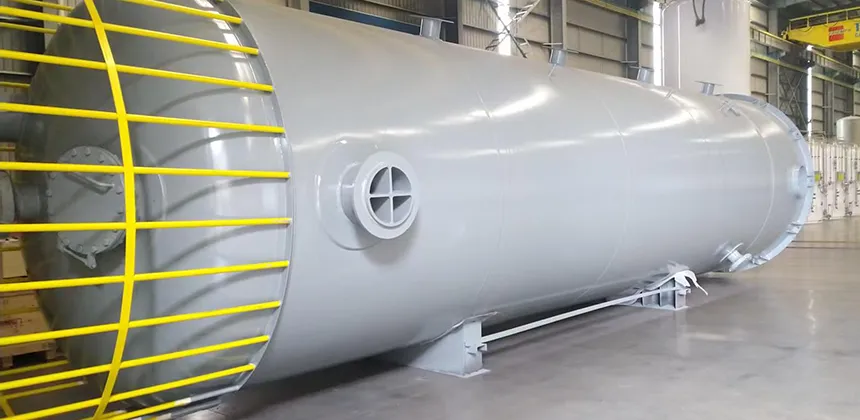
A water-bath vaporizer uses heated water or another controlled liquid medium as the heat-transfer source.
The basic heat-transfer path is:
Heated water → Heat-transfer tube → Cryogenic liquid
Instead of depending directly on atmospheric heat, the vaporizer receives heat from a controlled thermal medium.
Water has a much higher volumetric heat capacity than air and can provide substantially stronger convective heat transfer under suitable circulation conditions.
As a result, a water-bath vaporizer can transfer large quantities of heat through a relatively compact heat-transfer system.
This makes heated water-bath vaporizers particularly attractive for continuous high-flow cryogenic gas applications.
Is a Water-Bath Vaporizer More Efficient Than an Air Vaporizer?
The answer depends on how efficiency is defined.
If efficiency means heat-transfer capability per unit heat-transfer area, a heated water system can generally provide substantially higher heat-transfer performance than natural ambient air.
However, a water-bath vaporizer requires an external heat source.
This may require:
- Electrical energy
- Natural gas
- Steam
- Hot water
- Another controlled thermal energy source
An ambient air vaporizer, by comparison, can use atmospheric heat without a dedicated heating system.
Key Point:
Water-bath vaporizers generally provide higher and more controllable heat-transfer capacity, while ambient air vaporizers generally provide lower external energy consumption and simpler operation.
Ambient Air vs Water-Bath Vaporizer
| Parameter | Ambient Air Vaporizer | Water-Bath Vaporizer |
|---|---|---|
| Heat source | Atmospheric air | Heated water or liquid medium |
| Heat-transfer capability | Moderate | High |
| Continuous high-flow operation | Application dependent | Very suitable |
| Dependence on weather | High | Low |
| Frost formation | Important consideration | Much less critical |
| Outlet temperature stability | More variable | More controllable |
| External energy requirement | Very low | Higher |
| Operating cost | Generally low | Generally higher |
| System complexity | Low | Higher |
| Maintenance | Relatively low | Higher |
| Footprint for high capacity | Can become large | More compact for high duty |
| LNG applications | Suitable for many applications | Suitable for high-flow applications |
| LIN / LOX / LAR applications | Common | Suitable for high-duty systems |
When Is an Ambient Air Vaporizer Better ?
Ambient air vaporizers are often a good choice when:
- Gas demand is moderate.
- Ambient temperatures are suitable.
- Very low operating energy consumption is desired.
- Frost formation can be managed.
- Some variation in outlet temperature is acceptable.
- A simple and low-maintenance system is preferred.
- Sufficient space is available for the required heat-transfer surface.
They are particularly attractive for industrial gas installations where
continuous demand is relatively predictable and the climate is favorable.
For example, an ambient air vaporizer can be installed downstream of a
cryogenic storage tank to convert LIN, LOX, or LAR into gas for an
industrial distribution pipeline.
When Is a Water-Bath Vaporizer Better?
A heated water-bath vaporizer becomes more attractive when the application
requires:
- High continuous gas flow
- Stable outlet temperature
- Operation under low ambient temperatures
- Reduced dependence on weather
- High and controllable heat-transfer capacity
- Long-duration continuous operation
This can be particularly important for larger LNG storage systems and other cryogenic gas systems where interruption of gas supply is unacceptable.
For these applications, relying exclusively on naturally available
atmospheric heat may require a very large vaporizer surface area or may
result in insufficient performance during unfavorable weather conditions.
Other Types of Heated Cryogenic Vaporizers
Electric Vaporizers
Electric vaporizers use electrical heating elements to provide controlled heat input.
Advantages include:
- Precise temperature control
- Compact design
- Easy automation
However, electrical energy consumption can become significant at high vaporization rates.
Steam-Heated Vaporizers
Industrial steam can be used as the heat source where a suitable steam system is already available.
This approach can be effective in process plants and industrial facilities with existing steam infrastructure.
Gas-Fired Vaporizers
Natural gas or another fuel can provide the required thermal energy. These systems can support high vaporization duties but require appropriate combustion, safety, control, and emissions considerations.
Submerged Combustion Vaporizers
For large LNG installations, submerged combustion vaporizers can provide very high vaporization capacity by transferring combustion heat through a water bath.
These systems are more complex but can be suitable for high-throughput LNG regasification applications.
How Should Cryogenic Vaporizer Capacity Be Selected?
Selecting a cryogenic vaporizer based only on nominal flow rate is not sufficient.
The vaporizer should be evaluated as part of the complete cryogenic storage system and its operating envelope.
1. Required Gas Flow
Determine both the normal flow rate and maximum continuous flow rate.
Peak demand and continuous demand should not automatically be treated as the same design condition.
2. Cryogenic Fluid
Different cryogenic liquids have different thermodynamic properties. Vaporizer selection for LIN, LOX, LAR, LNG, and LCO2 should therefore be based on the actual fluid and operating conditions.
3. Inlet Pressure
Operating pressure affects boiling behavior, pressure drop, and overall vaporizer performance.
4. Required Outlet Temperature
Outlet temperature is a critical design parameter.
A system that only requires complete vaporization may have very different requirements from a system that requires the gas to leave the vaporizer at a controlled positive temperature.
5. Minimum Ambient Temperature
For an ambient air vaporizer, minimum design ambient temperature can be one of the most important capacity parameters.
6. Frost Formation
Humidity, ambient temperature, and operating duration should be considered when determining realistic continuous vaporization capacity.
7. Pressure Drop
The vaporizer should provide the required flow without creating excessive pressure loss in the cryogenic gas supply system.
The Key Difference: Passive vs Controlled Heat Input
The fundamental difference between the two technologies can be summarized by their heat-transfer paths.
Ambient Air Vaporizer
Cryogenic liquid ← Heat exchanger ← Ambient air
Heat input depends directly on the surrounding environment.
Heated Water-Bath Vaporizer
Cryogenic liquid ← Heat exchanger ← Heated water ← External heat source
Heat input can be actively controlled.
This distinction explains why ambient air vaporizers are attractive for low-energy applications while heated vaporizers become increasingly important as gas demand and reliability requirements increase.
Can an Ambient Air Vaporizer Be Used for Very High Flow Rates?
Yes, but there are practical limitations.
A large ambient air vaporizer can achieve high nominal flow rates by increasing the available heat-transfer surface area.
However, simply increasing the size does not eliminate:
- Frost formation
- Low ambient temperature
- Humidity effects
- Limited natural convection
- Outlet temperature limitations
- Large equipment footprint
For very high continuous flow rates, a heated vaporizer or a hybrid vaporization system may therefore be more practical.
In some installations, multiple ambient air vaporizers can also be installed in parallel to provide additional capacity and operational flexibility.
Hybrid Cryogenic Vaporization Systems
For demanding applications, a combination of vaporization technologies can provide a practical solution.
A typical configuration may be:
Cryogenic storage tank → Ambient air vaporizer → Heated trim vaporizer → Gas pipeline
The ambient air vaporizer performs most of the vaporization using atmospheric heat, while a smaller heated vaporizer provides additional heat when necessary to achieve the required outlet temperature.
This approach can reduce energy consumption while maintaining more stable gas delivery.
Hybrid systems can be particularly useful when:
- Normal demand is moderate.
- Peak demand is high.
- Ambient conditions vary significantly.
- Stable outlet temperature is required.
- Energy consumption needs to be controlled.
How to Choose Between Air and Water-Bath Vaporization
The selection should be based on the actual operating requirements rather than simply choosing the vaporizer with the highest nominal capacity.
| Application Requirement | Recommended Approach |
|---|---|
| Moderate gas demand | Ambient air vaporizer |
| Low operating energy requirement | Ambient air vaporizer |
| Warm or moderate climate | Ambient air vaporizer |
| High continuous flow | Heated water-bath or other heated vaporizer |
| Stable outlet temperature | Heated vaporizer |
| Cold ambient conditions | Heated or hybrid vaporization system |
| Variable demand | Hybrid or appropriately sized multi-stage system |
| Large LNG regasification duty | High-capacity heated vaporization technology |
Need Help Selecting a Cryogenic Vaporizer?
The correct vaporizer depends on the cryogenic medium, required gas flow, operating pressure, outlet temperature, ambient conditions, and continuous operating duty.
Conclusion
Ambient air vaporizers and water-bath vaporizers serve different engineering requirements.
Ambient air vaporizers offer a simple, low-energy solution by using naturally available atmospheric heat. However, their continuous capacity is affected by ambient temperature, humidity, frost formation, heat-transfer area, and outlet temperature requirements.
Water-bath and other heated vaporizers provide a more controlled heat source and can achieve higher and more stable heat-transfer capacity. Their main trade-off is higher system complexity and energy consumption.
Therefore, the right question is not:
“Is a water vaporizer more efficient than an air vaporizer?”
A better engineering question is:
“Which vaporization technology can provide the required continuous duty,
outlet temperature, and reliability under the actual operating conditions?”
For moderate gas demand and suitable climates, an ambient air vaporizer
can be an economical and reliable solution.
For high continuous flow, demanding outlet-temperature requirements,
cold climates, or applications where gas supply continuity is critical,
a heated or hybrid vaporization system may be the better choice.
Final vaporizer selection should always consider the
cryogenic fluid, flow rate, inlet pressure, outlet temperature, minimum ambient conditions, frost conditions, pressure drop, and required operating duty
rather than nominal capacity alone.
TECHNICAL FAQs
FAQs About High-Performance Liquid Nitrogen Vaporizer
Yes. The practical continuous capacity of an ambient air vaporizer is affected by ambient temperature, humidity, frost formation, heat-transfer surface area, cryogenic fluid properties, and required outlet gas temperature. Its rated capacity should therefore be evaluated together with the actual operating conditions.
Frost forms when moisture in the surrounding air freezes on the cold heat-transfer surfaces. As the frost layer becomes thicker, it adds thermal resistance and reduces heat transfer, which can lower the vaporization capacity and outlet gas temperature during continuous operation.
A water-bath vaporizer generally provides higher and more controllable heat-transfer capacity, but it requires an external heat source. Ambient air vaporizers use atmospheric heat and normally have much lower external energy requirements. The better technology depends on flow rate, climate, outlet temperature, and operating requirements.
Heated vaporizers are generally considered for high continuous flow rates, low ambient temperatures, stable outlet temperature requirements, or applications where reliable vaporization must be maintained independently of weather conditions.
Yes. Ambient air vaporizers can be used for LNG vaporization when the required flow rate, ambient conditions, outlet temperature, and operating duty are suitable. For high continuous LNG regasification duties, heated or hybrid vaporization systems may provide more stable performance.
Vaporizer capacity should be selected based on the cryogenic fluid, required gas flow, inlet pressure, outlet temperature, minimum ambient temperature, frost conditions, pressure drop, and required continuous operating time. Nominal flow capacity alone is not sufficient for final equipment selection.

No comment