


Cryogenic tank sizing is the process of determining the storage capacity, operating pressure, and supply configuration required to meet an industrial facility’s liquid gas demand. The right tank size depends on daily consumption, delivery frequency, peak demand, reserve requirements, vaporizer performance, and available installation space.
Choosing a tank based only on nominal capacity can lead to frequent deliveries, insufficient gas supply, unnecessary capital costs, or operational interruptions. This guide explains how to estimate cryogenic storage capacity, evaluate the main engineering factors, and select a suitable stationary tank for liquid oxygen (LOX), liquid nitrogen (LIN), liquid argon (LAr), liquid carbon dioxide (LCO₂), or liquefied natural gas (LNG), where the tank is designed for the relevant medium.
What Is Cryogenic Tank Sizing?
Cryogenic tank sizing involves matching a vacuum-insulated storage vessel to a facility’s actual gas consumption and operating requirements. Unlike a simple comparison of tank dimensions, sizing considers how much liquid must be available between deliveries and whether the complete supply system can deliver gas at the required flow rate and pressure.
A properly sized system should account for:
- Average and peak gas consumption
- Required storage autonomy between deliveries
- Usable liquid capacity and operating inventory limits
- Emergency reserve and delivery delays
- Required gas pressure and flow rate
- Vaporizer capacity and downstream equipment requirements
- Installation space, safety clearances, and future demand
For an overview of tank configurations, components, and industrial applications, see our cryogenic tanks guide.
Key Factors That Determine Cryogenic Tank Capacity
1. Daily Gas Consumption
Daily consumption is the starting point for calculating storage requirements. Use actual operating data whenever possible rather than relying only on equipment nameplate ratings or estimated production demand.
For an existing facility, review gas flow meters, production records, and historical delivery quantities. For a new installation, estimate demand from process equipment, operating hours, production schedules, and the expected utilization rate.
Because a cryogenic tank stores liquid rather than gas, gaseous consumption must be converted into an equivalent liquid quantity when the calculation begins with Nm³/day, Sm³/day, or another gas-volume unit. Use a conversion factor appropriate to the specific gas and the stated reference conditions.
For preliminary calculations, the daily liquid consumption can be expressed as:
Daily liquid consumption = Daily gas consumption ÷ Gas volume produced per unit of liquid volume
The gas-to-liquid expansion ratio is not identical for oxygen, nitrogen, argon, carbon dioxide, and LNG. Confirm the appropriate conversion basis with the gas supplier or process engineer before finalizing the tank capacity.
2. Delivery Frequency and Storage Autonomy
Storage autonomy is the number of days a facility must operate without receiving another liquid delivery. A site with reliable, frequent deliveries may need less inventory than a remote facility with longer transportation lead times.
Consider the normal delivery interval as well as potential delays caused by weather, road access, supplier availability, or production schedules. The reserve period should reflect the actual consequences of a supply interruption rather than an arbitrary number of days.
For example, a facility that consumes 2.4 m³ of liquid nitrogen per day and plans for five days of inventory requires 12 m³ of liquid for that period before accounting for peak demand, reserve assumptions, and usable tank capacity.
3. Peak Demand and Production Variations
Average daily consumption alone may underestimate the storage or supply capacity required by a plant. Batch processing, simultaneous equipment operation, seasonal production changes, and planned capacity expansion can increase demand above the normal operating level.
Review both total daily consumption and short-duration peak flow. A higher peak flow may require a larger vaporizer or a different supply-system configuration even when the daily liquid consumption remains unchanged.
Use measured peak demand or a justified engineering design factor. Do not apply an arbitrary peak factor without checking how it affects the required inventory and equipment performance.
4. Usable Capacity and Operating Limits
The nominal capacity of a cryogenic storage tank is not necessarily the amount of liquid available for normal process consumption. Filling limits, required vapor space, minimum operating inventory, pressure-management requirements, and the permitted operating range all affect usable capacity.
For preliminary sizing, an estimated usable-capacity fraction can be applied to the calculated liquid inventory. The fraction must be verified against the tank manufacturer’s design, filling limits, and operating procedures; it should not be treated as a universal value for every cryogenic liquid or tank.
Nominal tank capacity = Required liquid inventory ÷ Usable-capacity fraction
This calculation provides an initial estimate only. The selected vessel must also satisfy the applicable design code, pressure rating, filling restrictions, and project-specific operating requirements.
How to Calculate Cryogenic Storage Tank Capacity
A practical preliminary calculation can be completed in five steps.
- Determine daily liquid consumption. Convert measured or estimated gas demand into the equivalent liquid volume for the specific gas.
- Set the delivery interval. Determine how many days the tank must support normal operations between deliveries.
- Establish the reserve requirement. Add justified inventory for peak demand, delivery delays, or other identified operating risks.
- Account for usable capacity. Divide the required liquid inventory by the verified usable-capacity fraction.
- Select and verify the next suitable tank configuration. Check available nominal capacities, pressure rating, vaporizer performance, site constraints, and applicable regulations.
For a simplified estimate, where a peak-demand factor is applied to daily consumption and the reserve is expressed as additional days, the formula is:
Estimated nominal capacity (m³) = Daily liquid consumption (m³/day) × (Delivery interval + Reserve days) × Peak-demand factor ÷ Usable-capacity fraction
This formula is a preliminary inventory model, not a substitute for detailed engineering. The assumptions must be consistent with the facility’s actual operating profile, and the final design should consider minimum operating inventory, filling limits, boil-off, pressure requirements, and any other factors that affect available supply.
Cryogenic Tank Sizing Example
Consider an industrial facility that uses liquid nitrogen continuously and needs a preliminary storage estimate.
| Sizing parameter | Illustrative assumption |
|---|---|
| Daily liquid nitrogen consumption | 2.4 m³/day |
| Delivery interval | 4 days |
| Additional reserve | 1 day |
| Peak-demand factor | 1.20 |
| Assumed usable-capacity fraction | 90% (illustrative only) |
Step 1: Calculate the base inventory.
2.4 m³/day × (4 days + 1 reserve day) = 12 m³
Step 2: Apply the illustrative peak-demand factor.
12 m³ × 1.20 = 14.4 m³
Step 3: Account for the assumed usable-capacity fraction.
14.4 m³ ÷ 0.90 = 16 m³
The preliminary result is approximately 16 m³ of nominal storage capacity under these assumptions. A 20 m³ tank could be considered as a candidate for further engineering evaluation, subject to the actual usable inventory, filling limits, pressure requirements, delivery strategy, and site conditions.
Important: The values in this example are illustrative, not universal design recommendations. A larger nominal tank is not automatically the best solution. The final selection must be checked against the facility’s actual demand profile and the manufacturer’s verified technical specifications.
Why Pressure and Vaporizer Capacity Matter
Storage volume is only one part of cryogenic tank sizing. The supply system must also convert the stored liquid into gas and deliver it at the required pressure and flow rate.
Working Pressure
The required outlet pressure depends on the downstream process and distribution network. Tank operating pressure, pressure-building equipment, pressure regulators, piping losses, and safety devices must be evaluated as part of the complete system.
A tank with sufficient liquid inventory may still fail to meet process requirements if the pressure-control arrangement is unsuitable. The selected design pressure and working pressure must be appropriate for the stored medium and the applicable engineering code.
Vaporizer Flow Rate
The vaporizer must convert liquid into gas at a rate that meets the facility’s maximum required flow under the specified operating conditions. Its capacity depends on gas demand, inlet conditions, outlet pressure, ambient conditions for ambient vaporizers, and the intended operating cycle.
For plants with high or fluctuating demand, engineers may need to assess multiple vaporizers, standby capacity, or an alternative configuration. Tank capacity and vaporizer capacity should therefore be evaluated together rather than selected independently.
How Gas Type Affects Cryogenic Tank Selection
Different cryogenic liquids require different storage conditions, material compatibility, pressure arrangements, and safety measures. A tank intended for one medium should not automatically be assumed suitable for another.
| Stored medium | Typical applications | Sizing considerations |
|---|---|---|
| Liquid oxygen (LOX) | Healthcare, metal processing, industrial oxidation | Oxygen-compatible materials, oxygen-service cleanliness, demand profile, and delivery pressure |
| Liquid nitrogen (LIN) | Inerting, food processing, electronics, industrial cooling | Consumption rate, delivery frequency, gas purity, and required vaporizer output |
| Liquid argon (LAr) | Welding, metallurgy, inert atmospheres | Process flow, purity requirements, and operating pressure |
| Liquid carbon dioxide (LCO₂) | Food and beverage processing, industrial processes | CO₂-specific pressure and temperature conditions, product quality, and delivery demand |
| Liquefied natural gas (LNG) | Industrial fuel supply, gas distribution, energy applications | Fuel demand, gasification rate, operating pressure, and LNG-specific safety requirements |
The tank, valves, instrumentation, piping, and associated equipment must be designed for the intended medium. Material compatibility and applicable safety requirements should be confirmed during engineering review.
Vertical vs. Horizontal Cryogenic Tanks
After estimating the required capacity, consider the tank orientation and installation arrangement.
Vertical Cryogenic Tanks
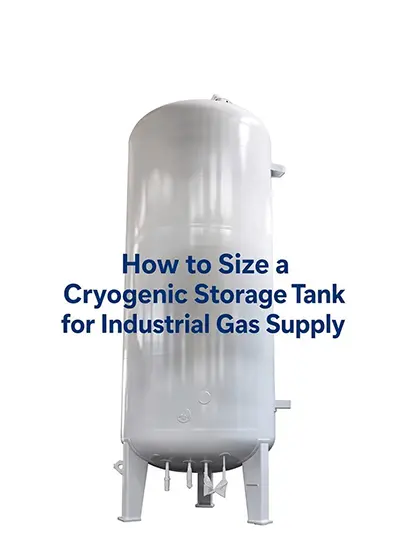
Vertical tanks can reduce the ground footprint and are often suitable for industrial sites with adequate installation height. They may be appropriate for facilities that need substantial storage capacity within a relatively compact area.
Horizontal Cryogenic Tanks
Horizontal tanks may suit sites with height restrictions or projects where the installation and transportation arrangement favors a lower-profile vessel. The required foundation, access, piping layout, and maintenance clearances should be evaluated before choosing the configuration.
To compare available capacities and technical specifications, visit our stationary cryogenic tank sizes guide.
Common Cryogenic Tank Sizing Mistakes
- Using average consumption alone: Ignoring peak demand can leave the supply system unable to support production during high-use periods.
- Confusing nominal capacity with usable inventory: Filling restrictions and minimum operating levels affect how much liquid is available to the process.
- Ignoring delivery uncertainty: A tank sized for an ideal delivery schedule may not provide enough reserve when deliveries are delayed.
- Checking storage volume but not vaporizer output: Sufficient liquid inventory does not guarantee adequate gas flow or outlet pressure.
- Choosing a tank without confirming gas compatibility: The vessel and associated equipment must be designed for the intended cryogenic medium.
- Overlooking future demand: Planned production increases should be considered without automatically oversizing the initial installation.
- Ignoring site and code requirements: Foundation loads, clearances, access, pressure-vessel regulations, and emergency provisions affect the final design.
How to Choose the Right Cryogenic Storage Tank
Before requesting a quotation, prepare the basic operating information needed for a technically suitable recommendation.
- Stored gas and required purity
- Average daily consumption and maximum instantaneous flow
- Required operating pressure and outlet pressure
- Preferred delivery interval and reserve requirement
- Indoor or outdoor installation conditions and available footprint
- Applicable design codes and certification requirements
- Vaporizer configuration and expected future demand
BluNet supplies cryogenic storage tanks and related equipment for industrial gas applications. Depending on the project, a suitable configuration may include a stationary storage tank, vaporizer, pressure-control equipment, instrumentation, and associated piping.
Explore our cryogenic liquid tanks to review available product options. For a project-specific recommendation, provide your gas type, consumption data, required pressure, delivery schedule, and installation conditions so the proposed configuration can be evaluated against your actual requirements.
TECHNICAL FAQs
About Stationary Cryogenic Tank Sizes
Start with daily liquid consumption, multiply it by the required delivery interval plus any justified reserve period, and account for peak demand and usable tank capacity. The result is a preliminary estimate that must be checked against operating limits and engineering requirements.
Key inputs include gas type, average and peak consumption, delivery frequency, reserve requirements, required operating pressure, vaporizer output, installation constraints, and applicable regulations.
No. A larger tank may reduce delivery frequency, but it can increase capital costs and installation requirements. The best capacity balances supply reliability, usable inventory, delivery logistics, operating costs, and site limitations.
It should. Storage capacity determines how much liquid is available, while the vaporizer and pressure-control system determine whether the facility can receive gas at the required flow rate and pressure. Both must be evaluated as part of the complete supply system.
Cryogenic tank sizing focuses on calculating the capacity and system configuration needed for a particular application. Cryogenic tank sizes focuses on the nominal capacities, dimensions, pressure ratings, and available models. Use the stationary cryogenic tank sizes guide to compare available specifications.
Conclusion
Accurate cryogenic tank sizing starts with actual gas consumption and a realistic delivery schedule. Peak demand, reserve inventory, usable capacity, pressure requirements, vaporizer output, and site conditions must also be considered before selecting a nominal tank volume.
By evaluating the storage vessel and its supporting equipment as one system, industrial facilities can improve supply reliability, manage delivery costs, and avoid capacity mismatches. BluNet can help industrial buyers review cryogenic storage tank options based on their gas type, consumption profile, and project requirements.

No comment