

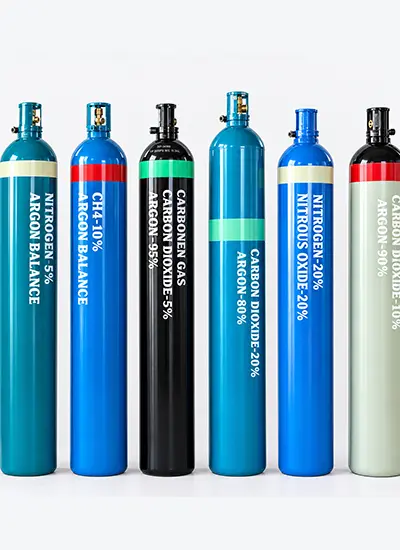
Welding shielding gas mixtures play an important role in arc stability, weld-pool protection, penetration, and overall weld quality. By combining gases such as argon, helium, hydrogen, nitrogen, oxygen, and carbon dioxide, welders can adjust the welding environment to suit different metals and welding processes.
The appropriate welding gas mixture depends on the base material, welding process, material thickness, filler metal, joint design, and required weld properties. This guide explains six common argon-based shielding gas combinations, their characteristics, and the factors to consider when selecting a mixture for industrial welding.
Why Are Mixed Shielding Gases Used in Welding?
During arc welding, shielding gas helps protect the molten weld pool and, depending on the process, the hot electrode or filler metal from atmospheric contamination. Oxygen, nitrogen, and moisture in the surrounding air can contribute to oxidation, porosity, or other weld defects when protection is inadequate.
Different gases have different physical and chemical properties. Argon provides an inert shielding atmosphere, while helium can increase heat transfer. Hydrogen and oxygen can alter arc and weld-pool behavior under suitable conditions. Carbon dioxide is an active shielding gas commonly used in gas metal arc welding of steels, while nitrogen has specific applications in selected materials and welding procedures.
Blending these gases allows manufacturers to balance several performance factors, including:
- Arc stability: Maintaining a consistent welding arc under the selected operating conditions.
- Heat transfer and penetration: Adjusting the heat delivered to the workpiece and the resulting weld profile.
- Weld-pool behavior: Influencing wetting, fluidity, and bead formation.
- Metal transfer and spatter: Affecting how filler metal transfers across the arc and how much spatter is produced.
- Weld integrity: Supporting the required mechanical and metallurgical properties when the gas is compatible with the material and welding procedure.
No single shielding gas mixture is suitable for every welding application. Gas selection should follow a qualified welding procedure and the requirements of the base metal and filler metal.
Common Types of Welding Shielding Gas Mixtures
Argon-based shielding gas mixtures are widely used in industrial welding because argon can provide a stable inert atmosphere for many applications. Adding another gas changes the mixture’s thermal, chemical, or arc characteristics.
The following table summarizes six combinations and their typical applications.
| Gas Mixture | Typical Applications | Main Characteristics |
|---|---|---|
| Argon–Helium (Ar–He) | Selected aluminum, copper, and other highly conductive metal applications | Higher heat transfer and potential for increased penetration |
| Argon–Hydrogen (Ar–H₂) | Selected austenitic stainless steel welding applications | Can increase heat input and welding speed in suitable procedures |
| Argon–Nitrogen (Ar–N₂) | Selected copper and copper-alloy applications | Provides application-specific shielding and weld-pool characteristics |
| Argon–Oxygen (Ar–O₂) | Selected steel gas metal arc welding applications | Can improve arc stability and weld-pool wetting |
| Argon–Carbon Dioxide (Ar–CO₂) | Carbon and low-alloy steel gas metal arc welding | Influences penetration, metal transfer, spatter, and weld-metal properties |
| Argon–CO₂–Oxygen (Ar–CO₂–O₂) | Selected steel welding procedures | Combines active-gas additions to adjust arc and weld-pool behavior |
Note: Applications are indicative, not universal recommendations. The suitable gas composition depends on the welding process, base material, filler metal, transfer mode, and qualified welding procedure.

1. Argon–Helium (Ar–He) Welding Gas Mixtures
Argon–helium mixtures are used in selected applications involving aluminum, copper, and other metals with high thermal conductivity. Argon provides an inert shielding atmosphere, while helium has a higher thermal conductivity and can increase heat transfer to the workpiece.
Depending on the welding process and operating conditions, adding helium can support deeper penetration, higher travel speeds, or improved welding performance on thicker sections. However, helium also affects arc characteristics, gas consumption, and process cost.
The required argon-to-helium ratio depends on the material, thickness, joint configuration, and welding method. Different proportions may be appropriate for different aluminum welding procedures, so a single ratio should not be treated as a universal specification.
Typical applications: Selected aluminum and copper-alloy welding operations, including applications where additional heat transfer is beneficial.
2. Argon–Hydrogen (Ar–H₂) Welding Gas Mixtures
Argon–hydrogen mixtures are used in selected welding applications, particularly certain austenitic stainless steel procedures. Hydrogen can influence arc energy, heat transfer, and weld-pool behavior, potentially supporting higher welding speeds or improved productivity under suitable conditions.
Hydrogen is not appropriate for every metal. Depending on the base material, filler metal, and welding conditions, it can increase the risk of hydrogen-related cracking, embrittlement, or other weld defects. Its use therefore requires careful material compatibility assessment and adherence to the applicable welding procedure.
Hydrogen concentration should not be selected using a general percentage range alone. The appropriate composition depends on the specific grade of stainless steel, the welding process, and the required weld properties.
Typical applications: Selected austenitic stainless steel welding operations using a procedure qualified for hydrogen-containing shielding gas.
3. Argon–Nitrogen (Ar–N₂) Welding Gas Mixtures
Argon–nitrogen mixtures are used in selected applications where nitrogen can provide useful process or metallurgical effects. Certain copper and copper-alloy welding operations may benefit from nitrogen-containing shielding atmospheres, depending on the material and welding procedure.
Nitrogen does not function as a universal replacement for helium or pure argon. Its suitability depends on how it interacts with the base metal, filler metal, and molten weld pool. Incompatible gas compositions may adversely affect weld quality or the properties of the finished joint.
Before choosing an argon–nitrogen mixture, evaluate the alloy composition, required mechanical properties, and applicable welding procedure. Material-specific testing may be necessary to confirm performance.
Typical applications: Selected copper and copper-alloy welding applications where nitrogen-containing shielding gas is appropriate.
4. Argon–Oxygen (Ar–O₂) Welding Gas Mixtures
Argon–oxygen mixtures are used in selected gas metal arc welding applications, particularly for certain steels. Although argon is inert, a controlled oxygen addition makes the mixture more chemically active and changes the behavior of the arc and molten weld pool.
Small oxygen additions can improve arc stability and weld-pool wetting under suitable conditions. These effects can support more consistent bead formation and metal transfer when the mixture is compatible with the wire, material, and welding parameters.
Oxygen concentration must be controlled carefully. Excessive or unsuitable oxygen can increase oxidation and negatively affect weld-metal properties. Do not assume that a high-oxygen mixture is appropriate for ordinary steel welding without specific technical guidance and a qualified procedure.
Typical applications: Selected steel gas metal arc welding procedures requiring controlled arc behavior and weld-pool wetting.
5. Argon–Carbon Dioxide (Ar–CO₂) Welding Gas Mixtures
Argon–carbon dioxide mixtures are widely used for gas metal arc welding (GMAW), also known as MIG welding, of carbon and low-alloy steels. Argon provides the principal inert component, while carbon dioxide contributes active-gas characteristics that affect the arc, metal transfer, and penetration.
Changing the carbon dioxide proportion can alter arc stability, weld profile, spatter, and weld-metal properties. A mixture designed for one transfer mode or wire specification may not provide the same results under different operating conditions.
Compared with pure carbon dioxide shielding, an argon-rich mixture may offer different metal-transfer behavior and spatter characteristics. The actual results depend on gas composition, welding current, voltage, wire diameter, electrode type, and transfer mode.
For production welding, gas selection should be coordinated with the filler metal manufacturer’s recommendations and the qualified welding procedure.
Typical applications: Carbon and low-alloy steel fabrication, structural welding, and other suitable GMAW operations.
6. Argon–Carbon Dioxide–Oxygen (Ar–CO₂–O₂) Mixtures
Argon–carbon dioxide–oxygen mixtures combine argon with two active gases to adjust shielding behavior for selected steel welding applications. Depending on the formulation, these additions can influence arc stability, metal transfer, weld-pool wetting, and bead formation.
The effects of carbon dioxide and oxygen are not interchangeable, and the proportions of both gases must be considered. The suitability of a three-component mixture also depends on the welding wire, base metal, transfer mode, and required weld properties.
Because the combined composition affects several process variables, it should be selected using qualified welding procedures or application-specific technical recommendations rather than a generic gas ratio.
Typical applications: Selected steel GMAW procedures where the specified three-component shielding gas has been validated for the application.
How to Select the Right Welding Gas Mixture
Selecting the correct shielding gas involves more than comparing gas prices or choosing a commonly used blend. The mixture must be compatible with the material, welding process, and performance requirements of the finished joint.
Identify the Base Material
Start by identifying the material grade and its metallurgical characteristics. Aluminum, copper, stainless steel, carbon steel, and nickel alloys can respond differently to the same shielding gas. A mixture suitable for one alloy may cause unacceptable defects or changes in weld properties when used on another.
Confirm the Welding Process
Determine whether the application uses gas tungsten arc welding (GTAW/TIG), gas metal arc welding (GMAW/MIG), or another process. Each process has different shielding requirements. A gas blend suitable for one process should not automatically be assumed suitable for another.
Consider Material Thickness and Joint Design
Material thickness, joint geometry, welding position, and required penetration all influence shielding gas selection. Some applications benefit from increased heat transfer, while others prioritize controlled heat input, bead appearance, or the prevention of distortion.
Evaluate Filler Metal and Required Weld Properties
The filler metal and required mechanical or corrosion-resistance properties can limit the gas compositions that are acceptable. Hydrogen, oxygen, carbon dioxide, and nitrogen may affect weld chemistry or defect risk in different ways. Confirm compatibility with the filler metal manufacturer’s guidance and the applicable welding procedure.
Balance Weld Quality, Productivity, and Cost
Gas consumption, welding speed, spatter, rework, and finished weld quality all contribute to the total cost of welding. A lower-cost gas may not be the most economical choice if it increases defects or slows production. Evaluate performance under representative operating conditions before making a production change.
Are Welding Gas Mixture Ratios Standardized?
Welding shielding gas compositions are available in different formulations, but no single set of proportions is appropriate for every application. Commonly discussed mixtures can contain different percentages of argon, helium, hydrogen, oxygen, or carbon dioxide depending on the welding process and material.
For example, an argon–helium blend selected for aluminum welding may have different requirements from a blend used on a thick copper component. Likewise, a hydrogen-containing mixture for a qualified stainless steel procedure should not be transferred to another alloy without checking compatibility.
When reviewing a gas specification, confirm:
- The identity and proportion of each gas component.
- The required gas purity and applicable supply specification.
- The welding process and base material covered by the procedure.
- The filler metal and transfer mode, where applicable.
- The welding procedure qualification and any relevant standards or project requirements.
A quoted gas percentage should always be interpreted in its application context. Neither a single hydrogen threshold nor a generic helium or oxygen range can establish suitability for every material and welding condition.
Choosing a Welding Shielding Gas for Your Application
The appropriate welding shielding gas mixture depends on the base metal, welding process, material thickness, filler metal, and required weld properties. Argon–helium mixtures are considered for selected applications involving highly conductive metals, while argon-based mixtures containing hydrogen, nitrogen, oxygen, or carbon dioxide serve different process and material requirements.
Before selecting a mixture, evaluate arc stability, penetration, weld-pool behavior, defect risk, productivity, and compatibility with the qualified welding procedure. Correct gas selection can support consistent weld quality and help reduce unnecessary rework and operating costs.
For industrial gas supply requirements, review the relevant industrial argon gas information and confirm that the available gas specification matches your welding application. You can also consult the relevant argon gas category if that cross-domain product resource is intentionally part of your purchasing journey.
For application-specific requirements, consult a qualified welding engineer or gas supplier before changing the shielding gas composition used in an established welding procedure.

No comment