

BluNet manufactures ISO tank containers for the safe transportation and temporary storage of cryogenic gases, liquefied gases, and bulk liquids. Our manufacturing process integrates pressure vessel fabrication, ISO container frame construction, vacuum insulation, piping and valve installation, pressure testing, leak inspection, and final quality control.
We manufacture standard and customized ISO tank container solutions for industrial gas suppliers, LNG logistics, chemical producers, energy companies, and international transportation applications. Depending on the product and operating conditions, ISO tanks can be engineered for LNG, liquid nitrogen, liquid oxygen, liquid argon, carbon dioxide, and other compatible products.
What Is an ISO Tank Container?
An ISO tank container is a pressure vessel installed inside a standardized intermodal container frame. The frame allows the tank to be handled and transported using existing road, rail, and marine container infrastructure without transferring the bulk product between transport vessels.
Cryogenic ISO tank containers use double-wall construction and vacuum insulation to reduce heat transfer and maintain low temperatures during transportation and storage. For cryogenic applications, the inner vessel, insulation system, pressure-control equipment, safety devices, and structural frame must be designed as an integrated system.
For a broader technical explanation, see our ISO Tank Container Guide.
ISO Tank Container Types We Manufacture
| ISO Tank Type | Typical Products | Typical Applications |
|---|---|---|
| T75 Cryogenic ISO Tank | LIN, LOX, LAr, LNG | Cryogenic gas transportation and distribution |
| LNG ISO Tank Container | Liquefied Natural Gas | LNG logistics, energy supply and marine applications |
| Liquid Nitrogen ISO Tank | LIN / LN2 | Industrial gas distribution, food processing and laboratories |
| Liquid Oxygen ISO Tank | LOX | Medical oxygen and industrial gas supply |
| Liquid Argon ISO Tank | LAr | Welding, metallurgy and industrial gas distribution |
| Custom ISO Tank Container | Project-specific media | Specialized transportation and bulk liquid applications |
ISO Tank Container Manufacturing Process
Our manufacturing process combines pressure vessel fabrication with container-frame engineering and cryogenic insulation technology. Each stage is controlled to ensure dimensional accuracy, structural integrity, pressure performance, and reliable operation.
1. Engineering Design
The manufacturing process begins with engineering specifications covering tank capacity, design pressure, operating temperature, product characteristics, insulation requirements, transport configuration, piping arrangement, and applicable regulations.
2. Material Selection
Materials are selected according to the service temperature, pressure, corrosion resistance, mechanical strength, and product compatibility. Cryogenic vessels commonly use austenitic stainless steel for the inner vessel, while the outer structure and frame are selected according to mechanical and environmental requirements.
3. Tank Vessel Fabrication
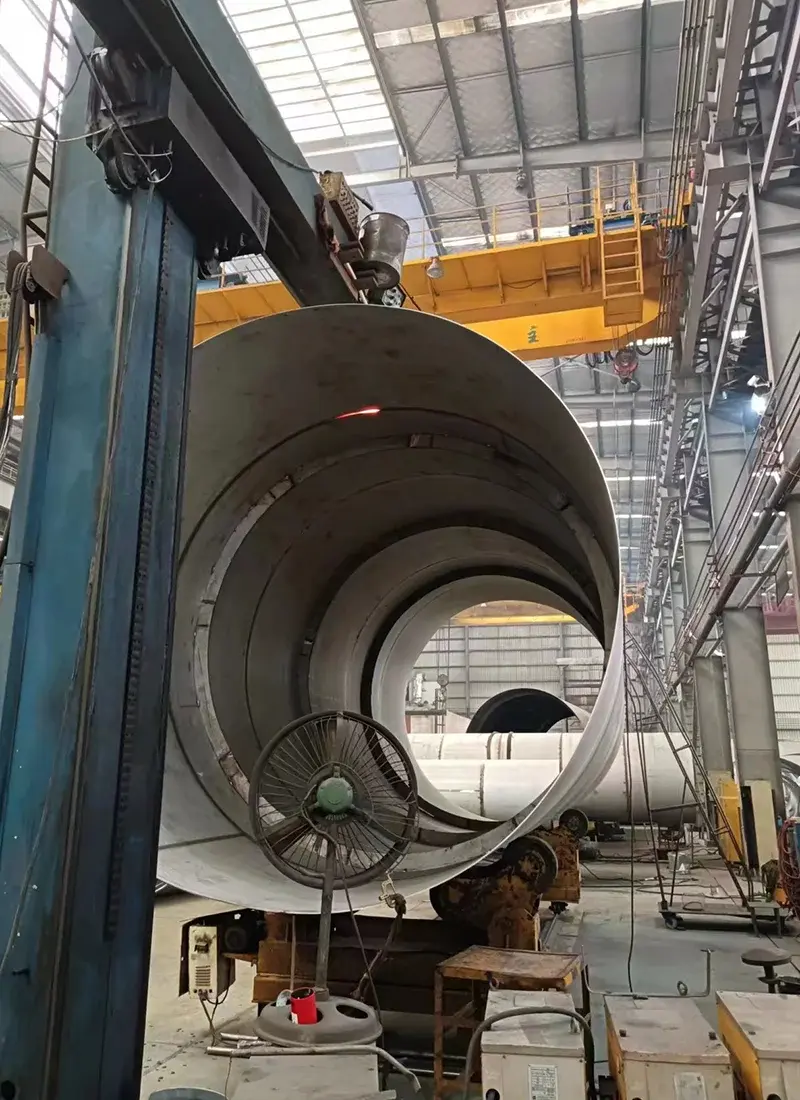
The pressure vessel is formed and welded according to the approved engineering design. Welding procedures, dimensional control, joint quality, and material traceability are monitored throughout fabrication.
4. ISO Frame Fabrication
The tank is integrated with a high-strength ISO container frame designed for lifting, securing, stacking, and multimodal transportation. Frame dimensions and structural interfaces are controlled to support international intermodal handling.
5. Vacuum Insulation System
For cryogenic ISO tanks, the insulation system is designed to minimize heat ingress and product evaporation. Depending on the configuration, vacuum insulation and multilayer insulation technology can be integrated into the annular space.
6. Piping, Valves and Safety Systems
Process piping, filling and discharge connections, pressure-building circuits, pressure relief devices, isolation valves, gauges, and other safety components are installed according to the approved system design.
7. Pressure and Leak Testing
Manufactured tanks undergo appropriate pressure, leak, and inspection procedures before final delivery. Cryogenic configurations can also undergo vacuum and insulation-performance verification to confirm the integrity of the thermal system.
8. Final Inspection and Certification
Final inspection verifies vessel condition, weld quality, dimensions, valves, safety devices, markings, documentation, and transportation configuration. Certification and third-party inspection can be arranged according to project requirements.
Cryogenic ISO Tank Manufacturing Technology
| Manufacturing Technology | Purpose |
|---|---|
| Pressure Vessel Welding | Creates the pressure boundary and maintains structural integrity |
| Vacuum Insulation | Reduces heat transfer and cryogenic product loss |
| Multilayer Insulation | Improves thermal insulation performance in the vacuum space |
| Precision Piping Assembly | Provides controlled filling, discharge, pressure building and gas handling |
| Pressure Relief Systems | Provides controlled pressure protection during operation and transportation |
| Leak Detection | Verifies pressure boundary and insulation-system integrity |
| Dimensional & Structural Inspection | Confirms frame geometry and mechanical requirements |
ISO Tank Container Specifications
ISO tank containers can be engineered according to the required product, capacity, pressure rating, temperature range, insulation system, and transportation regulations. A typical cryogenic configuration may include a 20-ft ISO frame, stainless-steel inner vessel, vacuum insulation, pressure-control equipment, and integrated safety systems.
| Parameter | Typical Configuration |
|---|---|
| Container Length | 20 ft or 40 ft |
| Tank Type | Vacuum-insulated pressure vessel |
| Inner Vessel Material | Austenitic stainless steel for cryogenic service |
| Design Temperature | Application dependent; cryogenic configurations can reach approximately -196°C |
| Insulation | Vacuum and multilayer insulation |
| Transport Modes | Road, rail and marine |
| Pressure Rating | Selected according to product and project requirements |
For an example of a 20-ft cryogenic configuration, our existing product specification includes a 20.8 m³ gross vessel, 1.6 MPa design pressure, -196°C design temperature, vacuum insulation, and ISO T75 portable-tank configuration.
Quality Control and Testing
Quality control is integrated throughout the ISO tank manufacturing process rather than performed only at the final stage. Inspection requirements are established during engineering and maintained through material receiving, fabrication, welding, assembly, testing, and final inspection.
- Raw material inspection and traceability
- Dimensional inspection
- Welding procedure and weld quality control
- Pressure testing
- Leak testing
- Vacuum inspection for cryogenic tanks
- Valve and piping inspection
- Safety device verification
- Surface treatment and coating inspection
- Final dimensional and structural inspection
- Documentation and certification review
ISO Tank Container Standards and Compliance
ISO tank containers are subject to requirements covering container dimensions, pressure vessel construction, transportation, dangerous goods, and operational safety. The exact standards and approvals depend on the tank type, cargo, destination country, and transportation mode.
| Standard / Regulation | Typical Relevance |
|---|---|
| ISO 1496-3 | Container requirements for tank containers |
| ISO 668 | Container dimensions and classifications |
| ADR | International road transportation of dangerous goods in applicable regions |
| RID | International rail transportation of dangerous goods |
| IMDG Code | International maritime transport of dangerous goods |
| CSC | Safety requirements for containers used in international transport |
| ASME | Pressure vessel design and fabrication where specified |
Actual certification and approval requirements are determined according to the final design, product classification, jurisdiction, and intended transportation routes. Third-party inspection can be arranged where required.
Applications of ISO Tank Containers
Industrial Gas Transport
Bulk transportation of liquid nitrogen, oxygen, argon and other industrial gases between production facilities, distributors and end users.
LNG Logistics
Transportation and distribution of LNG between terminals, industrial facilities, fueling infrastructure and remote users.
Medical Gas Supply
Bulk liquid oxygen and nitrogen transportation for healthcare and medical gas supply chains.
Food Processing
Transportation of cryogenic products used for food freezing, cooling and temperature-controlled processing.
Chemical Logistics
Intermodal transportation of compatible bulk chemicals and liquefied products using specialized ISO tank configurations.
Energy & Clean Fuel
LNG and other low-temperature liquid transportation applications supporting energy distribution and emerging clean-fuel infrastructure.
Why Choose BluNet for ISO Tank Manufacturing?
| Capability | Customer Benefit |
|---|---|
| Pressure Vessel Engineering | Integrated vessel design for pressure and temperature requirements |
| Cryogenic Technology | Vacuum insulation and thermal-performance engineering |
| ISO Frame Manufacturing | Intermodal transportation and handling compatibility |
| Integrated Assembly | Tank, frame, valves, piping and safety systems supplied as one engineered unit |
| Testing & Inspection | Verification of pressure, leakage, structural and thermal performance |
| Custom Engineering | Configurations adapted to product, capacity, pressure and transport requirements |
Custom ISO Tank Container Manufacturing
Different gases and transportation routes require different tank configurations. BluNet can develop ISO tank containers according to required capacity, design pressure, operating temperature, insulation performance, filling and discharge arrangement, safety devices, frame configuration, and applicable transportation regulations.
For project-based orders, customers can provide the product being transported, required capacity, working pressure, design temperature, preferred tank size, destination market, transportation modes, and required certifications. Our engineering team can then establish the appropriate tank configuration and manufacturing specification.
ISO Tank Container Manufacturing vs. Conventional Bulk Transport
| Factor | ISO Tank Container | Conventional Bulk Transport |
|---|---|---|
| Transport Modes | Road, rail and marine | Depends on equipment |
| Cargo Handling | Intermodal handling without transferring cargo | May require additional transfer operations |
| Cryogenic Insulation | Available with vacuum-insulated construction | Configuration dependent |
| Mobility | Designed for intermodal logistics | Often dedicated to a transport method |
| Bulk Capacity | Suitable for bulk transportation | Varies by transport system |
Request an ISO Tank Container Manufacturing Solution
Tell us the product, required capacity, working pressure, operating temperature, transportation route, and certification requirements. BluNet can provide an engineered ISO tank container configuration for your application.