

LNG tank manufacturers serve a wide range of applications, from large-scale LNG terminals and storage facilities to small and medium-scale LNG storage, fueling stations, transportation systems, and marine LNG applications.
However, LNG tank manufacturers do not all specialize in the same type of equipment. Some focus on large site-built LNG storage tanks for terminals, while others manufacture factory-built cryogenic tanks, LNG transport equipment, marine fuel tanks, or integrated LNG storage systems.
This guide reviews major LNG tank manufacturers and explains the types of LNG storage and transportation equipment they are associated with. It also highlights BluNet’s specialization in small- and medium-scale LNG storage tanks and integrated LNG tank skid systems for industrial, commercial, fueling, distribution, and modular LNG applications.
The companies discussed in this guide are not presented as a universal ranking. Instead, they are considered according to their documented LNG or cryogenic equipment capabilities, application areas, project experience, and product scope. The most suitable manufacturer depends on the required capacity, tank configuration, application, standards, site conditions, and project delivery requirements.
What Is an LNG Tank?
An LNG tank is a cryogenic storage or transportation vessel designed to contain liquefied natural gas at temperatures close to -162°C (-260°F).
At cryogenic temperatures, natural gas is maintained in liquid form and occupies much less volume than the equivalent amount of natural gas in its gaseous state. LNG tanks therefore require specialized materials, insulation, pressure-control systems, safety equipment, and instrumentation.
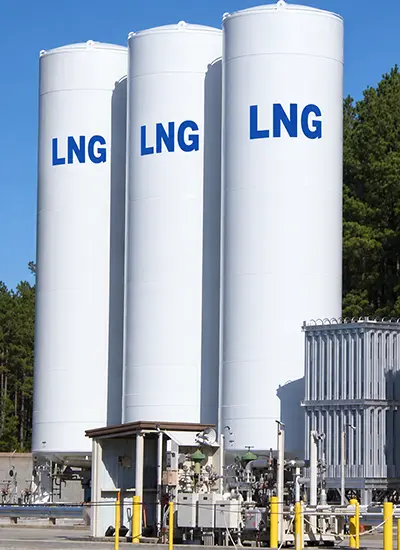
The design of an LNG tank depends on its intended application. A small LNG fueling station may use a factory-manufactured vacuum-insulated pressure vessel, while a large LNG receiving terminal may use a site-built double-containment or full-containment tank with a capacity of tens or hundreds of thousands of cubic meters.
For this reason, LNG tank manufacturer is a broad category that includes companies serving very different project scales and technical requirements.
Types of LNG Storage and Transport Tanks
Understanding the different LNG tank categories is important before comparing manufacturers. A manufacturer experienced in large LNG terminal tanks may not manufacture small skid-mounted LNG systems, while a specialist in transport tanks may not provide site-built terminal storage.
Large-Scale LNG Storage Tanks
Large LNG receiving terminals, export facilities, and major storage installations commonly use site-built atmospheric LNG tanks.
Depending on the project, these may include:
- Single-containment LNG tanks
- Double-containment LNG tanks
- Full-containment LNG tanks
- In-ground LNG storage tanks
- Other specialized large-scale containment systems
These projects typically involve substantial civil engineering, foundations, tank construction, insulation, instrumentation, safety systems, and integration with LNG receiving, unloading, vaporization, and gas distribution facilities.
Companies such as CB&I / McDermott and IHI have documented experience in large-scale LNG storage and terminal projects.
Small- and Medium-Scale LNG Storage Tanks
Small- and medium-scale LNG storage tanks are used for applications where a large site-built terminal tank is not required.
Typical applications include:
- LNG fueling stations
- Industrial LNG supply
- Small-scale LNG terminals
- LNG satellite stations
- Distributed LNG storage
- Backup LNG supply
- Peak-shaving applications
- LNG storage and regasification systems
- Remote and off-grid LNG supply
These tanks are commonly factory manufactured and can be supplied as individual storage vessels or integrated into packaged LNG systems.
This is the segment where BluNet specializes. BluNet focuses on manufacturing small- and medium-scale LNG storage tanks and integrated LNG tank skid systems for applications that require a factory-built, modular, and coordinated LNG storage solution.
LNG Transport Tanks
LNG transport tanks are designed to store and transport LNG while withstanding the mechanical, thermal, and regulatory requirements associated with transportation.
They can include:
- LNG road tankers
- LNG semi-trailers
- LNG ISO tank containers
- Intermodal cryogenic tanks
- Other mobile LNG storage equipment
Manufacturers such as CIMC ENRIC, Chart Industries, and Cryolor have documented cryogenic transportation and LNG-related equipment portfolios.
Marine LNG Fuel Tanks
Marine LNG tanks are designed for vessels using LNG as a marine fuel. Their design must account for vessel geometry, available installation space, bunkering arrangements, fuel-gas supply, marine safety requirements, and applicable classification rules.
Marine LNG systems can use different tank configurations depending on vessel type and application, including Type C pressure tanks and other specialized containment technologies.
Companies such as Wärtsilä and CIMC ENRIC have documented capabilities in marine LNG fuel systems and tanks.
How We Compare LNG Tank Manufacturers
There is no single specification that determines whether an LNG tank manufacturer is suitable for every project.
For example, the engineering requirements for a 200,000 m³ LNG terminal tank are fundamentally different from those of a 100 m³ LNG fueling station or a skid-mounted LNG storage system.
This guide considers manufacturers according to several practical criteria:
- LNG tank capability: documented LNG storage or transportation equipment.
- Application range: terminal, industrial, fueling, transport, marine, or modular LNG applications.
- Tank scale: small, medium, or large-scale LNG storage capability.
- Tank configuration: vacuum-insulated, pressure-vessel, double-wall, full-containment, marine, transport, or other configurations.
- Engineering capability: equipment engineering, system integration, EPC, or application-specific design.
- Manufacturing capability: documented production of cryogenic or LNG equipment.
- Project experience: publicly documented LNG projects or equipment deliveries.
- Standards and certification: relevant codes, standards, and project-specific approvals.
The purpose is not to assign a universal ranking. Instead, the comparison helps buyers identify manufacturers whose capabilities match their particular LNG project.
LNG Tank Manufacturer Comparison
| Manufacturer | Primary LNG Focus | Typical Applications | Relevant Capability |
|---|---|---|---|
| Linde | Cryogenic tanks and LNG | Industrial and cryogenic applications | Broad cryogenic tank and engineering portfolio |
| CB&I / McDermott | Large-scale LNG storage | LNG terminals and large storage facilities | Large site-built LNG tank systems |
| IHI | LNG storage and terminals | Large LNG receiving and storage facilities | Large and specialized LNG tank technologies |
| CIMC ENRIC | LNG storage and transportation | Storage, transport, ISO tanks and marine | Broad LNG and cryogenic equipment portfolio |
| Chart Industries | Cryogenic and LNG equipment | Storage, transport and fueling | Integrated cryogenic equipment solutions |
| INOXCVA | Cryogenic equipment | LNG storage, transport and packaged systems | Cryogenic storage and integrated equipment |
| Cryolor | Cryogenic storage and transport | LNG storage and fueling | Factory-manufactured cryogenic tanks |
| Wärtsilä | LNG systems and marine | Terminals, bunkering and marine fuel | Integrated LNG and marine fuel systems |
| BluNet | Small- and medium-scale LNG storage | Industrial LNG, fueling, distribution and modular systems | LNG storage tanks and integrated LNG tank skid systems |
1. Linde
Linde is a major global industrial-gas and engineering company with extensive experience in cryogenic equipment. Linde Engineering states that it has supplied more than 20,000 cryogenic tanks for liquefied gases since 1960.
Its documented cryogenic tank portfolio covers capacities from approximately 3,000 litres to more than 100,000 litres, with standardized working pressures of 18, 22, or 36 bar for the referenced tank range. The company states that its tanks are vacuum insulated and can be supplied in vertical or horizontal configurations. LNG is among the liquefied gases covered by its cryogenic tank portfolio.
Relevant LNG applications
- Cryogenic LNG storage
- LNG-related industrial applications
- Standardized cryogenic tank installations
- Custom-engineered cryogenic solutions
Best suited for: projects requiring an established cryogenic equipment and engineering supplier with a broad liquefied-gas portfolio.
2. CB&I / McDermott
CB&I, part of McDermott, has extensive experience in large-scale storage tanks, LNG terminals, and energy infrastructure. Its LNG work is particularly relevant to large stationary storage rather than small factory-built cryogenic vessels.
CB&I has documented projects involving full-containment LNG tanks at large LNG export and import facilities. For example, the company was awarded an EPC contract for a 165,000 m³ full-containment concrete LNG storage tank at the Marsa LNG project in Oman’s Port of Sohar.
Its documented project portfolio also includes the Freeport LNG facility, where the scope included a 165,000 m³ double-walled full-containment LNG storage tank.
Relevant LNG applications
- LNG import terminals
- LNG export terminals
- Large-scale storage
- Peak-shaving facilities
- Full-containment LNG tanks
Best suited for: large LNG infrastructure projects where site-built storage tanks and EPC capabilities are central to the project.
3. IHI
IHI has documented capabilities in LNG receiving terminals and large LNG storage tanks. Its LNG tank portfolio includes double-walled metal tanks, prestressed-concrete full-containment tanks, and in-ground LNG tanks.
IHI states that it has experience in LNG receiving terminal and storage tank projects in markets including India, Qatar, Mexico, Taiwan, the United States, and China.
In April 2026, IHI announced that an IHI Plant Services and Shimizu Corporation project at Tokyo Gas’s Ohgishima LNG Terminal had received Guinness World Records certification for the largest in-ground LNG storage tank, with a capacity of 250,000 m³.
Relevant LNG applications
- LNG receiving terminals
- Large LNG storage tanks
- In-ground LNG tanks
- Prestressed-concrete full-containment tanks
- Double-wall LNG tanks
Best suited for: large LNG terminal and storage projects requiring specialized tank configurations and substantial civil and engineering integration.
4. CIMC ENRIC
CIMC ENRIC is a major manufacturer of gas storage and transportation equipment, with products covering LNG, CNG, industrial gases, hydrogen, helium, and related energy infrastructure.
Its published portfolio includes cryogenic storage tanks, LNG semi-trailers, cryogenic ISO tanks, small-scale gas supply systems, and other cryogenic equipment. Its cryogenic tank documentation describes double-layer vacuum-insulated designs and product ranges covering LNG and other liquefied gases.
CIMC ENRIC also has documented marine LNG capabilities. In 2023, CIMC announced orders for 15 sets of marine LNG fuel tanks, including Type B and Type C tanks with capacities ranging from 3,400 m³ to 13,000 m³ in that order.
Relevant LNG applications
- LNG storage tanks
- LNG semi-trailers
- LNG ISO tank containers
- Small-scale LNG systems
- Marine LNG fuel tanks
- LNG terminal and supply-chain equipment
Best suited for: projects requiring a broad combination of LNG storage, transportation, containerized equipment, and related gas infrastructure.
5. Chart Industries
Chart Industries provides cryogenic storage tanks and integrated LNG equipment. Its published cryogenic tank portfolio includes storage solutions for LNG as well as oxygen, nitrogen, hydrogen, argon, carbon dioxide, and helium.
Chart describes its bulk cryogenic tanks as engineered systems that can be customized according to application requirements. Its LNG portfolio also includes cryogenic ISO tanks, transport trailers, LNG vehicle fuel systems, regasification equipment, and other LNG infrastructure.
For LNG vehicle applications, Chart documents vacuum-insulated fuel tanks with single- and dual-tank configurations and manufacturing in the United States and Europe.
Relevant LNG applications
- Bulk LNG storage
- LNG ISO tanks
- LNG transport trailers
- LNG vehicle fuel tanks
- LNG fueling stations
- LNG regasification
Best suited for: projects where LNG storage needs to be integrated with cryogenic transportation, fueling, regasification, or other downstream equipment.
6. INOXCVA
INOXCVA is an India-based cryogenic equipment manufacturer with a portfolio covering industrial gases, LNG, hydrogen, scientific applications, and related cryogenic systems.
The company states that it designs, engineers, manufactures, supplies, and commissions cryogenic equipment for storage, distribution, and transfer of cryogenic liquids. Its published LNG portfolio includes small-scale LNG solutions as well as equipment for storage, transportation, vaporization, and distribution.
INOXCVA also documents LNG fuel tank projects. Its published milestones include commissioning LNG fuel tanks for container ships in 2020 and an LNG division project for a mini LNG terminal in the Bahamas in 2024.
Relevant LNG applications
- LNG storage
- Small-scale LNG
- LNG transportation
- LNG fuel tanks
- Packaged cryogenic systems
- LNG distribution equipment
Best suited for: LNG and cryogenic projects requiring integrated equipment and packaged system capabilities.
7. Cryolor
Cryolor specializes in cryogenic equipment for the storage and transportation of liquefied gases. Its product portfolio covers industrial gases and LNG and includes cryogenic storage tanks, transport equipment, and related services.
Cryolor states that its standard and custom cryogenic storage tanks range from 3,000 litres to 160,000 litres and can be supplied in vertical or horizontal configurations. Its portfolio includes LNG cryogenic storage as well as tanks for liquid hydrogen, nitrogen, oxygen, argon, carbon dioxide, and nitrous oxide.
For LNG fueling stations, Cryolor documents LNG tanks ranging from 30,000 to 160,000 litres and configurations intended for installation and operation under relevant site conditions.
Relevant LNG applications
- LNG fueling stations
- Small- and medium-scale LNG storage
- LNG transport
- Vacuum-insulated cryogenic storage
- Custom cryogenic equipment
Best suited for: projects requiring factory-fabricated cryogenic storage and transport equipment across a range of liquefied gases.
8. Wärtsilä
Wärtsilä has documented LNG capabilities across terminal infrastructure and marine fuel systems. Its LNGPac system integrates LNG storage, bunkering, process equipment, control, and monitoring for LNG-fueled vessels.
The company states that LNGPac can use Type C pressure storage tanks and membrane tank solutions and can be configured for different vessel types. Its portfolio includes applications for cruise ships, ferries, RoRo and RoPax vessels, tankers, offshore vessels, tugs, dredgers, and other marine applications.
Wärtsilä has also supplied LNG terminal systems. Its published project information includes the Hamina LNG terminal in Finland, with a 30,000 m³ full-containment storage tank in the initial project scope.
Relevant LNG applications
- LNG terminal storage
- Small- and medium-scale LNG terminals
- Marine LNG fuel tanks
- LNG bunkering
- Fuel-gas supply systems
- Integrated LNG systems
Best suited for: LNG projects where storage needs to be integrated with terminal, bunkering, marine fuel, or fuel-gas supply systems.
Need a Reliable Cryogenic Storage Tank Supplier?
ASME-certified cryogenic tanks and vacuum-insulated systems for global industrial, LNG, and medical projects.
9. BluNet: Small- and Medium-Scale LNG Tank Manufacturer
BluNet specializes in manufacturing small- and medium-scale LNG storage tanks and integrated LNG tank skid systems.
Its LNG equipment focus is different from manufacturers whose primary work involves very large site-built LNG terminal tanks. BluNet’s focus is on factory-manufactured, modular, and packaged LNG storage solutions for applications where flexibility, integration, and practical installation are important.
This makes BluNet relevant to projects such as LNG fueling stations, industrial LNG supply, small-scale LNG distribution, satellite LNG stations, backup LNG systems, and other applications requiring compact or modular LNG infrastructure.
Small- and Medium-Scale LNG Storage Tanks
BluNet manufactures LNG storage tanks for small- and medium-scale applications where a factory-built cryogenic storage solution is more appropriate than a large site-built LNG terminal tank.
The required tank configuration can be developed according to factors such as:
- Required LNG storage capacity
- Operating and design pressure
- LNG consumption
- Filling and unloading requirements
- Outlet pressure
- Installation environment
- Available space
- Downstream gas supply requirements
- Applicable design standards
The tank can be supplied as a standalone cryogenic storage vessel or incorporated into a larger LNG storage and supply system.
LNG Tank Skid Systems
LNG tank skid systems are an important part of BluNet’s small- and medium-scale LNG equipment offering.
An LNG tank skid combines the storage tank with selected supporting components into a coordinated packaged system. Depending on the project specification, an LNG tank skid may incorporate:
- LNG storage tank
- Cryogenic piping
- Valves
- Pressure-control components
- Instrumentation
- Safety devices
- Filling and unloading connections
- Transfer components
- Other project-specific equipment
Instead of treating the LNG storage tank as an isolated vessel, the skid approach allows the storage and supporting equipment to be engineered as an integrated package.
Advantages of an LNG Tank Skid
An integrated LNG tank skid can offer several practical advantages for small- and medium-scale LNG projects.
Factory-Manufactured Package
A larger portion of the equipment can be assembled and checked in the manufacturing environment before delivery to the project site.
Modular Installation
A packaged skid can reduce the amount of field assembly and simplify site connection work, depending on the project configuration.
Integrated Equipment Arrangement
The storage tank, piping, valves, instrumentation, and other equipment can be arranged as a coordinated system rather than as separate equipment packages.
Compact Configuration
For sites where available space is limited, an engineered skid can help organize equipment around the storage tank and optimize the overall installation footprint.
Project Flexibility
Skid-mounted LNG systems can be adapted to different storage, fueling, distribution, and industrial supply requirements.
Applications of BluNet LNG Tank Skid Systems
BluNet LNG tank skid systems are intended for applications where LNG storage and supporting supply equipment need to be delivered as an integrated package.
Potential applications include:
- LNG fueling stations
- Industrial LNG supply systems
- Small-scale LNG distribution
- LNG satellite stations
- LNG storage and regasification systems
- Backup LNG supply systems
- Peak-shaving LNG systems
- Modular LNG infrastructure
BluNet’s Position in the LNG Tank Market
The LNG tank industry covers several distinct market segments. Large terminal projects may require site-built tanks with capacities measured in tens or hundreds of thousands of cubic meters. Other projects require factory-manufactured cryogenic tanks in smaller capacities, often combined with transfer, pressure-control, instrumentation, and gas-supply equipment.
BluNet focuses on the small- and medium-scale segment, with particular emphasis on LNG storage tanks and integrated LNG tank skid systems.
This specialization makes BluNet relevant to project owners, EPC contractors, distributors, and industrial gas users looking for a factory-manufactured LNG storage solution rather than a large site-built terminal tank.
How to Choose an LNG Tank Manufacturer
Selecting an LNG tank manufacturer should start with the engineering requirements rather than the manufacturer’s name. The same company may be highly suitable for one LNG project and unsuitable for another because tank capacity, configuration, installation method, regulations, and operating conditions can differ substantially.
1. Define the required LNG capacity
Determine the required working capacity, gross tank capacity, expected inventory range, filling level, operating cycle, and future expansion requirements.
A 50 m³ LNG fueling application has fundamentally different tank requirements from a 180,000 m³ LNG receiving terminal.
2. Determine the tank configuration
Possible configurations include vacuum-insulated pressure vessels, horizontal or vertical tanks, bullet tanks, double-wall tanks, full-containment tanks, in-ground tanks, membrane systems, and marine Type C or other vessel-specific arrangements.
The tank configuration should be selected according to the project application, capacity, pressure, site conditions, safety requirements, and applicable codes.
3. Check operating pressure and temperature
LNG storage systems operate under cryogenic conditions, but pressure requirements vary considerably between applications. The manufacturer should confirm:
- Design temperature
- Design pressure
- Normal operating pressure
- Pressure-relief requirements
- Vacuum conditions where applicable
- Boil-off gas management requirements
4. Evaluate insulation performance
Heat ingress can cause LNG evaporation and pressure increase. Depending on the tank design, insulation may involve vacuum systems, multilayer insulation, perlite, polyurethane foam, or other engineered insulation methods.
The required insulation system should be evaluated using expected ambient conditions, operating cycles, hold time, allowable boil-off, and maintenance requirements.
5. Review applicable codes and standards
The applicable standards depend on the location, tank type, capacity, application, and authority having jurisdiction.
Depending on the project, relevant requirements may involve standards such as API, NFPA, EN, ASME, ISO, PED, marine classification rules, or national regulations.
Do not assume that a certificate or standard used for one manufacturer’s product automatically applies to a different tank configuration or installation. The project engineering team should confirm the complete compliance basis before purchase.
6. Consider site conditions
Large LNG tanks are strongly influenced by site conditions. Important factors include:
- Seismic design requirements
- Wind loading
- Foundation conditions
- Groundwater
- Available land area
- Ambient temperature
- Flood risk
- Marine or coastal exposure
- Access for construction and maintenance
For large projects, site conditions should be incorporated into the tank concept during the early engineering stages rather than after the tank configuration has already been selected.
7. Evaluate boil-off gas management
LNG naturally absorbs heat from its surroundings. Even well-insulated tanks therefore require engineering consideration of boil-off gas and pressure management.
Depending on the facility, the system may include pressure-control equipment, boil-off gas handling, compressors, recondenser systems, vaporizers, or other process equipment.
8. Review manufacturing and inspection capability
For factory-built cryogenic tanks, procurement teams should evaluate manufacturing capacity, welding procedures, inspection and testing procedures, vacuum performance, leak testing, pressure testing, documentation, and quality-control systems.
For site-built LNG tanks, the assessment should additionally cover construction methodology, foundation engineering, field welding, tank commissioning, project management, and site safety.
9. Review project references
Past projects are useful when they are genuinely comparable to the proposed application.
Instead of asking only how many LNG tanks a company has supplied, compare references according to:
- Similar capacity
- Similar tank configuration
- Similar climate
- Similar seismic conditions
- Similar LNG application
- Similar regulatory environment
- Similar project delivery model
10. Evaluate the complete lifecycle cost
The purchase price is only one component of an LNG tank project’s total cost.
Procurement teams should consider:
- Tank purchase cost
- Transportation
- Installation
- Foundation and civil works
- Insulation performance
- Boil-off losses
- Instrumentation
- Maintenance
- Spare parts
- Inspection
- Commissioning
- After-sales technical support
LNG Storage Tank Design Considerations
An LNG tank is part of a larger storage system rather than an isolated vessel. The final design normally needs to consider LNG receiving, storage, pressure control, transfer, vaporization, loading or unloading, safety systems, and instrumentation.
Vacuum insulation
Vacuum-insulated tanks are commonly used for smaller and medium-sized cryogenic storage applications. The vacuum reduces gas conduction and convection between the inner and outer vessels, while insulation materials further limit heat transfer.
Double-wall and full-containment systems
Large LNG storage facilities may use double-wall or full-containment concepts. The exact configuration depends on project requirements, applicable regulations, risk assessment, site conditions, and engineering criteria.
For example, CB&I describes full-containment systems in which a primary container holds the LNG and a secondary structure provides additional containment. The company notes that tank configuration affects facility siting and must be considered together with process requirements and applicable codes.
Boil-off gas control
Boil-off gas management is an important part of LNG storage design. The appropriate solution depends on tank size, operating conditions, LNG turnover, facility configuration, and the intended use of recovered gas.
Instrumentation and safety systems
Typical LNG storage systems may include:
- Level measurement
- Pressure measurement
- Temperature measurement
- Pressure-relief devices
- Emergency shutdown systems
- Gas detection
- Fire and safety systems
- Control and monitoring systems
The actual equipment list should be determined through project-specific engineering and applicable regulations.
LNG Tank Manufacturer vs. LNG Tank Supplier
The terms manufacturer, supplier, engineering contractor, and EPC contractor are sometimes used interchangeably in LNG procurement, but they can represent different roles.
A manufacturer may fabricate the tank itself. A supplier may integrate equipment from multiple manufacturers. An engineering company may design the system, while an EPC contractor may take responsibility for engineering, procurement, construction, commissioning, and project integration.
For a large LNG terminal, the tank contractor may therefore be only one part of the overall project delivery structure.
For a smaller LNG storage installation, by contrast, a manufacturer may be able to supply the tank, piping, valves, instrumentation, vaporization equipment, and other packaged components as an integrated system.
Why Manufacturer Experience Should Match the Application
There is a major difference between manufacturing a factory-built LNG pressure vessel and engineering a 150,000 m³ or larger site-built LNG terminal tank.
Similarly, marine LNG tanks have requirements that are different from stationary storage tanks, while LNG transport containers must satisfy transportation and intermodal requirements.
For this reason, procurement teams should avoid selecting a manufacturer based only on a general claim such as “LNG tank manufacturer.” The more important question is:
Has the manufacturer delivered a tank or system comparable to the intended application?
This approach makes manufacturer selection more technically meaningful and helps reduce the risk of comparing fundamentally different types of LNG equipment.
BluNet LNG and Cryogenic Tank Solutions
BluNet supplies cryogenic storage and gas-handling equipment for industrial and energy applications. Its product and engineering scope can be considered when a project requires cryogenic storage equipment, LNG-related systems, or supporting equipment for liquefied-gas storage and supply.
For an LNG or cryogenic storage project, the required configuration can be developed around factors such as gas type, storage capacity, operating pressure, installation conditions, insulation requirements, transfer method, and downstream gas supply requirements.
Depending on the project scope, an LNG storage installation may incorporate storage tanks together with vaporizers, cryogenic pumps, pressure-control equipment, valves, piping, instrumentation, and other gas-supply components.
For projects requiring a complete cryogenic storage and supply configuration, the engineering scope should be established before selecting individual components. This allows the tank, transfer equipment, vaporization capacity, pressure-control system, and gas distribution arrangement to be designed as a coordinated system.
TECHNICAL QUESTIONS
FAQs About Cryogenic Storage Tanks Manufacturers
A cryogenic storage tank is a vacuum-insulated pressure vessel designed to safely store liquefied gases at ultra-low temperatures. These tanks are commonly used for LNG, liquid nitrogen, oxygen, argon, hydrogen, and carbon dioxide applications in industrial, medical, aerospace, and energy sectors.
Cryogenic storage tanks are used for liquefied gases such as LNG (liquefied natural gas), liquid nitrogen (LIN), liquid oxygen (LOX), liquid argon (LAR), liquid hydrogen, helium, and liquid carbon dioxide (CO₂).
Cryogenic storage tanks are commonly manufactured according to international standards such as ASME Section VIII, PED (Pressure Equipment Directive), ISO standards, EN standards, TPED, API, and DOT regulations depending on the application and export market.
LNG storage tanks are designed for liquefied natural gas at approximately -162°C and focus on minimizing boil-off gas for energy applications. Liquid oxygen tanks operate at around -183°C and require oxygen-compatible materials and safety systems for industrial and medical gas applications.
Leading hydrogen-ready cryogenic storage tank manufacturers include Linde Engineering, Chart Industries, INOXCVA, Cryolor, Air Liquide Advanced Technologies, CB&I, and DSW Industry. These companies develop advanced vacuum-insulated storage systems for liquid hydrogen infrastructure and clean energy applications.
Conclusion
The global LNG tank manufacturing industry includes companies with very different areas of specialization. Some focus on large LNG terminal tanks and EPC projects, while others specialize in factory-built cryogenic vessels, LNG transport equipment, marine fuel tanks, or integrated LNG systems.
Major companies with documented LNG or cryogenic capabilities include Linde, CB&I/McDermott, IHI, CIMC ENRIC, Chart Industries, INOXCVA, Cryolor, and Wärtsilä. Their capabilities overlap in some areas but differ substantially in tank scale, configuration, application, and project scope.
For buyers, the most useful approach is therefore not simply to identify a “top” manufacturer. Instead, define the required LNG capacity, tank type, operating conditions, standards, site requirements, and project scope first, then compare manufacturers against those engineering criteria.
For LNG storage projects, early technical coordination between the tank manufacturer, system engineer, EPC contractor, and project owner can also help ensure that storage, transfer, pressure control, boil-off gas management, vaporization, and safety systems are designed as an integrated installation.

No comment