


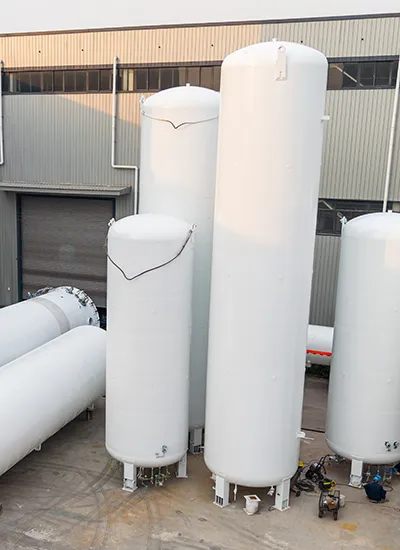
Cryogenic tanks store liquefied gases at extremely low temperatures, typically below −150 °C (−238 °F). Choosing the right cryogenic tank sizes is crucial for operational efficiency, safety, and cost optimization, whether for industrial gas supply, medical oxygen, food processing, or LNG fueling infrastructure.
This guide covers stationary cryogenic tank sizes, design considerations, and selection tips to help businesses optimize storage and delivery.
Understanding Cryogenic Tank Sizes
Cryogenic tank sizes are measured by storage volume, usually in liters (L) or gallons (gal). The capacity you select impacts:
- Daily gas consumption
- Delivery frequency
- Space availability
- Pressure and vaporization requirements
- Regulatory compliance
Unlike portable cryogenic cylinders or ISO containers, stationary cryogenic tanks are permanently installed and designed for continuous, long-term storage.
Common Stationary Cryogenic Tank Sizes
Stationary tanks are available in small, medium, large, and custom capacities. Selecting the right size depends on your gas demand, site limitations, and operational needs.
Small-to-Medium Tanks (120–1,000 gal / 450–3,800 L)
| Capacity | Liters | Typical Applications |
|---|---|---|
| 120 gal | 450 L | Small labs, specialty gases |
| 250 gal | 950 L | Medical oxygen backup, welding |
| 500 gal | 1,900 L | Light industrial facilities |
| 1,000 gal | 3,800 L | Medium commercial operations |
Best For: Moderate daily gas usage, limited space, and periodic deliveries.
Large Tanks (2,000–6,000 gal / 7,600–22,700 L)
| Capacity | Liters | Typical Applications |
|---|---|---|
| 2,000 gal | 7,600 L | Large industrial plants |
| 4,000 gal | 15,000 L | Centralized gas supply sites |
| 6,000 gal+ | 22,700 L | Continuous industrial operations |
Best For: High-volume operations, industrial gas distribution, energy facilities.
Extra-Large & Custom Tanks (10,000 gal+ / 37,850 L+)
Custom solutions are designed for high-demand industrial sites or LNG fueling stations. Features may include:
- Dual compartments
- High-pressure operation
- Specialized fittings for automated distribution
Detailed List of LO, LN, LAr Cryogenic Tanks (Vacuum Powder Insulation)
| Type / Model | Effective Volume (m³) | Working Pressure (MPa) | Static Evaporation (%/day) | Weight (Kg) – Inner Tank | Weight (Kg) – Total | Dimensions (mm) – Diameter × Length × Thickness |
|---|---|---|---|---|---|---|
| V-5/0.8 | 5 | 0.8 | 0.43 | 1040 | 1430 | Inner: Φ1400×3680×6 Outer: Φ1900×5115×8 |
| V-5/1.6 | 5 | 1.6 | 0.43 | 1600 | 2250 | Inner: Φ1400×3680×10 Outer: Φ1900×5115×8 |
| V-10/0.8 | 10 | 0.8 | 0.36 | 1980 | 2565 | Inner: Φ1700×4950×8 Outer: Φ2200×6400×8 |
| V-10/1.6 | 10 | 1.6 | 0.36 | 3020 | 3815 | Inner: Φ1700×4950×12 Outer: Φ2200×6400×8 |
| V-15/0.8 | 15 | 0.8 | 0.35 | 2735 | 3272 | Inner: Φ1900×5950×8 Outer: Φ2400×7330×8 |
| V-15/1.6 | 15 | 1.6 | 0.35 | 4460 | 5293 | Inner: Φ1900×5950×14 Outer: Φ2400×7330×8 |
| V-20/0.8 | 20 | 0.8 | 0.33 | 3575 | 3925 | Inner: Φ2100×6465×8/10 Outer: Φ2600×7955×8 |
| V-20/1.6 | 20 | 1.6 | 0.33 | 5530 | 6030 | Inner: Φ2100×6465×14 Outer: Φ2600×7955×8 |
| V-30/0.8 | 30 | 0.8 | 0.29 | 5300 | 5630 | Inner: Φ2400×7410×10 Outer: Φ3000×8930×10 |
| V-30/1.6 | 30 | 1.6 | 0.29 | 8300 | 8730 | Inner: Φ2400×7410×16 Outer: Φ3000×8930×10 |
| V-50/0.8 | 50 | 0.8 | 0.23 | 8705 | 9080 | Inner: Φ2600×10380×10/12 Outer: Φ3200×12000×12 |
| V-50/1.6 | 50 | 1.6 | 0.23 | 14045 | 14460 | Inner: Φ2600×10380×18/20 Outer: Φ3200×12000×12 |
| V-100/0.8 | 100 | 0.8 | 0.16 | 16140 | 16457 | Inner: Φ3000×15425×12/14 Outer: Φ3600×17260×14 |
| V-100/1.6 | 100 | 1.6 | 0.16 | 27570 | 27800 | Inner: Φ3000×15425×22 Outer: Φ3600×17260×14 |
Detailed List of Horizontal LO, LN, and LAr Cryogenic Tanks (Vacuum Powder Insulation)
| Model | Effective Volume (m³) | 3M | Working Pressure (MPa) | Static Evaporation (%/day) | Weight – LO (Kg) | Weight – LN (Kg) | Weight – LAr (Kg) | Total Weight (Kg) | Dimensions (mm) – Diameter × Length × Thickness |
|---|---|---|---|---|---|---|---|---|---|
| H-5/0.8 | 5 | 0.65 | 0.8 | 0.43 | 1000 | 1550 | 1920 | 4490 | Inner: Φ1400×3680×6 Outer: Φ1900×4980×8 |
| H-5/1.6 | 5 | 0.65 | 1.6 | 0.43 | 1550 | 1920 | 3040 | 5100 | Inner: Φ1400×3680×10 Outer: Φ1900×4980×8 |
| H-10/0.8 | 10 | 0.55 | 0.8 | 0.36 | 1920 | 3040 | 2650 | 7510 | Inner: Φ1700×4950×8 Outer: Φ2200×6250×8 |
| H-10/1.6 | 10 | 0.55 | 1.6 | 0.36 | 3040 | 2650 | 4380 | 8550 | Inner: Φ1700×4950×12 Outer: Φ2200×6250×8 |
| H-15/0.8 | 15 | 0.53 | 0.8 | 0.35 | 2650 | 3350 | 4950 | 9450 | Inner: Φ1900×5950×8 Outer: Φ2400×7150×8 |
| H-15/1.6 | 15 | 0.53 | 1.6 | 0.35 | 4380 | 4950 | 5210 | 11250 | Inner: Φ1900×5950×14 Outer: Φ2400×7150×8 |
| H-20/0.8 | 20 | 0.5 | 0.8 | 0.33 | 3350 | 4950 | 5210 | 11350 | Inner: Φ2100×6465×8/10 Outer: Φ2600×7830×8 |
| H-20/1.6 | 20 | 0.5 | 1.6 | 0.33 | 4950 | 5210 | 8180 | 13400 | Inner: Φ2100×6465×14 Outer: Φ2600×7830×8 |
| H-30/0.8 | 30 | 0.44 | 0.8 | 0.29 | 5210 | 8180 | 8000 | 17400 | Inner: Φ2400×7410×10 Outer: Φ3000×8750×10 |
| H-30/1.6 | 30 | 0.44 | 1.6 | 0.29 | 8180 | 8000 | 13535 | 20400 | Inner: Φ2400×7410×16 Outer: Φ3000×8750×10 |
| H-50/0.8 | 50 | 0.35 | 0.8 | 0.23 | 8000 | 13535 | 14740 | 26150 | Inner: Φ2600×10380×10 Outer: Φ3200×11780×12 |
| H-50/1.6 | 50 | 0.35 | 1.6 | 0.23 | 13535 | 14740 | 27070 | 31750 | Inner: Φ2600×10380×18 Outer: Φ3200×11750×12 |
| H-100/0.8 | 100 | 0.25 | 0.8 | 0.16 | 14740 | 27070 | 4490 | 45900 | Inner: Φ3000×15425×12/14 Outer: Φ3500×16870×14 |
| H-100/1.6 | 100 | 0.25 | 1.6 | 0.16 | 27070 | 4490 | 58225 | 58225 | Inner: Φ3000×15425×22 Outer: Φ3600×16870×14 |
Detailed List of Vertical LCO2 Cryogenic Tanks (Vacuum Powder Insulation)
| Type / Model | Effective Volume (m³) | Working Pressure (MPa) | Test Pressure (MPa) | Leak Test | Inner Tank Material | Outer Tank Material | Interlayer | Inner Tank Dimensions (mm) – Diameter × Length × Thickness | Outer Tank Dimensions (mm) – Diameter × Length × Thickness | Weight (Kg) – Inner Tank | Total Weight (Kg) |
|---|---|---|---|---|---|---|---|---|---|---|---|
| BluNetV-5/2.16 | 5 | 2.16 | 2.65 | Helium Test | 16 MnDR | Q235-B | Brilliant Expansion Perlite | Φ1400×3680×12 | Φ1900×4980×8 | 1000 | 4490 |
| BluNetV-10/2.16 | 10 | 2.16 | 2.65 | Helium Test | 16 MnDR | Q235-B | Brilliant Expansion Perlite | Φ1700×4960×14 | Φ1900×4980×8 | 1550 | 5100 |
| BluNetV-15/2.16 | 15 | 2.16 | 2.65 | Helium Test | 16 MnDR | Q235-B | Brilliant Expansion Perlite | Φ1900×5920×14 | Φ2200×6250×8 | 1920 | 7510 |
| BluNetV-20/2.16 | 20 | 2.16 | 2.65 | Helium Test | 16 MnDR | Q235-B | Brilliant Expansion Perlite | Φ2000×7075×6 | Φ2200×6250×8 | 3040 | 8550 |
| BluNetV-30/2.16 | 30 | 2.16 | 2.65 | Helium Test | 16 MnDR | Q235-B | Brilliant Expansion Perlite | Φ2400×7460×18 | Φ2400×7150×8 | 2650 | 9450 |
| BluNetV-50/2.16 | 50 | 2.16 | 2.65 | Helium Test | 16 MnDR | Q235-B | Brilliant Expansion Perlite | Φ2600×10395×20 | Φ2400×7150×8 | 4380 | 11250 |
| BluNetV-100/2.16 | 100 | 2.16 | 2.65 | Helium Test | 16 MnDR | Q235-B | Brilliant Expansion Perlite | Φ3000×15425×24 | Φ2600×7830×8 | 3350 | 11350 |
Detailed List of LNG Cryogenic Tanks (Vertical Type, Vacuum Powder Insulation)
| Type / Model | Effective Volume (m³) | Design Pressure (MPa) | Working Pressure (MPa) | Loading Medium | Inner Tank Material | Outer Tank Material | Interlayer | Test Pressure (MPa) | Leak Test | Inner Tank Temperature (℃) | Static Evaporation (%/day) | Weight – Inner Tank (Kg) | Total Weight (Kg) | Inner Tank Dimensions (mm) – Diameter × Length × Thickness | Outer Tank Dimensions (mm) – Diameter × Length × Thickness |
|---|---|---|---|---|---|---|---|---|---|---|---|---|---|---|---|
| BluNetV-5/0.8 | 5 | 0.84-0.1 | 0.8 | LNG | 16 MnDR | Q235-B | Brilliant Expansion Perlite | 1.1 | Helium Test | -196 | 0.65 | 1040 | 4430 | Φ1400×3680×6 | Φ1900×5115×8 |
| BluNetV-10/0.8 | 10 | 0.84-0.1 | 0.8 | LNG | 16 MnDR | Q235-B | Brilliant Expansion Perlite | 1.1 | Helium Test | -196 | 0.55 | 1980 | 7230 | Φ1700×4950×8 | Φ2200×6400×8 |
| BluNetV-15/0.8 | 15 | 0.84-0.1 | 0.8 | LNG | 16 MnDR | Q235-B | Brilliant Expansion Perlite | 1.1 | Helium Test | -196 | 0.53 | 2735 | 9080 | Φ1900×5905×8 | Φ2400×7330×8 |
| BluNetV-20/0.8 | 20 | 0.84-0.1 | 0.8 | LNG | 16 MnDR | Q235-B | Brilliant Expansion Perlite | 1.1 | Helium Test | -196 | 0.5 | 3575 | 11010 | Φ2100×6465×8/10 | Φ2600×7955×8 |
| BluNetV-30/0.8 | 30 | 0.84-0.1 | 0.8 | LNG | 16 MnDR | Q235-B | Brilliant Expansion Perlite | 1.1 | Helium Test | -196 | 0.44 | 5300 | 16440 | Φ2400×7410×10 | Φ3000×8930×10 |
| BluNetV-50/0.8 | 50 | 0.84-0.1 | 0.8 | LNG | 16 MnDR | Q235-B | Brilliant Expansion Perlite | 1.1 | Helium Test | -196 | 0.35 | 8705 | 25870 | Φ2600×10380×10/12 | Φ3200×12000×12 |
| BluNetV-100/0.8 | 100 | 0.84-0.1 | 0.8 | LNG | 16 MnDR | Q235-B | Brilliant Expansion Perlite | 1.1 | Helium Test | -196 | 0.25 | 16140 | 48765 | Φ3000×15425×12/14 | Φ3600×17260×14 |
Key Factors in Selecting Stationary Cryogenic Tank Sizes
1. Gas Consumption Rate
2. Delivery Frequency & Logistics
3. Installation Space & Site Restrictions
4. Thermal Management & Boil-Off Loss
5. Safety & Regulatory Compliance
Enhancing Stationary Cryogenic Tank Efficiency
Choosing the Right Tank: Step-by-Step
- Calculate Actual Gas Usage: Convert usage into liquid equivalent and consider peak demand.
- Plan Delivery Logistics: Assess supplier access and delivery frequency.
- Anticipate Future Growth: Select a tank that accommodates expanding operations.
- Budget vs Lifecycle Cost: Larger tanks reduce delivery frequency, saving long-term operational costs.
- Check Regulatory Compliance: Ensure installation meets safety codes and industry standards.
Applications of Different Cryogenic Tank Sizes
Different cryogenic tank sizes are designed to meet specific industry requirements based on gas demand, operational scale, and storage duration.
- Small tanks (120–500 gal): Used in laboratories, medical facilities, and specialty gas applications requiring compact and flexible storage.
- Medium tanks (1,000–2,000 gal): Suitable for food processing, welding operations, and small industrial plants with moderate gas consumption.
- Large tanks (4,000–6,000+ gal): Ideal for continuous industrial manufacturing, metal processing, and bulk gas supply systems.
- Custom large tanks (10,000+ gal): Common in LNG fueling stations, petrochemical plants, and large-scale energy infrastructure.
Selecting the correct tank size ensures efficient gas utilization, reduced delivery frequency, and improved operational reliability across applications.
TECHNICAL FAQs
About Stationary Cryogenic Tank Sizes
Stationary cryogenic tanks are permanently installed, vacuum-insulated vessels designed to store liquefied gases at extremely low temperatures, typically below −150 °C. They provide continuous, long-term storage for industrial, medical, or LNG applications.
Cryogenic tank sizes are based on storage volume, usually in liters or gallons. Selection depends on daily gas consumption, delivery frequency, available installation space, pressure requirements, and regulatory compliance.
Cryogenic tanks can store a variety of liquefied gases including liquid oxygen (LOX), liquid nitrogen (LN₂), liquid argon (LAr), liquid carbon dioxide (LCO₂), and liquefied natural gas (LNG), depending on tank design and material compatibility.
Small tanks (120–500 gal) are used in labs and medical facilities, medium tanks (1,000–2,000 gal) in food processing and light industrial use, large tanks (4,000–6,000+ gal) for continuous industrial operations, and custom tanks (10,000+ gal) for LNG fueling or large-scale energy applications.
Key factors include gas consumption rate, delivery logistics, installation space, thermal management and boil-off losses, safety regulations, and long-term operational cost efficiency.
Conclusion
Selecting the correct cryogenic tank sizes ensures safety, efficiency, and cost-effectiveness. From small lab tanks (120 gal) to custom 10,000 + gal industrial tanks, understanding your gas demand, site limitations, and operational goals is critical.
Properly sized stationary cryogenic tanks minimize boil-off losses, optimize delivery logistics, and ensure uninterrupted gas supply for industrial, medical, and energy applications.

No comment