

Cryogenic Storage Tanks Overview
Cryogenic storage tanks play a critical role in LNG infrastructure, hydrogen energy systems, industrial gas distribution, aerospace engineering, and medical gas supply chains.
Selecting the right cryogenic storage tank manufacturer directly impacts operational safety, thermal efficiency, regulatory compliance, boil-off performance, and long-term lifecycle cost.
As global investment in LNG terminals, hydrogen mobility, semiconductor manufacturing, and clean energy infrastructure accelerates, demand for high-performance vacuum-insulated cryogenic vessels continues to grow worldwide.
This guide compares the top 10 cryogenic storage tank manufacturers in the world (2026 updated) based on key engineering and market factors.
Evaluation Criteria
- Manufacturing capacity
- International standards (ASME, PED, ISO)
- Gas compatibility (LNG, hydrogen, nitrogen, oxygen, argon)
- Engineering strength and R&D capability
- Global market coverage and export capability
- Application focus (energy, medical, aerospace, industrial gas)
Types of Cryogenic Storage Tank Suppliers and Manufacturers
Cryogenic storage tank suppliers and manufacturers can be classified into several categories based on their engineering capability, production scale, and application focus. Understanding these types helps buyers select the right partner for LNG, hydrogen, nitrogen, and industrial gas storage projects.
1. EPC Engineering Giants
EPC (Engineering, Procurement, and Construction) companies provide complete cryogenic storage tank systems for large-scale industrial projects, including LNG terminals and hydrogen infrastructure.
- Examples: Linde Engineering, Chart Industries, CB&I
- Focus: Large LNG plants, hydrogen energy systems
- Strength: Full turnkey project delivery capability
2. Industrial Gas Equipment Suppliers
These suppliers specialize in standard cryogenic storage tanks used in industrial gas distribution systems for oxygen, nitrogen, argon, and LNG.
- Examples: INOXCVA, Air Liquide Advanced Technologies, Cryolor
- Focus: Industrial gas supply chain systems
- Strength: High efficiency and mass production capability
3. Custom Cryogenic Engineering Manufacturers
These manufacturers focus on tailor-made cryogenic storage tanks designed for laboratories, medical applications, and research institutions.
- Examples: Cryofab, Cryeng Group, Wessington Cryogenics
- Focus: Custom-built and OEM cryogenic systems
- Strength: High flexibility and precision engineering
4. Regional and Mid-Sized Suppliers
Regional suppliers provide cost-effective cryogenic storage tank solutions for local industrial markets and export customers.
- Examples: Auguste Cryogenics, DSW Industry
- Focus: Medium-scale industrial and export markets
- Strength: Competitive pricing and flexible production
Technical Insight: Understanding different types of cryogenic storage tank suppliers helps buyers evaluate engineering capability, cost efficiency, and application suitability before selecting a manufacturer.
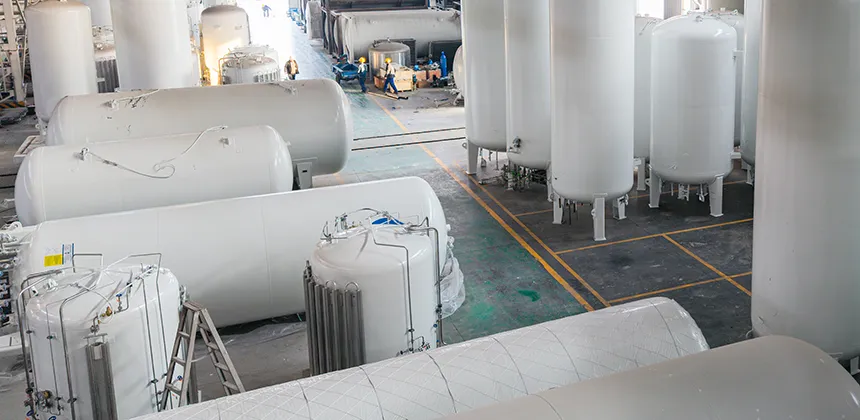
Types of Cryogenic Storage Tanks
Cryogenic storage tanks are available in multiple configurations depending on storage capacity, operating pressure, transportation requirements, and application industry. Different tank types are designed for LNG, liquid nitrogen, oxygen, argon, hydrogen, CO₂, and other liquefied industrial gases stored at ultra-low temperatures.
Understanding the different types of cryogenic storage tanks helps industrial buyers select the most suitable solution for energy infrastructure, industrial gas supply, medical applications, aerospace systems, and industrial manufacturing projects.
1. Vertical Cryogenic Storage Tanks
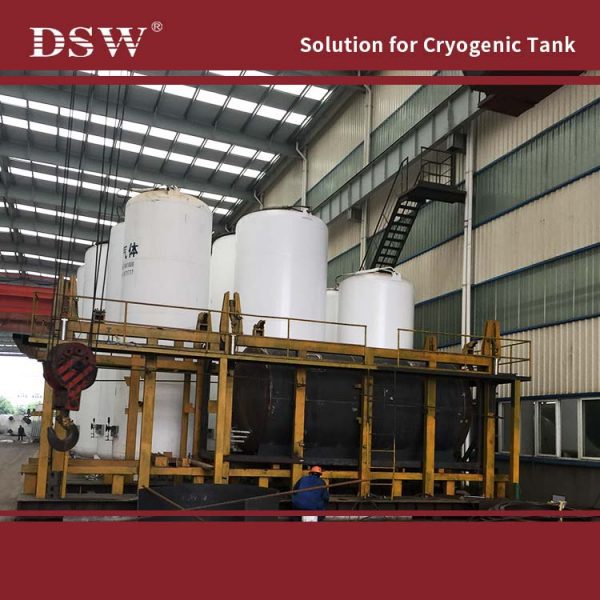
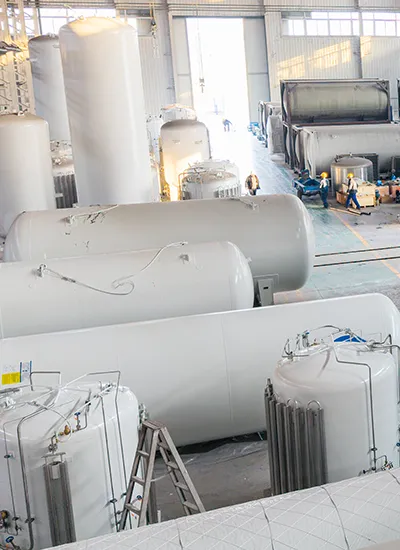
Vertical cryogenic tanks are widely used for industrial gas storage in factories, hospitals, LNG stations, and industrial gas distribution systems. They offer space-saving installation and efficient vacuum insulation performance.
- Typical Capacity: 3,000–100,000+ liters
- Common Gases: LNG, LOX, LIN, LAR, CO₂
- Main Advantage: Compact footprint and high storage efficiency
2. Horizontal Cryogenic Storage Tanks
Horizontal cryogenic tanks are commonly used for transportation, mobile fueling systems, and industrial locations with lower height restrictions. They provide stable structural support and flexible installation capability.
- Typical Capacity: 1,000–80,000 liters
- Common Gases: LNG, nitrogen, oxygen, hydrogen
- Main Advantage: Easier transportation and flexible site integration
3. Microbulk Cryogenic Tanks
Microbulk cryogenic tanks are compact storage systems designed for small- to medium-gas-consumption applications. They are widely used in laboratories, medical facilities, food processing, welding, and small industrial operations.
- Typical Capacity: 500–7,500 litres
- Common Gases: Nitrogen, oxygen, argon, CO₂
- Main Advantage: Lower operating cost compared with gas cylinders
4. LNG Storage Tanks
LNG storage tanks are specially engineered for liquefied natural gas applications. These tanks feature advanced double-wall vacuum insulation systems and are widely used in LNG terminals, satellite stations, and clean energy infrastructure projects.
- Typical Capacity: 10,000–1,000,000+ liters
- Common Gases: LNG
- Main Advantage: Ultra-low boil-off and long-term LNG storage capability
5. Cryogenic ISO Tank Containers
Cryogenic ISO tank containers are transportable vacuum-insulated containers designed for international shipping and intermodal transportation of liquefied gases. They comply with global transport regulations for marine, rail, and road logistics.
- Typical Capacity: 10,000–26,000 liters
- Common Gases: LNG, LIN, LOX, LAR, CO₂
- Main Advantage: International transport compatibility and logistics efficiency
6. Cryogenic Semi-Trailers
Cryogenic semi-trailers are mobile transport systems designed for bulk distribution of liquefied industrial gases. They are widely used in LNG transportation networks and industrial gas supply chains.
- Typical Capacity: 20,000–60,000 liters
- Common Gases: LNG, oxygen, nitrogen, argon
- Main Advantage: Efficient long-distance cryogenic transportation
Industry Insight: Different cryogenic storage tank types are optimized for LNG infrastructure, hydrogen energy, industrial gas distribution, laboratory systems, and aerospace engineering applications. Selecting the correct tank configuration improves thermal efficiency, operational safety, and long-term lifecycle performance.
Top Cryogenic Storage Tank Suppliers in the World (2026)
Answer: The leading cryogenic storage tank suppliers in 2026 include Linde Engineering, Chart Industries, DSW Industry, INOXCVA, Cryofab Inc., Cryolor, Wessington Cryogenics, Auguste Cryogenics, Cryeng Group, Air Liquide Advanced Technologies, and CB&I.
These companies are globally recognized for their advanced cryogenic engineering capabilities, LNG and hydrogen infrastructure solutions, and compliance with international standards such as ASME, PED, and ISO. They supply vacuum-insulated storage tanks, cryogenic vessels, and complete industrial gas storage systems for energy, medical, aerospace, and industrial applications.
Top Cryogenic Storage Tank Suppliers (2026 List)
- Linde Engineering — Germany
- Chart Industries — USA
- DSW Industry — China
- INOXCVA — India
- Cryofab Inc. — USA
- Cryolor — France
- Wessington Cryogenics — United Kingdom
- Auguste Cryogenics — Europe
- Cryeng Group — Australia
- Air Liquide Advanced Technologies — France
- Taylor-Wharton — USA
Technical Insight: Cryogenic storage tank suppliers are essential in LNG, hydrogen energy, industrial gas, and aerospace sectors. Choosing the right supplier ensures safety, efficiency, and long-term operational reliability in cryogenic systems.
How We Evaluated These Manufacturers
Top Cryogenic Storage Tank Manufacturers Comparison
A global comparison of leading cryogenic storage tank manufacturers based on capacity range, standards, gas compatibility, and engineering strength.
| Company | Country | Capacity Range | Standards | Gas Types | Strength |
|---|---|---|---|---|---|
| Linde Engineering | Germany | 3,000–100,000+ L | ASME, PED | LNG, LOX, LIN, Hydrogen | EPC leader |
| Chart Industries | USA | 1,000–150,000+ L | ASME, ISO | LNG, Hydrogen | Clean energy leader |
| DSW Industry | China | 2,000–200,000+ L | ASME, CE, ISO, GOST | LNG, LOX, LIN, CO₂ | Cost-effective OEM & export manufacturing |
| INOXCVA | India | 2,000–200,000+ L | ASME, CE | LNG, Hydrogen | Cost-efficient EPC |
| Cryofab | USA | 1–5,000 L | ASME, DOT | Medical gases | Custom specialist |
| Cryolor | France | 3,000–160,000 L | PED, EN | LNG, CO₂ | Eco-design leader |
| Wessington Cryogenics | UK | 100–150,000 L | PED, ISO | Hydrogen, Nitrogen | Custom engineering |
| Auguste Cryogenics | Europe | 70–350,000 L | PED, TPED | LNG, CO₂ | Microbulk systems |
| Cryeng Group | Australia | Custom | ASME | Hydrogen, Helium | R&D specialist |
| Air Liquide Advanced Tech | France | Custom | NASA, ESA | Hydrogen, Oxygen | Aerospace leader |
| CB&I | USA | 50,000–1,000,000+ L | ASME, API | LNG, Hydrogen | Mega EPC projects |
Leading Cryogenic Vessel Manufacturers & Suppliers
The top 15 cryogenic tank manufacturers & cryogenic storage equipment suppliers are Listed in the Cryogenic Tank Market Report.
1. Linde Engineering
Linde Engineering is one of the oldest and most advanced cryogenic storage tank manufacturers in the world. It is a global EPC leader in industrial gas and LNG infrastructure. The company is known for high-performance vacuum insulated cryogenic systems.
Established: 1879
Headquarters: Munich, Germany
Manufacturing Capacity:
3,000 – 100,000+ L
Up to 36 bar pressure
Annual Output: Thousands of cryogenic vessels globally
Standards:
ASME Section VIII
PED
ISO 9001
Gas Range:
LNG, Nitrogen, Oxygen, Argon, Hydrogen
Advantages:
Global EPC leadership
High-purity insulation systems
Remote monitoring technology
Strong lifecycle engineering
Why Choose: Best for large-scale LNG plants, petrochemical systems, and global industrial gas infrastructure.
2. Chart Industries
Chart Industries is a global leader in clean energy and cryogenic equipment manufacturing. It focuses on LNG, hydrogen, and industrial gas storage systems. The company is highly innovative in energy transition technologies.
Established: 1992
Headquarters: USA
Capacity: 1,000–150,000+ L
Standards: ASME, ISO
Gas Range: LNG, Hydrogen, CO₂, Oxygen, Nitrogen
Advantages:
Hydrogen innovation leader
MicroBulk delivery systems
Strong transport solutions
Global aftermarket support
Why Choose: Ideal for hydrogen mobility, LNG distribution, and clean energy infrastructure.
3.DSW Industry
Company Overview
DSW Industry is a China-based manufacturer specializing in cryogenic storage and transportation equipment for LNG, industrial gas, and clean energy applications. The company supplies vacuum-insulated cryogenic systems for international industrial projects, gas distribution networks, and LNG infrastructure developments.
With strong manufacturing and export capabilities, DSW Industry supplies cryogenic equipment to customers across Asia, the Middle East, Africa, Europe, and South America.
Key Strengths
- Cost-effective cryogenic storage solutions
- Flexible OEM and custom manufacturing capabilities
- International certifications and export support
- Broad range of cryogenic and LNG equipment
- Strong focus on customer-specific engineering solutions
Product Range
- Cryogenic liquid storage tanks
- LNG storage tanks
- Cryogenic ISO tank containers
- Cryogenic semi-trailers
- Microbulk storage systems
- Vaporizers and cryogenic pumps
- CNG tank containers
Best Applications
- LNG distribution projects
- Industrial gas supply systems
- Cryogenic transportation infrastructure
- OEM cryogenic equipment manufacturing
- Medium-scale industrial and energy projects
Competitive Advantage
DSW Industry is suitable for buyers seeking cost-effective cryogenic storage and transport equipment with flexible engineering support and international export capability. The company focuses on customized cryogenic systems for LNG, industrial gas, and developing energy infrastructure markets.
Need a Reliable Cryogenic Storage Tank Supplier?
ASME-certified cryogenic tanks and vacuum-insulated systems for global industrial, LNG, and medical projects.
3. INOXCVA
INOXCVA is a leading Indian cryogenic equipment manufacturer. It specializes in LNG systems and industrial gas storage solutions. It is widely used in global EPC and energy projects.
Established: 1991
Headquarters: India
Capacity: 2,000–200,000+ L
Standards: ASME, CE, ISO
Gas Range: LNG, Hydrogen, Oxygen, Nitrogen, Argon
Advantages:
Cost-effective manufacturing
Strong EPC capability
Global export network
Turnkey solutions
Why Choose: Best for LNG terminals and industrial gas systems with cost efficiency.
4. Cryofab
Cryofab is a US-based precision cryogenic manufacturer. It focuses on medical, laboratory, and scientific applications. It is known for highly customised cryogenic systems.
Established: 1971
Headquarters: USA
Capacity: 1–5,000 L
Standards: ASME, DOT, PED
Gas Range: Helium, Nitrogen, Oxygen, Argon
Advantages:
High customization capability
OEM production specialist
Medical-grade systems
Precision engineering
Why Choose: Best for laboratories, biotech, and medical cryogenic applications.
5. Cryolor (Cryogenic Storage Tank Manufacturer)
Cryolor is a European manufacturer focusing on sustainable cryogenic systems. It specializes in LNG and hydrogen transport solutions. It is known for eco-efficient insulation systems.
Established: 1981
Headquarters: France
Capacity: 3,000–160,000 L
Standards: PED, EN
Gas Range: LNG, Hydrogen, CO₂, Nitrogen
Advantages:
Low evaporation design
Eco-friendly manufacturing
Strong transport focus
Hydrogen-ready systems
Why Choose: Best for Europe-based LNG logistics and green energy systems.
6. Wessington Cryogenics
Wessington is a UK engineering manufacturer for cryogenic vessels. It delivers both standard and custom cryogenic systems. It is expanding into hydrogen and net-zero markets.
Established: 1984
Headquarters: UK
Capacity: 100–150,000 L
Standards: PED, ISO
Gas Range: Hydrogen, Nitrogen, Oxygen, LNG
Advantages:
Custom engineering strength
Flexible production system
Net-zero focus
High-quality fabrication
Why Choose: Best for scientific, hydrogen, and bespoke industrial applications.
7. Auguste Cryogenics
Auguste Cryogenics is a European cryogenic equipment supplier. It provides LNG microbulk and industrial storage systems. It focuses on high-efficiency vacuum technology.
Established: 2000s
Headquarters: Europe
Capacity: 70–350,000 L
Standards: PED, TPED
Gas Range: LNG, CO₂, Oxygen, Nitrogen
Advantages:
Wide product range
Microbulk LNG systems
Low boil-off rate
Flexible engineering
Why Choose: Best for LNG microbulk and modular cryogenic systems.
8. Cryeng Group
Cryeng Group is an Australian engineering company. It specializes in custom cryogenic vessel design. It focuses on research and high-performance systems.
Established: 1990s
Headquarters: Australia
Capacity: Custom engineered
Standards: ASME, ISO
Gas Range: Helium, Hydrogen, Nitrogen
Advantages:
High R&D capability
Custom engineering focus
Project-based manufacturing
High reliability systems
Why Choose: Best for research institutions and specialised cryogenic engineering.
9. Air Liquide Advanced Technologies
Air Liquide Advanced Technologies is a global aerospace cryogenic leader. It designs ultra-lightweight cryogenic tanks for space systems. It supports NASA and ESA missions.
Established: 1960s
Headquarters: France
Capacity: Custom aerospace systems
Standards: NASA, ESA, ASME
Gas Range: Liquid Hydrogen, Oxygen, Helium
Advantages:
Aerospace-grade engineering
Ultra-lightweight design
High precision systems
Space mission reliability
Why Choose: Best for aerospace and ultra-high precision cryogenic applications.
10. CB&I
CB&I is one of the largest EPC cryogenic storage infrastructure companies. It specializes in mega LNG and hydrogen storage tanks. It has delivered some of the world’s largest cryogenic projects.
Established: 1889
Headquarters: USA
Capacity: 50,000–1,000,000+ L
Standards: ASME, API
Gas Range: LNG, Hydrogen, Industrial gases
Advantages:
Mega-scale EPC capability
Global infrastructure leadership
Seismic engineering expertise
Large LNG terminal projects
Why Choose: Best for national LNG terminals and large-scale energy infrastructure.
How to Choose a Cryogenic Storage Tank Manufacturer
When selecting a cryogenic storage tank manufacturer, it is important to evaluate technical capability, compliance standards, and long-term service support to ensure safety, efficiency, and operational reliability.
- Required capacity: Small, medium, large, or mega-scale cryogenic storage systems based on project demand.
- Gas type: Compatibility with LNG, hydrogen, nitrogen, oxygen, argon, or other industrial gases.
- Standards compliance: Ensure adherence to ASME, PED, ISO, and other international pressure vessel regulations.
- Application field: Suitable for medical, industrial gas, aerospace, energy, or research applications.
- EPC capability vs custom fabrication: Evaluate whether the manufacturer provides full EPC solutions or specialised custom engineering services.
- After-sales service: Global support, maintenance capability, spare parts availability, and technical assistance.
Choosing the right supplier ensures long-term performance, safety compliance, and optimized lifecycle cost for cryogenic storage systems.
2026 Cryogenic Storage Tank Industry Trends
The cryogenic storage tank market continues to grow due to LNG expansion, hydrogen energy investment, semiconductor manufacturing demand, and industrial gas infrastructure development worldwide.
Hydrogen Infrastructure Growth
Hydrogen-ready cryogenic storage tanks are becoming a major focus as governments and energy companies accelerate clean hydrogen projects. Global hydrogen infrastructure investment is projected to exceed $60 billion by 2030, increasing demand for advanced liquid hydrogen storage systems.
LNG Storage Expansion
Global LNG demand is expected to reach approximately 450–500 million tonnes annually by 2026, driving investment in LNG storage tanks, cryogenic transport systems, satellite stations, and regasification infrastructure for energy security and cleaner fuel applications.
Industrial Gas & Semiconductor Demand
The global industrial gas market is projected to approach $90 billion by 2026, supported by healthcare, manufacturing, electronics, and food processing industries. At the same time, semiconductor manufacturing continues to increase demand for ultra-pure cryogenic gases and microbulk storage systems.
Microbulk and Modular Cryogenic Systems
Modern cryogenic tanks increasingly incorporate IoT monitoring, automated pressure control, and remote safety management systems to improve efficiency and reduce boil-off losses. Microbulk and modular cryogenic systems are also rapidly replacing traditional gas cylinders in medical, laboratory, and industrial applications.
Industry Insight: LNG infrastructure, hydrogen energy, and industrial gas demand are expected to remain the primary drivers of the global cryogenic storage tank market through 2026 and beyond.
Cryogenic Storage Tank Trends (2026)
Cryogenic storage tanks are becoming mission-critical systems in energy, healthcare, industrial gas, and aerospace industries.
With the rapid growth of LNG infrastructure and hydrogen energy systems, demand for high-performance cryogenic storage solutions continues to rise globally.
Modern cryogenic tanks must deliver high thermal efficiency, strict safety compliance, and long-term operational reliability under extreme low-temperature conditions.
Choosing the right supplier is no longer based only on price — but on engineering capability, international certifications (ASME, PED, ISO), and lifecycle service support.
Key Insight: The future of cryogenic storage is driven by LNG expansion, hydrogen energy transition, and increasing demand for safe, efficient, and scalable industrial gas storage systems.
TECHNICAL QUESTIONS
FAQs About Cryogenic Storage Tanks Manufacturers
A cryogenic storage tank is a vacuum-insulated pressure vessel designed to safely store liquefied gases at ultra-low temperatures. These tanks are commonly used for LNG, liquid nitrogen, oxygen, argon, hydrogen, and carbon dioxide applications in industrial, medical, aerospace, and energy sectors.
Cryogenic storage tanks are used for liquefied gases such as LNG (liquefied natural gas), liquid nitrogen (LIN), liquid oxygen (LOX), liquid argon (LAR), liquid hydrogen, helium, and liquid carbon dioxide (CO₂).
Cryogenic storage tanks are commonly manufactured according to international standards such as ASME Section VIII, PED (Pressure Equipment Directive), ISO standards, EN standards, TPED, API, and DOT regulations depending on the application and export market.
LNG storage tanks are designed for liquefied natural gas at approximately -162°C and focus on minimizing boil-off gas for energy applications. Liquid oxygen tanks operate at around -183°C and require oxygen-compatible materials and safety systems for industrial and medical gas applications.
Leading hydrogen-ready cryogenic storage tank manufacturers include Linde Engineering, Chart Industries, INOXCVA, Cryolor, Air Liquide Advanced Technologies, CB&I, and DSW Industry. These companies develop advanced vacuum-insulated storage systems for liquid hydrogen infrastructure and clean energy applications.
Methodology
This article is based on publicly available engineering data, manufacturer specifications, international certifications (ASME, PED, ISO), and global industrial project references from leading cryogenic storage tank manufacturers.
The information is structured to help engineers, procurement teams, and industrial buyers evaluate cryogenic storage tank suppliers based on technical capability, safety compliance, and application suitability.
Looking for a Cryogenic Storage Tank Manufacturer?
BluNet provides vacuum insulated cryogenic tanks, LNG storage systems, ISO tank containers, vaporizers, and complete industrial gas storage solutions for global customers.
ASME Certified • OEM Manufacturing • Global Export Support
)
No comment